Community Corner
Dealing with Diabetes, One Patient at a Time
The Diabetes Health Center is open for walk-ins at low or no cost, and there is free Diabetes Health Fair on Friday in the Plaza.




Latinos are twice as likely to get diabetes than Caucasians, a reality that plays out in the Pajaro Valley every day.
About 18,000 people in Watsonville, Freedom, Pajaro and Aromas are diabetic, according to the Pajaro Valley Community Health Trust, which operates the adjacent to Watsonville Community Hospital as is a member of the Regional Diabetes Collective.
"Diabetes is such a huge health challenge," said Kathleen King, Chief Executive Officer of the Health Trust.
Find out what's happening in Watsonvillefor free with the latest updates from Patch.
Friday afternoon, the diabetes collective will host the during the Farmers Market in Watsonville's City Plaza. From 3-5:30 p.m., people can get free blood glucose screenings, cholesterol screenings, blood pressure, vision and dental screenings. There also will be information booths, activities for kids and lots of prizes.
The fair is among the largest outreach effort done by the consortium, but it is just the beginning of the efforts to educate Pajaro Valley residents about the risks of diabetes and how to control the disease.
Find out what's happening in Watsonvillefor free with the latest updates from Patch.
At the Diabetes Health Center, staff works with individuals and families to improve diets. The health center, funded through the Pajaro Valley Health Trust, provides its bilingual services for free to those without health insurance. It serves about 2,000 people annually through walk-ins and referrals.
"We are here to serve the community regardless of an individual's ability to pay," Kind said.
Type-2 diabetes strikes women more often than men and, in recent years, is affecting people at younger and younger ages, said Martha Quintana, a certified RN who has been with the Diabetes Health Center since it opened 14 years ago.
"The sad thing is we're seeing more and more kids," said Quintana.
The youngest diagnosis of type-2 diabetes—the strand that develops from poor diet—at the clinic as been age 8. It used to be a disease that only appeared after age 40.
At the current rate, "it's going to be the one out of three diagnosed" in this generation, Quintana said. She estimated that children born after 2000 will be the first US generation to not outlive their parents.
One big obstacle is teaching those with diabetes that they can manage their illness, Quintana said.
"It doesn't mean because you have diabetes that your life is over," she said.
That included a little boy who was told he could never play soccer because a leg injury might mean his leg would have to be amputated. Another girl's family moved her to Mexico after her diagnosis and she ended up suffering from renal failure due to a lack of medical treatment. She came back to Watsonville, went on dialysis at the Diabetes Health Center and later got a life-saving kidney transplant.
Quintana noted that both of those cases were type-1 diabetes, the strand more often seen in children. Both types of diabetes are managed at the Diabetes Health Center.
A significant portion of that treatment comes down to teaching people about food: what they eat and why it's good or bad for them.
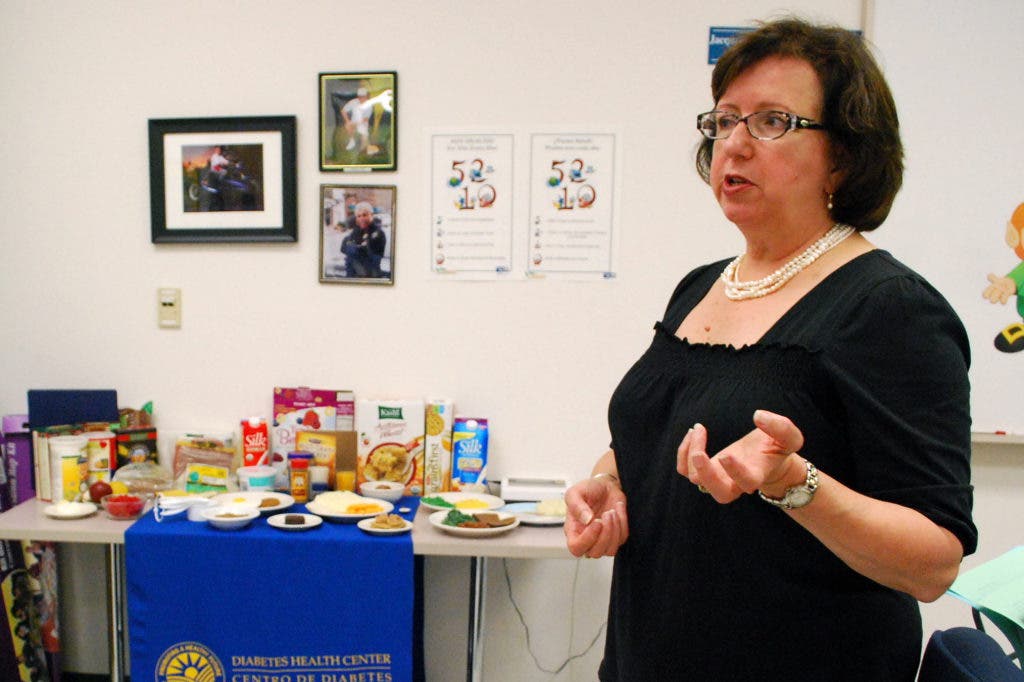
Table displays at the Diabetes Health Center is one tool for this. The presentations looked similar to a school science project than a medical education center. One explained portion control, to help patients keep meals reasonable and balanced. The second revealed the amount of sugar in a can of Arizona Iced Tea or a Capri Sun drink—there's 42 tablespoons of sugar in a large soda. Fat amounts and salt quantities for popular foods were also outlined.
"A lot of people have no idea what's in the food their eating," King said as she gave a tour of the diabetes clinic recently.
For more information about the Diabetes Health Center, call 831-763-6445.
Get more local news delivered straight to your inbox. Sign up for free Patch newsletters and alerts.