Community Corner
West Hollywood Creatives: Why an AI-Generated Website Is Quietly Costing You Clients
WeHo's audience can spot a template from the hero image down. Here's why custom human design still wins in a market built entirely on taste.
This is a paid post contributed by a Patch Community Partner. The views expressed in this post are the author's own, and the information presented has not been verified by Patch.
WeHo's audience can spot a template from the hero image down. Here's why custom human design still wins in a market built entirely on taste.
In most cities, a website is a brochure. In West Hollywood, it's the brand. This is a square mile packed with design studios, boutique retail, beauty labels, hospitality concepts, talent and management firms — businesses whose entire value proposition is taste. Your customers here are visually fluent. They've been trained by the work around them to read design the way a sommelier reads a wine list, and they form a judgment about your competence in the first three seconds, before they've read a single word.
That's exactly why the recent flood of AI-generated websites is a quiet problem. Tools like Wix ADI, Framer AI, and Webflow AI can spin up a site that looks fine to almost anyone — except the design-literate audience you're trying to win. To them, "fine" reads as "didn't care enough to invest in their own brand," and that impression transfers directly to your work. Below is what those sites actually signal to a WeHo audience, the specific tells that give them away, and where custom human design still earns its keep.
In West Hollywood, Your Audience Reads Design Fluently
Walk down Melrose, Robertson, or Santa Monica Boulevard and you're surrounded by businesses that compete on aesthetics: interior designers, fashion showrooms, photographers, salons and aesthetic clinics, members-only hospitality, entertainment and management offices, indie beauty brands. The people who run them — and the people who buy from them — spend their days immersed in visual craft. That changes the math on your website.
In a market like this, your audience isn't evaluating whether your site "works." They're evaluating whether you have taste. And they're doing it with a trained eye. A creative director who art-directs shoots for a living will clock a stock-photo hero and a default font pairing instantly, the same way you'd notice a knockoff handbag across a room. They may not consciously articulate "this is a Wix template" — but they register the feeling, and the feeling is this brand is a tier below the work I want to be associated with.
That perception does real damage in WeHo specifically, because here the website is often the first proof of your standards. A prospect deciding between two boutique studios, two stylists, two hospitality concepts will treat your site as a sample of your judgment. If it looks like the default, they assume the work is the default too. Fair or not, in a taste-driven market your homepage is a portfolio piece whether you intended it to be one or not — and it's being graded by the most discerning audience in Los Angeles.
How People Spot an AI-Generated Site in Seconds
AI builders are trained on the most common patterns on the web, so they reproduce the average. The problem is that "average" has a look, and a design-literate audience recognizes it on sight. Here are the specific tells.
The same five hero layouts
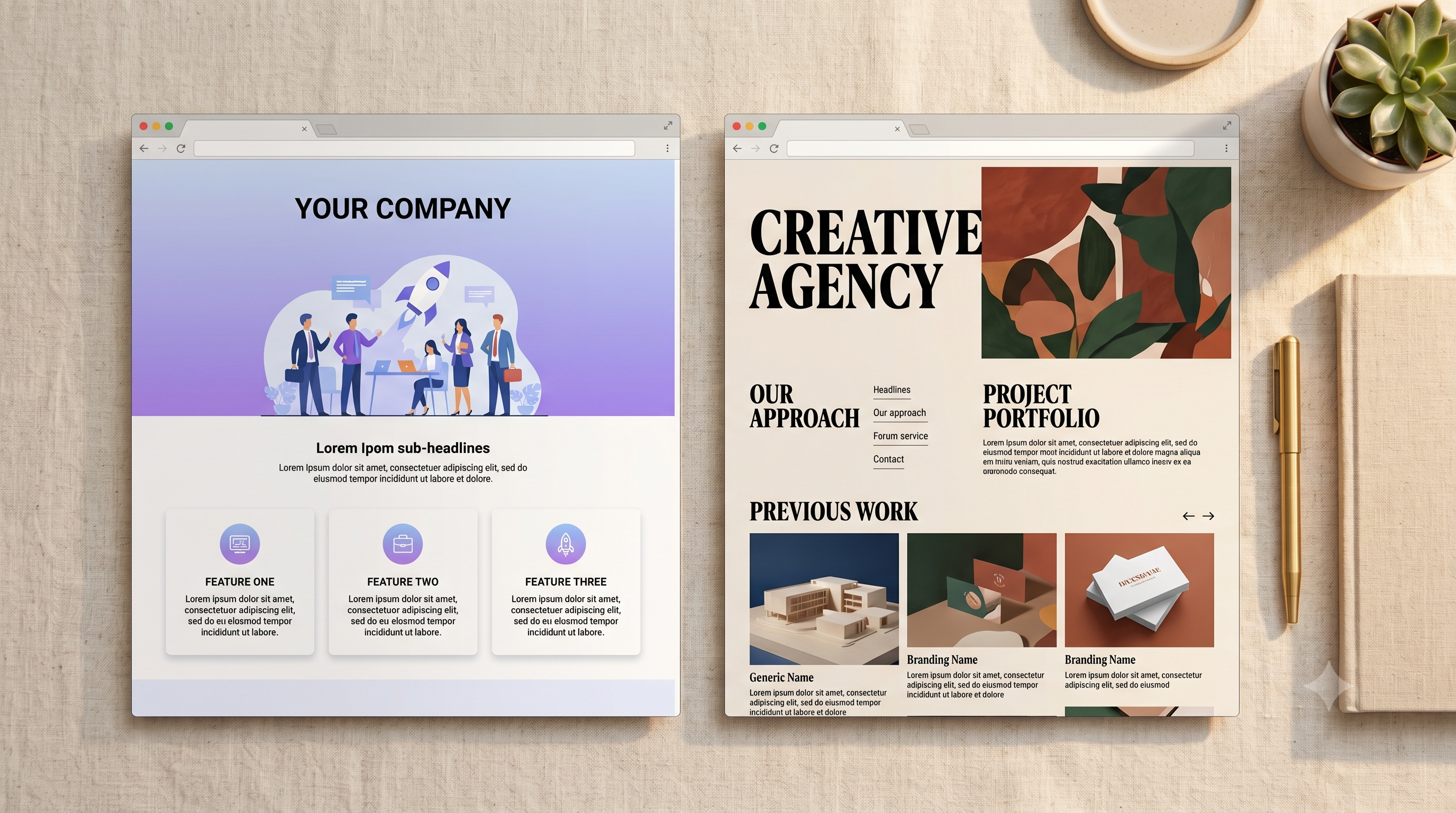
AI tools default to a tiny set of opening compositions: centered headline over a full-bleed gradient, headline-left with a floating product mockup on the right, or a big word stack on a muted background. Once you've seen them a few hundred times — which your WeHo customers have — they stop reading as design and start reading as a setting that was never changed. The hero is the first thing a visitor sees, and a templated hero spends your most valuable second telling them you're generic.
Generic gradients and stock illustration
Soft purple-to-blue gradients, abstract blob shapes, and that specific style of flat vector illustration with disproportionate limbs are AI-builder signatures. They exist because they're safe and they fill space, not because they say anything about your brand. To an audience that commissions real photography and original art direction, these elements read as placeholder — the visual equivalent of "lorem ipsum" that nobody ever replaced.
Predictable section flow
Hero, three feature cards, a testimonial slider, a logo bar, a final call-to-action — in that exact order, every time. AI tools assemble pages from this template because it's statistically common, but the predictability itself is the tell. A site that moves in the expected rhythm with no surprises signals that no human made a deliberate choice about how to tell your story. Creative audiences notice the absence of intent.
Copy that says nothing
AI-generated body text is fluent and empty: "We deliver innovative solutions tailored to your unique needs." It's grammatically perfect and completely interchangeable with a thousand other businesses. In a market where voice and point of view are the product, generic copy undercuts you as much as generic visuals — it tells a discerning reader there's no distinct person or perspective behind the brand.
Why "Good Enough" Is a Liability in a Creative Market
In most industries, a passable website is a non-issue — customers care about price, location, or speed, and the site just needs to load. Creative West Hollywood is the opposite. Here, "good enough" is a competitive liability, because your prospect is almost never looking at your site in isolation. They're comparing you against the studio two doors down whose site feels unmistakably bespoke.
That side-by-side is where templated sites lose business quietly. The prospect rarely tells you "your website looked generic, so I went with someone else." They just go with someone else. You never see the lost inquiry, the booking that didn't happen, the brand collaboration that went to a competitor who simply looked more like a peer. In a referral-and-reputation economy like WeHo's, those invisible losses compound — every prospect who bounces is also one who didn't refer you.
The competitor threat is sharper now precisely because AI builders lowered the floor. When a custom-looking site was expensive and rare, a clean template held its own. Now that anyone can generate a "fine" site in an afternoon, fine is the baseline, and standing out requires clearing a higher bar than it did two years ago. Your competitors who invested in distinctive, human-made design didn't just keep pace — they widened the gap, because the contrast between their site and the AI-generated average is more obvious than ever. In a market that sells taste, looking like everyone else isn't neutral. It's a reason to be passed over.
What Custom Human Design Actually Does Differently
The alternative to a templated site isn't "more expensive" — it's intentional. Every choice a human designer makes is a decision about your specific brand and your specific audience, and those decisions are exactly what a creative-market customer is reading for.
A custom build starts with a visual system, not a layout. Color, type, spacing, and imagery are chosen to express one brand's personality — restrained and editorial for a luxury skincare label, bold and graphic for a music management firm — rather than pulled from a safe default that fits everyone and belongs to no one. Typography stops being an afterthought: the right typeface pairing does as much brand work as a logo, and a designer picks it on purpose instead of accepting whatever the builder defaulted to.
Then there's art direction. Original photography, custom graphics, and real work samples replace stock illustration, and they signal investment the way a well-shot lookbook does. The structure changes too — instead of the predictable hero-cards-testimonial march, a human designer sequences the page to tell your story, leading with whatever actually makes you compelling rather than whatever the template put first.
None of this is decoration for its own sake. In a taste-driven market, these are the signals that move a prospect from "this seems fine" to "these people clearly know what they're doing — I want to work with them." Custom design isn't about being fancy. It's about making your website an accurate sample of your standards, so the first impression matches the quality of the work behind it.
When an AI Builder Is Fine — and When It Isn't
To be fair, AI website builders aren't useless — and pretending otherwise would be dishonest. They're genuinely good at a specific set of jobs, and knowing where the line falls is what keeps you from overspending or underspending.
An AI builder is a reasonable choice when the stakes are low and speed matters more than distinction. Validating a new concept before you commit real budget, standing up a quick coming-soon or event page, building an internal tool nobody outside your team will see, or launching a weekend side project — in all of these, "fast and fine" is exactly right. Nobody is grading the typography on a landing page that exists for three weeks.
It stops being fine the moment the website becomes the public face of a brand whose value is its taste. If a prospect's decision to hire you, book you, stock you, or collaborate with you runs through your site — and in West Hollywood's creative economy, it almost always does — then a generic site is working against the exact impression you need to make. That's not a job for the tool that produces the statistical average. It's a job for someone who designs for your brand specifically.
The honest test is simple: is this site a placeholder, or is it a sample of your standards? Placeholders can be generated. Samples of your standards should be made on purpose.
Frequently Asked Questions
Can people really tell if a website was made with AI?
Most casual visitors can't name the tool, but they feel it — and design-literate audiences absolutely can. AI builders reproduce the most common patterns on the web, so they produce a recognizable "average" look: familiar hero layouts, default type pairings, stock illustration, and predictable section order. In a creative market like West Hollywood, customers register that sameness as a signal that the brand didn't invest in itself.
Are AI-generated websites bad for SEO?
Not inherently — an AI-built site can be technically sound. The real risks are softer: generic, interchangeable copy gives search engines little reason to rank you over competitors, and a homogeneous structure rarely earns links or engagement. The bigger cost usually isn't rankings at all — it's conversion. Traffic that lands on a site that looks generic is less likely to inquire, book, or buy.
How much does a custom website cost for a small West Hollywood business?
Most small-business custom builds in Los Angeles land somewhere between roughly $3,000 and $12,000, depending on page count, functionality, and whether you need custom photography or e-commerce. That's more than a template, but for a brand whose customers judge it on taste, the site is a revenue-driving sales asset, not an expense — and it's priced accordingly.
Can I start with an AI-built site and upgrade to a custom one later?
Yes, and for an early-stage business that's often a sensible path — launch fast, validate the concept, then invest in custom design once the brand and budget are established. The key is treating the AI version as a temporary placeholder, not a permanent storefront, and upgrading before the generic look starts costing you the exact high-value clients you're trying to win.
If your West Hollywood brand is hiding behind a templated or AI-generated site, your competitors are noticing — and so are the prospects deciding between you and them. Sunlight Media builds custom, human-designed websites for creative-industry businesses across Los Angeles, and we'll start with a free design audit: send us your site and we'll show you exactly how it reads against three of your direct competitors, with specific fixes you can act on whether you work with us or not.
Request your free design audit →
This post is an advertorial piece contributed by a Patch Community Partner, a local brand partner. To learn more, click here.