Community Corner
The 29th Connecticut: Significant And Symbolic In The Civil War
It's perhaps fitting on Juneteenth to recognize the 29th Connecticut Civil War regiment.


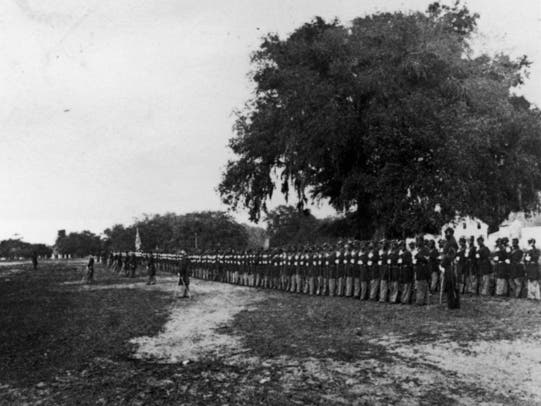

ACROSS CONNECTICUT — It's difficult to observe a day like Juneteenth without looking back on a Civil War regiment that played what is arguably both a significant and symbolic role in the struggle — the 29th Connecticut.
According to various historical accounts, Juneteenth is the oldest national commemoration of slavery ending in the United States.
The observance dates back to the Civil War and June 19, 1865, when Union Army soldiers, led by Maj. Gen. Gordon Granger, landed at Galveston, Texas and spread the news that the war had ended and that slaves were now free. For those keeping score, that's two-and-a half-years after Abraham Lincoln’s Emancipation Proclamation, which became effective on Jan, 1, 1863.
Find out what's happening in Across Connecticutfor free with the latest updates from Patch.
The 29th certainly had something to say about freedom. About two-and-a-half months before the march into Galveston, the 29th marched into Richmond as the first troops to occupy the surrendered Confederate capital. That was April 3, 1865.
The writings of the Rev. Henry G. Marshall, the unit historian, extend the tale to the following day, when Abraham Lincoln arrived and credited members of the 29th with "setting free" Richmond residents of color.
Find out what's happening in Across Connecticutfor free with the latest updates from Patch.
According to the Connecticut State Library, the 29th was mustered into service on March 8, 1864 at more than 1,000 strong.
The unit was comprised of non-white or "colored" recruits of varying origins, ages, and occupational backgrounds who were willing to fight for the Union.
Under the command of Col. William B. Wooster of Derby, and led by an all-white officer staff (as was the custom of the day), the black troops of the 29th would distinguish themselves not only at the siege of Richmond, but also at places like Beaufort, Petersburg, Chaffins Farm, Darbytown Road and Kell House.
Enlistment records show volunteers came from the far reaches of the state, like George Johnson, a 22-year-old barber who settled in Union and Isaac Merritt, a 41-year-old laborer from Greenwich. Many are listed as farmers on the books. One of the farmers was Albert Bailey, a 22-year-old who moved to Hartford from New Orleans. Another soldier who came from the South was William Carter, 21, a boatman who settled in Clinton by way of Clark County in Virginia.
Volunteers came from as far away as Trinidad in the West Indies in the case of John Alderman, 19, who settled in Suffield and whose listed occupation is listed as "waiter."
The regiment is honored with monuments in New Haven and Danbury.
The New Haven monument is located on the 29th's former training grounds at what is now Criscuolo Park. It lists the 45 officers and enlisted men killed or mortally wounded, and the 152 enlisted men and one officer who died from disease or accident.
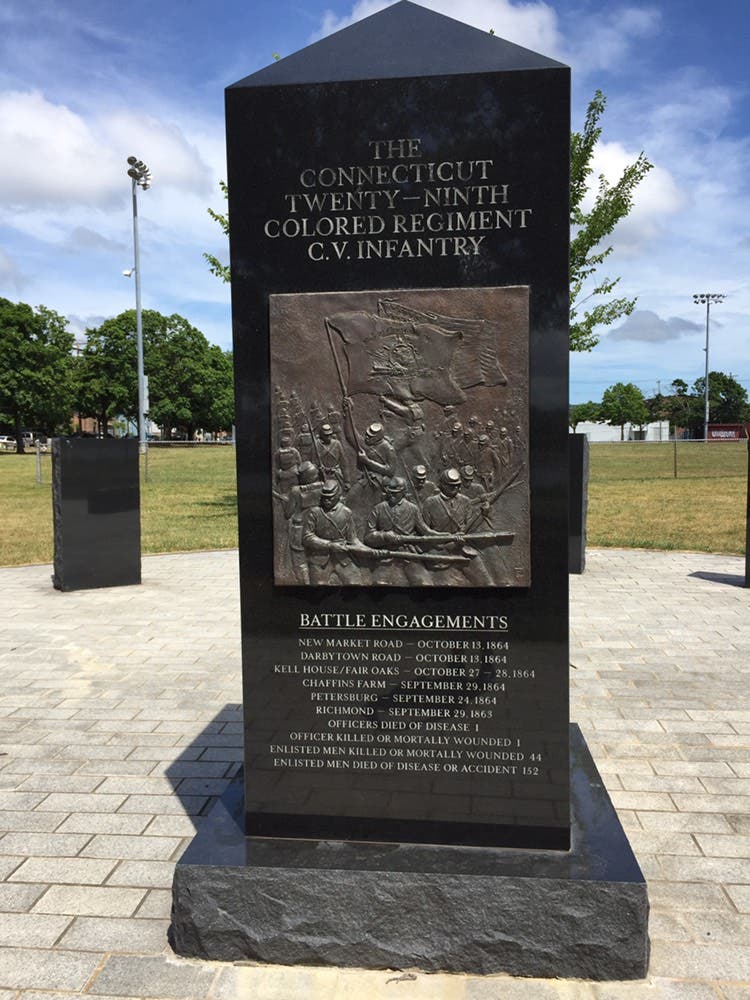
The 29th Connecticut monument in New Haven (Ellyn Santago/Patch)
Get more local news delivered straight to your inbox. Sign up for free Patch newsletters and alerts.