Community Corner
Data Collection in 2020 U.S. Census to Conclude September 30
Incomplete Count Could Cost State and Cities Millions of Dollars; CT Data Collaborative Points to Connecticut Response

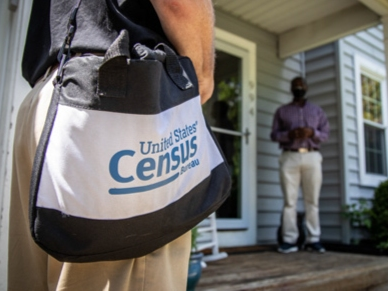
The 2020 U.S. Census now plans to conclude data collection operations a month from now, on September 30, and Connecticut still has some ground to cover if the state is to achieve a full count of its population in order to receive its fair share of federal funding for the next 10 years.
The Census Bureau began sending official Census takers in communities across the state and nation this summer, wearing masks and observing social distancing guidelines, in order to gather household data from those who had yet to respond by mail, by phone or via the internet.
Connecticut’s self-response rate of 68.6% of households as of August 25 is above the national average of 64.6%, ranking as the 11th highest percentage in the country. Since household enumeration has begun with the addition of Census takers in the field, data has been obtained from an additional 18.4% of the state’s households moving the state’s total to 87.1%, the 5th highest in the nation.
Find out what's happening in Across Connecticutfor free with the latest updates from Patch.
The state’s cities continue to lag as of August 25, as is evident in the self-response rates. The self-response rate in Hartford is 46.5%, below the 2010 level of 53.9%. New Haven self-response rate is 51.8%, compared with 58.9% in the 2010 Census; in Bridgeport the self-response is 51.4% compared with 56.8% in 2010; in Waterbury, the self-response was 53.6%, compared with 60.9% ten years ago.
The self-response rates in Norwalk, Bristol, Middletown, Torrington and Danbury are also below 2010 levels, although with a slightly smaller differential. Both New Britain and Stamford have recently passed their 2010 self-response rate. As Census takers continue to fan out across Connecticut, the goal remains to obtain as complete and accurate a count as possible.
Find out what's happening in Across Connecticutfor free with the latest updates from Patch.
In July, census takers began interviewing households around the country that have not yet responded online, by phone, or by mail to the 2020 Census. The U.S. Census Bureau is working to complete data collection as quickly and safely as possible, while ensuring a complete and accurate count as it strives to comply with the law and statutory deadlines.
“The challenges in achieving a strong response to the 2020 Census have been unprecedented, even as the number of ways responses can be made have expanded. As Connecticut reopens and the importance of a complete count becomes even more evident, increasing our state’s response across all our communities is a priority that will have an impact on Connecticut for the next 10 years,” said Michelle Riordan-Nold, a member of Connecticut’s Complete Count Committee and Executive Director of the Connecticut Data Collaborative, the lead organization for the State of Connecticut in the U.S. Census Bureau’s State Data Center Program.
The U.S. Constitution mandates a census of the population every 10 years. Census statistics are used to inform how hundreds of billions of dollars in public funds are allocated by state, local and federal lawmakers for public services and infrastructure like hospitals, emergency response, schools and bridges over the next 10 years. Research has found that Connecticut received $18.7 billion in fiscal year 2017 in
federal funding. Business decisions – such as where to locate or expand - are also often influenced by data that is provided based on Census counts, and the data is used to determine the number of seats each state holds in the U.S. House of Representatives.
An incomplete count will have ramifications that will last a decade and adversely impact the state. For example:
- When seeking federal funding, the state will not have the accurate census data it needs
- When deciding where to build job-creating factories, offices, and stores, businesses will
- When planning and preparing for emergencies, local governments will not have accurate
- When identifying community needs, nonprofit health and human service providers, citizen organizations, and philanthropic organizations will not have accurate census data to request and fund programs, and to assess program effectiveness.
- When assessing or comparing the quality-of-life within communities, residents will not have accurate census data to understand and support advocacy efforts.
All Census Bureau employees will present an official ID badge. If a household does not want to conduct the interview in person, they can provide the census taker with their phone number to complete it over the phone. By law, the brief census interviews are confidential, answers cannot be shared with immigration or law enforcement agencies and census takers must keep answers confidential for life. They face stiff fines and jail time if they break that law. There is no citizenship question on the 2020 Census.
To respond to the Census by phone, individuals should contact (844) 330-2020. Additional information about the 2020 Census is available at www.2020census.gov. Connecticut’s Complete Count Committee website is www.ct.gov/census.
The Connecticut Data Collaborative (www.ctdata.org) is the lead organization for Connecticut in the U.S. Census Bureau’s State Data Center Program and Connecticut’s official source for Census data related to the 2020 Census. Data and analysis, along with key information, is being posted to the website. The Connecticut Data Collaborative (CTData) is a statewide public-private partnership that advocates for the public availability of open and accessible data.
During the 2020 Census, the Census Bureau will never ask individuals for a Social Security number, bank or credit card account numbers, money or donations, or anything on behalf of a political party. If someone claiming to be from the Census Bureau contacts a person via email or phone and asks for one of these things, it is a scam, and individuals should not cooperate.