Weather
El Niño Watch Issued: What It Could Mean For Connecticut Weather
Forecasters say La Niña is weakening and El Niño could develop later this year, potentially influencing weather across the Northeast.


CONNECTICUT — A major climate pattern in the Pacific Ocean is beginning to shift, and forecasters say it could eventually influence weather across Connecticut.
The National Oceanic and Atmospheric Administration's Climate Prediction Center said in its latest update that El Niño has a 62% chance of developing between June and August, issuing an El Niño Watch.
La Niña conditions have been present for several months, but forecasters expect conditions to transition to neutral next month, persisting through May or June.
Find out what's happening in Across Connecticutfor free with the latest updates from Patch.
El Niño and La Niña are part of the El Niño-Southern Oscillation, a climate pattern that alters the global atmospheric circulation and influences temperatures and precipitation around the world.
El Niño occurs when Pacific Ocean surface temperatures are warmer than normal, while La Niña happens when temperatures are cooler than normal. A neutral phase occurs when ocean temperatures are near average.
Find out what's happening in Across Connecticutfor free with the latest updates from Patch.
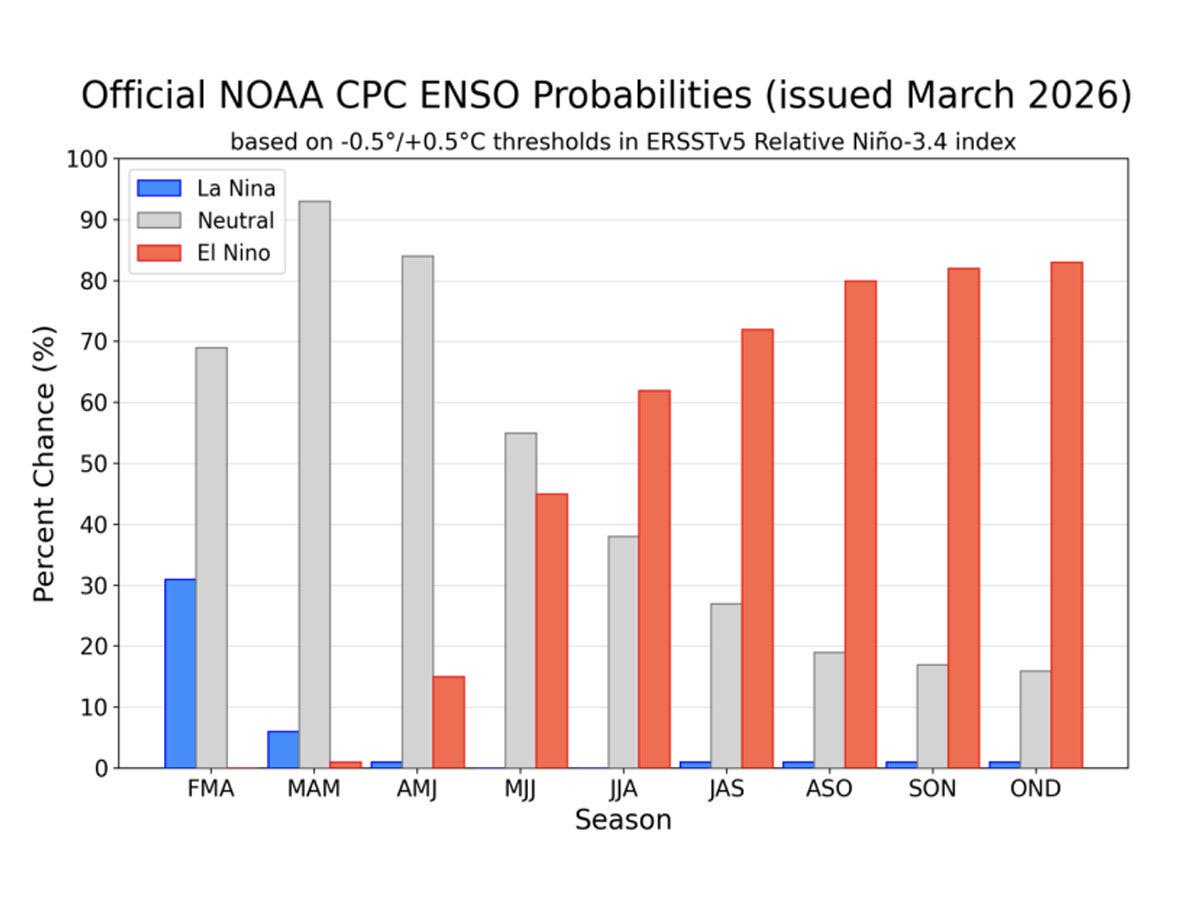
A chart from NOAA's Climate Prediction Center shows increasing odds that El Niño could develop later in 2026, following a transition from current La Niña conditions to neutral conditions this spring. Credit: NOAA Climate Prediction Center
But what does El Niño mean for weather in Connecticut? The biggest impacts typically show up in the winter months, when the pattern can influence storm tracks and precipitation.
"El Niño has weak relationships with temperatures in the Northeast," said Michelle L'Heureux, a meteorologist at NOAA's Climate Prediction Center. "For precipitation, during El Niño winters (when its influence is the greatest), there is historically a slight lean toward above-average precipitation for Connecticut."
Although El Niño could develop during the summer, it has limited impacts on summer temperatures and precipitation. Nationwide, it can cause cooler than average summers.
El Niño has historically been linked to reduced hurricane activity in the Atlantic, though other factors also influence the hurricane season.
Get more local news delivered straight to your inbox. Sign up for free Patch newsletters and alerts.