Politics & Government
Lamont Proposes Recreational Pot, Sports Betting, Trailer Tax
Gov. Ned Lamont's budget calls for legalizing recreational marijuana and sports betting, as well as a mileage tax on tractor-trailers.


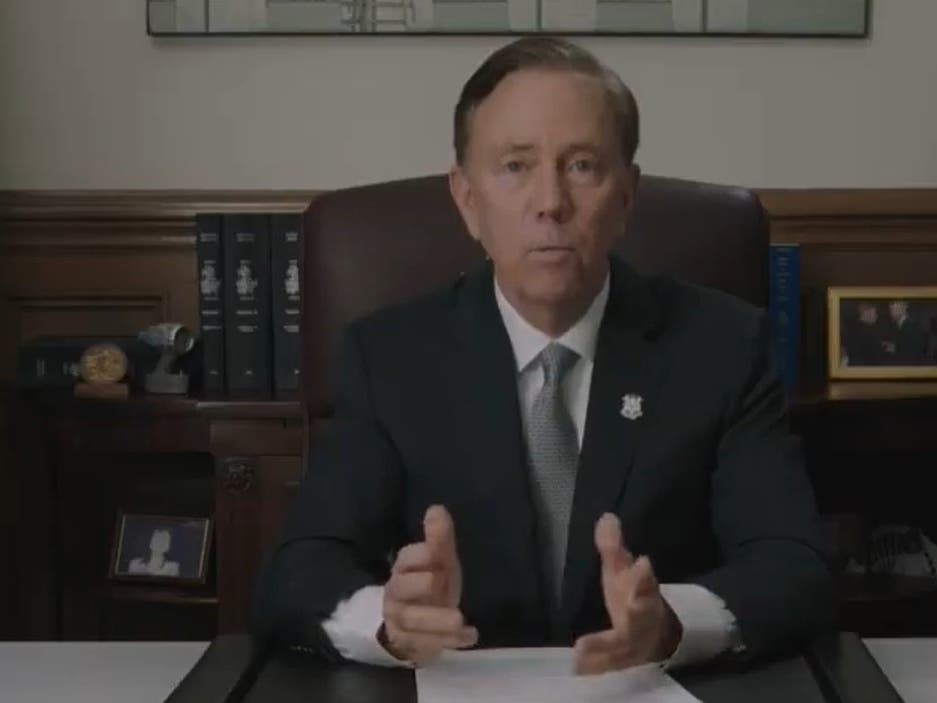
CONNECTICUT — Gov. Ned Lamont proposed legalizing recreational marijuana and sports betting as part of his 2021 budget plan Wednesday. He also proposed a new mileage tax on tractor-trailers to help fund the state’s transportation needs.
He said his budget proposal avoids large tax increases.
Lamont delivered his budget address in a pre-recorded video due to the coronavirus pandemic. Normally, the governor appears before a joint session of the House and Senate to make his proposal.
Find out what's happening in Across Connecticutfor free with the latest updates from Patch.
“True enough, our original path to solvency had some twists and turns thrown in, but we got to our final destination, and the rest of the country has taken notice” Lamont said. “Yep, there’s more work to do, but Connecticut has made significant progress in getting its fiscal house in order.”
A couple of large questions remain for Connecticut’s finances. One is how much support the federal government will give to states as part of a coronavirus aid bill. The other is to what extent the pandemic will affect revenues.
Find out what's happening in Across Connecticutfor free with the latest updates from Patch.
Budget shortfalls can be addressed in three ways, Lamont said. One is to expand the state’s economy. Another is federal aid and the final option is to rely on the state’s $3.5 billion rainy day fund.
Republican legislative leaders applauded Lamont's efforts to make state government more efficient, but were critical of the ways Lamont planned to plug budget deficits.
"The governor has given us a multiple choice budget that would fill the deficit through either federal aid, draining the rainy day fund, or intense economic growth," House Republican Leader Vincent Candelora said. "The framework he outlined not only fails to inspire, it will leave everyone from parents and teachers to employers and retirees feeling less confident that we’re positioned for anything but a rough road to recovery."
The Connecticut Council of Small Towns applauded Lamont's budget, especially because it doesn't cut municipal aid and proposes better broadband internet access in rural communities.
“The budget also maintains funding for Town Aid Road, the Local Capital ImprovementProgram, and the Local Bridge Program, which will ensure that towns can move forward withinfrastructure investment projects," council Director Betsy Gara said. "These projects are critical in supporting local economic recovery efforts."
Recreational marijuana
Lamont unveiled his recreational marijuana proposal during his address.
“Massachusetts dispensaries are advertising extensively here in Connecticut,” Lamont said. “And, rather than surrender this market to out-of-staters, or worse, to the unregulated underground market, our budget provides for the legalization of recreational marijuana.”
Lamont proposed that marijuana revenue go to distressed communities with half going to increasing the state’s Payment In Lieu of Taxes program, which gives towns money to make up for lost revenue from tax-exempt properties. Towns would also have the option of a 3 percent local excise tax option on marijuana sales.
Sales would begin in May 2022 and are expected to raise $33.6 million in fiscal year 2023. Revenue would grow to $97 million by fiscal year 2026.
Licensing would be established for cultivators, retailers and hybrid medical/adult-use retailers along with micro-cultivators, product manufacturers, food and beverage manufacturers, product packagers, and delivery services.
Up to 1.5 ounces of marijuana or equivalent amounts of other products would be allowed under the bill. Possession above the amount would be punishable by an infraction for a first offense.
Home growing wouldn't be allowed, but the state Department of Consumer Protection will conduct a study on the subject and criminal penalties would be substantially reduced.
The proposal would also automatically erase criminal records related to marijuana-related drug possession charges.
House Speaker Matt Ritter previously said legalization would be a priority for the legislative session. Legalization gets a little closer to reality each year in the state legislature, he said.
Ritter predicted a 50-50 chance of the legislation passing in 2021, according to the Hartford Courant.
The other option is to mirror most other states that have legalized it via a direct ballot question. In Connecticut that full process could take between two and four years depending on how much support the measure has in the state legislature. It would appear as a question on the 2022 ballot if at least three-fourths of state legislators supported it. It would appear on the 2024 ballot if both the House and Senate passed the measure by a majority vote in two consecutive years.
Massachusetts, Maine and Vermont have legalized recreational marijuana. New Jersey voters approved a constitutional amendment to legalize marijuana, but technically the drug remains illegal until legislators codify the change.
Sports betting
Again, Lamont doesn't want to lose out to neighboring states when it comes to legalized sports betting and internet gambling.
“Our neighboring states are moving forward with sports betting and i-gaming, and Connecticut should not leave these opportunities for other states to benefit from our inaction,” he said. “My administration has been in active negotiations with our tribal partners to bring the state’s gaming economy into the digital age.”
Lamont proposed patterning with the Mashantucket Pequot Tribe of Indians and the Mohegan Tribe of Indians of Connecticut to create a new compact for sports wagering, e-sports and daily fantasy contests both on and off tribal lands.
The budget proposal assumes $47.3 million in revenue in fiscal year 2023 from expanded gambling.
Transportation
Lamont proposed two new sources of revenue for the state’s transportation needs.
Lamont joined an initial agreement with Massachusetts, Rhode Island and the District of Columbia to put a cap on carbon emissions from gas and diesel road fuels. The state legislature would have to approve the plan for Connecticut to fully join it.
He also proposed a tractor-trailer mileage-based fee, which would raise an estimated $90 million annually and allow the state to qualify for more federal transportation funding.
Lamont’s multiple toll proposals didn’t gain traction in 2019. He pitched tolls as a way to rescue the state’s beleaguered Special Transportation Fund and as a way to upgrade Connecticut’s transportation infrastructure. Around half of Special Transportation Fund’s revenue comes from fuel taxes, according to the state Office Of Legislative Research.
“The Special Transportation Fund is broken and it needs to be fixed,” Lamont said in his budget address. “This comes at the very time the federal government is ready to provide significant funding to streamline transportation systems, but only if our state can pay its share.”
Local aid
Lamont proposed an additional $100 million to 25 financially-distressed cities and towns to help offset the loss of revenue for tax-exempt properties.
His budget would also maintain a commitment to the state’s education cost sharing formula.
Modernizing state government
Lamont’s goal is to get Connecticut residents out of line and online when it comes to dealing with the state. He recently announced the Department of Motor Vehicles will allow license renewals online.
State government also consolidated human resources and related technology platforms into one system instead of 25 separate ones.
Get more local news delivered straight to your inbox. Sign up for free Patch newsletters and alerts.