Politics & Government
Lamont Signs $15 Minimum Wage Bill Into Law
The first wage increase starts in October.


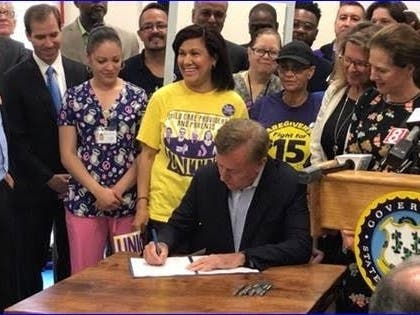
HARTFORD, CT — Gov. Ned Lamont signed Connecticut's $15 minimum wage bill into law Tuesday. The minimum hourly wage will gradually ramp up to $15 starting with an increase in October.
The minimum wage will be based off federal economic indicators after the wage hits $15.
"This is perhaps one of the most impactful pieces of legislation for working families that a governor can sign, and I am proud to place my signature on this law because it is the right thing to do,” Lamont said. “With this new law, thousands of hardworking women and men – many of whom are supporting families – will get a modest increase that will help lift them out of poverty, combat persistent pay disparities between races and genders, and stimulate our economy."
Find out what's happening in Across Connecticutfor free with the latest updates from Patch.
Here is the scheduled increase:
· $11.00 on October 1, 2019;
· $12.00 on September 1, 2020;
· $13.00 on August 1, 2021;
· $14.00 on July 1, 2022; and
· $15.00 on June 1, 2023.
Find out what's happening in Across Connecticutfor free with the latest updates from Patch.
The state House of Representatives held a marathon debate over the minimum wage increase before passing 85 to 59. Debate went 14 hours. Republicans argued that a higher minimum wage would make the state less desirable for businesses and could lead to greater automation as a cost-cutting measure.
"When you are forcing businesses to do one thing after another that makes it difficult for them to do business, they can't do it anymore… we agree people should be paid as fairly as possible but you can not only look at the fact that we want people to make more money," said Republican House leader Themis Klarides during the legislative debate.
About 130,000 people will get pay raises this year and more than half a million would get rraise by 2024, according to the state Department of Labor.
“Raising the minimum wage is going to benefit hundreds of thousands of people in Connecticut, especially people of color and working mothers,”Representative Robyn Porter said. “That extra disposable income for each low-wage worker will go right back into the local and state economies, benefiting our communities and local businesses and producing more revenue for the state."
The state would save money another way through an increased minimum wage by making fewer people qualify for state HUSKY insurance. At the current minimum wage a parent with a family of two would have to work 54 hours a week before becoming ineligible for HUSKY A. Under $15 minimum wage that drops to 36 hours, according to the Office of Fiscal Analysis.
Get more local news delivered straight to your inbox. Sign up for free Patch newsletters and alerts.