Community Corner
More Multigenerational Households in Connecticut
Increases in 130 of 169 Towns Between 2010 and 2020 Census, Data Analysis Shows

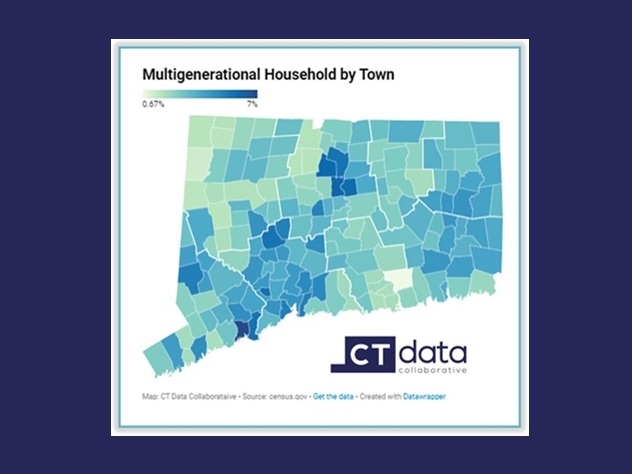
Connecticut has experienced a nearly statewide town-by-town increase in the number of multigenerational households, according to a new analysis by the Connecticut Data Collaborative of data from the U.S. Census.
The 2020 decennial census found that Connecticut has approximately 1.4 million households, of which 3.9%, or 55,526, are multigenerational. This marks an increase of about 0.3%, or 4,924 households, from the 2010 decennial census.
In comparing the change from 2010 to 2020, each of Connecticut’s nine planning regions experienced an increase in multigenerational households. The smallest increase was in the Lower Connecticut River Valley, with 77 households, or 4.3%, while the largest was in Western Connecticut, with 1,683 households, or 23.5%.
Find out what's happening in Across Connecticutfor free with the latest updates from Patch.
Overall, 130 of Connecticut’s 169 municipalities saw an increase in multigenerational housing, while only 39 saw a decrease from 2010 to 2020.
A household is classified as multigenerational if it includes three or more generations of family members residing together under one roof. For instance, this can consist of children, parents, and grandparents. Multigenerational households are composed of family members related by birth, marriage, or adoption.
Find out what's happening in Across Connecticutfor free with the latest updates from Patch.
The top 5 cities with the highest share of multigenerational households are Bridgeport (3,796, 6.8% of households), Hartford (2,842, 5.1% of households), Waterbury (2,491, 4.5% of households), New Haven (2,368, 4.3% of households) and Stamford (2,242, 4.0% of households).
The largest increases in the number of multigenerational households were seen in Danbury (389), Stamford (316), Norwalk (243), Hamden (228), Manchester (182), Waterbury (179), Stratford (171), Bridgeport (167), East Hartford (157), Fairfield (138), West Haven and Greenwich (122), New Britain (107) and Bristol (103).
The 39 communities that saw a decrease in the number of multigenerational households include Hartford, which experienced a reduction of 175 multigenerational households, the largest number in the state, along with Milford, Westbrook, Plymouth, Monroe, Enfield, North Branford, Bozrah, Chaplin, Harwinton, New Haven, Granby, Bethan, Litchfield, Sterling, Thomaston and Preston, which each saw a decrease of between 12 and 37 multigenerational households.
Almost 25% of all multigenerational households in Connecticut are in the cities of Bridgeport, Hartford, Waterbury, New Haven and Stamford.
“This analysis highlights changes in the population landscape in Connecticut that merit the continued attention of policymakers as new trends emerge or previous trends continue,” said Michelle Riordan-Nold, Executive Director of the Connecticut Data Collaborative. “As additional data is compiled, particularly in the aftermath of a housing market impacted by the pandemic, keeping an eye on what the data tell us can be helpful to our communities and residents across the state.”
Across the state’s nine planning regions, multigenerational households accounted for an average increase of 6,169, or 3.9%. The Capital Planning Region had the highest number of multigenerational households, with 14,511 households, which makes up 3.7 % of the total households within the region. The Greater Bridgeport Planning Region had 6,509 multigenerational households, which is 5.5% of the total households in that region. The Lower Connecticut River Valley Planning Region had the lowest, with 2.55%, or 1,858 households.
Connecticut’s nine planning regions, through which data is compiled and analyzed, include Capitol Region, Northwest Hills Region, Northeastern Region, Southeastern, Lower Connecticut River Valley, South Central, Greater Bridgeport, Western, and Naugatuck Valley.
The communities with the largest percentage of multigenerational households among households in their communities, according to the 2020 Census, are Bridgeport (7%), Hartford (6%), East Hartford and Bloomfield (5.9%), Stratford and Ansonia (5.7%), Waterbury (5.6%), Windsor (5.6%), Danbury (5.2%), West Haven (5.2%), New Britain (5.1%), Norwalk (4.7%), New Haven (4.5%), Hamden (4.3%) and Stamford (4.2%).
CTData provides services to residents, nonprofits, policymakers, and funders so they can use data to drive policy, program, and service improvements. The organization strives to promote and engage data users in implementing equitable data practices across the state.
CTData program initiatives include the CTData Academy, Equity in Data Community of Practice, Customized Data Workshops, and Data Consulting services. In addition, more than 200 datasets are now accessible on the CTData website, including many subject areas and policy categories of particular interest to businesses, municipalities, nonprofit organizations, educators, policymakers, and community groups.
“CTData is on the frontlines making data more accessible, developing analyses, and working with individuals and organizations to improve their understanding and use of data," added Riordan-Nold. “The public interest is well-served by these efforts to better inform the people who make decisions impacting our daily lives.”
Among its areas of responsibility, CTData has been designated as the lead organization for the State of Connecticut in the U.S. Census Bureau's State Data Center Program. Earlier this year, CTData added to its website U.S. Census American Community Survey (ACS) 5-year estimates for Connecticut's 169 cities and towns, with topics including income, education, housing, remote working, and more.
The data for the multigenerational household analysis comes from the U.S. Census Bureau 2020 Decennial Census Demographic and Housing Characteristics (DHC) profile, which presents an in-depth analysis of the American population.
More information about the multigenerational data analysis, including data on every town and city in Connecticut, as well as information on CTData workshops, initiatives, and datasets, is available on the website at www.ctdata.org.