Health & Fitness
New Executive Order By Lamont, More Benefits For CT Residents
Gov. Ned Lamont issued a series of updates concerning the coronavirus and its impact on Connecticut.


CONNECTICUT — Gov. Ned Lamont issued a series of updates concerning the coronavirus and its impact on Connecticut. He announced his 35th executive order and that 100,000 Connecticut households will receive additional Emergency Supplemental Nutrition Assistance (SNAP) benefits on May 8.
The Department of Social Services will be providing $15.4 million in Emergency Supplemental Nutrition Assistance (SNAP) benefits to nearly half of Connecticut’s SNAP participants on Friday, May 8, 2020 – adding to the $32.7 million in emergency benefits disbursed in April.
Authorized by the federal Families First Coronavirus Response Act of 2020, the extra food benefits are going to nearly 100,000 households not currently receiving the maximum benefits allowed for their household size, Lamont said.
Find out what's happening in Across Connecticutfor free with the latest updates from Patch.
This means that all households enrolled in SNAP will receive the maximum food benefit allowable for their household size, even if they are not usually eligible for the maximum benefit.
Specifically:
Find out what's happening in Across Connecticutfor free with the latest updates from Patch.
- The Department of Social Services expects that nearly 100,000 of 212,000 SNAP-participating households statewide will receive the emergency benefits in May.
- With this additional $15.4 million allocation by the U.S. Department of Agriculture’s Food and Nutrition Service, emergency benefits are totaling over $48 million in additional SNAP assistance statewide during April and May, with commensurate spending in the food economy.
- The average emergency benefit amount a household will see on its electronic benefits transfer (EBT) card on May 8 in $150.
- All participating households will also receive their normal SNAP benefits on the first three days of each month they normally do, according to last name.
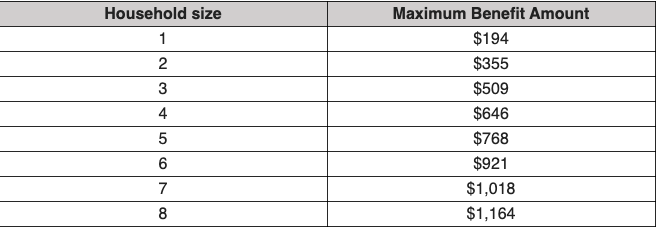
(Each additional person: add $146)
For example, if a household of two would normally receive $255 of SNAP benefits in May, $100 would bring this household up to the maximum benefit for its size. This household would receive a $100 emergency benefit on May 8.
Don't miss local and statewide news about coronavirus developments and precautions. Sign up for free Patch alerts and daily newsletters from all across Connecticut.
See also: CT, Six Other States Plan To Join Forces, Purchase PPE Together
Governor Lamont signs 35th executive order
The order:
"Mandatory suspension of annual town meeting or referendum to adopt budget: This clarifies that going forward, the relevant elected body or bodies in each municipality must adopt a budget for 2020-2021 without an in-person vote by residents. It also validates any budget referendum or annual town meeting that has already been conducted. This order clarifies Executive Order No. 7I, Section 13, to provide uniformity and consistency, and prioritize safety while the risk of transmission of COVID-19 in large gatherings remains high."
"Authorization for common-interest communities to hold meetings remotely: This allows common interest communities, such as condominium associations and homeowners associations, to conduct business remotely and hold votes entirely by ballot if their by-laws or governing documents do not already permit it."
SSI and VA recipients reminded to take action by May 5 to receive federal stimulus payments for dependents
While many people in Connecticut have already received their coronavirus stimulus payments as part of the federal assistance meant to help Americans suffering from the financial fallout of COVID-19, Lamont said he is reminding non-filers who have dependents that they must register with the Internal Revenue Service (IRS) by noon on May 5, 2020 in order to have $500 per child added to their $1,200 coronavirus stimulus payment.
This includes residents who receive either Supplemental Security Income (SSI) or Veterans Affairs (VA) benefits and didn’t file a tax return in 2018 or 2019.
U.S. citizens, permanent residents, and qualifying resident aliens who have a valid Social Security number, could not be claimed as a dependent of another taxpayer, and had an adjusted gross income under certain limits are eligible for the Economic Impact Payments. While most eligible U.S. taxpayers are receiving their Economic Impact payments automatically, non-filers who have dependents need to provide information to the IRS to receive the additional funding.
For more information on the steps non-filers should take, click here for guidance from the IRS.
Get more local news delivered straight to your inbox. Sign up for free Patch newsletters and alerts.