Community Corner
Gas Isn't The Only Thing Getting More Expensive In Connecticut
There's been a big jump at the pump. But Connecticut residents are also paying more for food, furniture, clothes and booze, too.


CONNECTICUT— There's been a big jump at the gas pump lately in the Nutmeg State. But Connecticut residents are also paying more for a wide variety of other essential items, including food, furniture and clothes, according to federal statistics.
Surging crude oil prices and tighter supplies are pushing up prices at the pump in Connecticut and nationally, says AAA Northeast.
On Monday, the statewide average for a gallon of self-service regular was $3.42, 11 cents higher than last week and $1.25 higher than last year. The last time Connecticut saw a gas price average of $3.42 was in October 2014.
Find out what's happening in Bethelfor free with the latest updates from Patch.
On the national level, the average price is $3.33, 6 cents more than a week ago and $1.16 more than a year ago.
"Compared to a year ago, it’s costing drivers about $17 more to fill up their vehicles," said Fran Mayko, AAA Northeast spokeswoman. "Unfortunately, however, it doesn't look like drivers will find relief at the pump any time soon."
Find out what's happening in Bethelfor free with the latest updates from Patch.
Crude oil prices, which account for more than half of the price of each gallon of gas, are now above the $80 a barrel mark. In addition, OPEC recently announced it wouldn’t increase oil production, which in turn has tightened global supplies. "Even though gasoline demand has softened, the higher cost of crude has cancelled out lower prices," said Mayko.
Here is AAA's weekly price survey of Connecticut’s six metro regions:
- Greater Bridgeport: $3.49
- Lower Fairfield County: $3.49
- New Haven/Meriden: $3.39
- Greater Hartford: $3.40
- New London/Norwich: $3.43
- Windham/Middlesex: $3.40
- Statewide Average: $3.42
As the cost to fill up rises, it may be causing a ripple effect for other essential goods, officials said.
The Consumer Price Index for All Urban Consumers (CPI-U) in the Northeast edged up 0.3 percent in September, the U.S. Bureau of Labor Statistics reported on Oct. 13. The increase was largely due to higher food prices, up 0.9 percent, according to Regional Commissioner Alexandra Hall Bovee.
The energy index and the "all items less food and energy index" also increased in September, up 1.1 and 0.1 percent, respectively. Prices were keenly higher for apparel and household furnishings. (Data in this report are not seasonally adjusted. Accordingly, month-to-month changes may reflect the impact of seasonal influences.)
Over-the Year Percent Change in CPI-U, Northeast Region, Sept. 2018 to Sept. 2021:
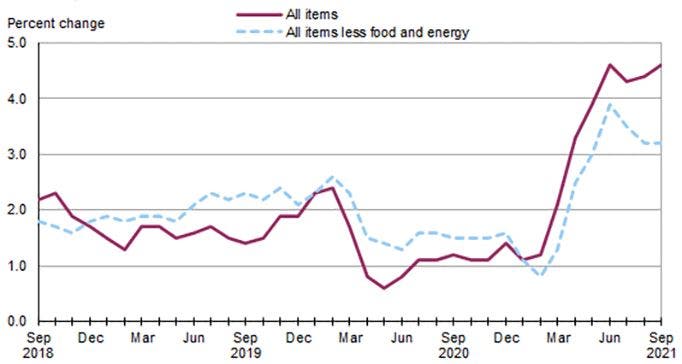
Over the last 12 months, the Northeast All Items CPI-U increased 4.6 percent, about where it has been since June, as it has ranged from 4.3 to 4.6 percent, compared with 0.8 to 1.2 percent between June and September 2020. All items other than food and energy increased 3.2 percent and the energy index jumped 24.3 percent—the index's largest over-the-year advance since August 2008. The food index also advanced over the year, up 4.1 percent – that index's largest 12-month increase since January 2009.
Food prices increased 0.9 percent in September following a 0.6 percent increase in August. Of the two components within the food index, prices for food at home (groceries) rose 0.9 percent and prices for food away from home (restaurant, cafeteria, and vending purchases) increased 1.0 percent over the month. Within the food at home group, categories experiencing increases included nonfrozen noncarbonated juices and drinks as well as the fresh biscuits, rolls, muffins group. Prices were lower for candy and chewing gum as well as pork chops.
From September 2020 to September 2021, the food index increased 4.1 percent, the highest 12-month change since January 2012. Grocery food prices rose 3.1 percent over the year and prices for food away from home increased sharply to 5.4 percent, its largest such increase since 1989. The cost of alcoholic beverages rose 1.9 percent during the same period. Over the last 2 years, the 12-month increase ranged from 3.0 to 4.6 percent while it ranged from just 2.2 to 3.1 percent between September 2017 and September 2019, according to the Bureau of Labor Statistics.
The energy index rose 1.1 percent in September led by an increase in the index for gasoline (1.1 percent). Prices also rose for utility gas service, up 2.5 percent, while those for electricity were unchanged over the month.
On an annual basis, the Northeast energy index recorded a 24.3-percent increase, its highest over-the-year rise in 13 years. Over the year, the index for gasoline jumped 40.9 percent. Prices for utility gas service and electricity also increased, up 17.2 and 6.7 percent, respectively.
Get more local news delivered straight to your inbox. Sign up for free Patch newsletters and alerts.