Community Corner
Alden M. Young's Profession Was...
Before coming to Pine Orchard, Alden M. Young had a successful career as a businessman – in a field that had a great impact on his summer home.
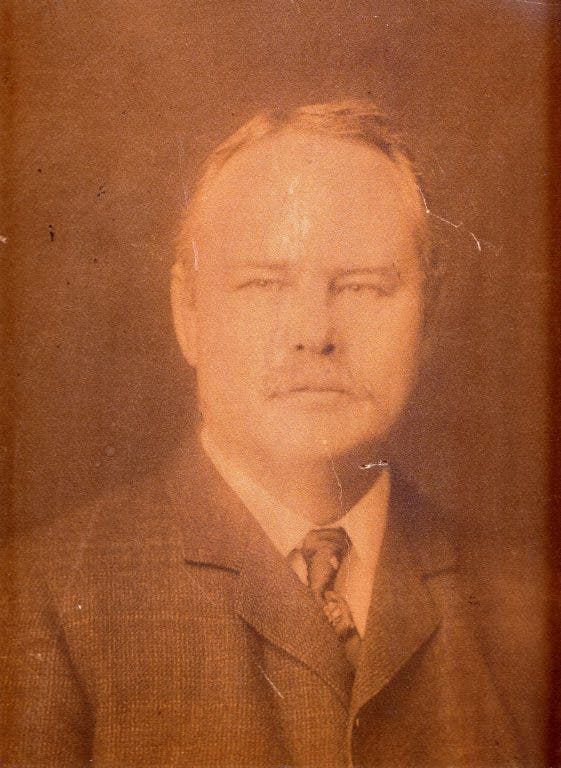


As reader Wayne Cooke said, "it would be probably easier to list what the man DIDN'T do."
The simplest answer to our question is that Mr. Young worked in the utilities industry. But that really only scratches the surface, particularly given how important a role he played in that industry. In an profile for A Modern History of New Haven and Eastern New Haven County, Everett Gleason Hill wrote that few businessmen made a greater impact on popularizing electricity in Connecticut and the northeast than Alden Young. The New Haven Saturday Chronicle called him "one of the most prominent businessmen of Connecticut."
Young was born in Hadley, New York, in 1853. His father wanted him to become a doctor, and though Young made an effort to study medicine, he found he was much better suited to business – particularly the business of electricity. His first job was with the Western Union Telegraph Company in Syracuse. He became so good at the telegraph that he was assigned to the stock exchange in Buffalo. After being offered a job with Atlantic and Pacific Telegraph Company, he moved to New York, then returned to Buffalo to become a manager there – a position he earned before he was 25 years old.
Find out what's happening in Branfordfor free with the latest updates from Patch.
In 1878, Young made the move from New York to Connecticut, becoming the superintendent and manager of the Waterbury Automatic Signal Telegraph Company. Though he did worked on developments in the new technology of the telephone, Young was primarily interested in electric lighting and power. In various positions at companies in Waterbury, he encouraged the creation of a power plant and the stringing of electric wire, bringing electric light and power to Waterbury in 1893. He was responsible for electrifying the Derby Street Railway, making him the first businessman in Connecticut to use electricity for street railway cars.
Despite what we might imagine now, introducing electricity wasn't always easy. He faced opposition from the steam power industry when he tried to bring an electric rail to New Haven. He also worked to make bringing electricity to people more efficient by consolidating companies. To that end, he created the Connecticut Railway and Lighting Company, which bought out several other, smaller companies throughout the state and turned them into a major company. Eventually, Young's efforts, served not only Connecituct, but New York, New Jersey, and even Ohio. To supplement his work in electricity, Young was also involved with the National Carbon Company, the New England Engineering company, a cement company, and two real estate companies. He was also an inventor, and he patented an electric battery in 1885.
Find out what's happening in Branfordfor free with the latest updates from Patch.
Once his business interests had spread that dramatically, he began spending his winters in New York and his summers in Pine Orchard. Though he only spent half the year there, he was known to have considered Pine Orchard home. In 1893, the same year he helped bring electric power to Waterbury, Young purchased property at Crescent Bluff and built a 21 room, 10 bath, 10 fireplace summer home called "The Anchorage." (It was torn down in 1948, but Anchorage Road retains its name.) He brought electricity, gas, water, and the trolley to Pine Orchard – along with founding the , building seawalls, maintaining , and generally improving the quality of life in Branford.
Young was credited as a visionary and a brilliant and influential businessman – as well as a man who was dedicated to his friends, family, and his community. He died on December 3, 1911, at the age of 58.