Community Corner
A Laborer's View at Malleable Iron Fittings (M.I.F.)
After 31 years at the Branford Lock Works, Llewellyn Barker found himself out of work. SEE MULTIPLE PHOTOS


The following content is from Ted Braun's book "The Barkers of Branford: Life in America Through A Local Lens". Details at www.BarkersOfBranford.com
Llewellyn Barker labored at the Branford Lock Works from the age of fifteen in 1866 until it closed down in June of 1902. He states in his diary, “Lock Shop closed tonight with a long blown whistle and sadness…“This is my last day… finishing a term of 31 years and 8 months, practically continuous service.”.
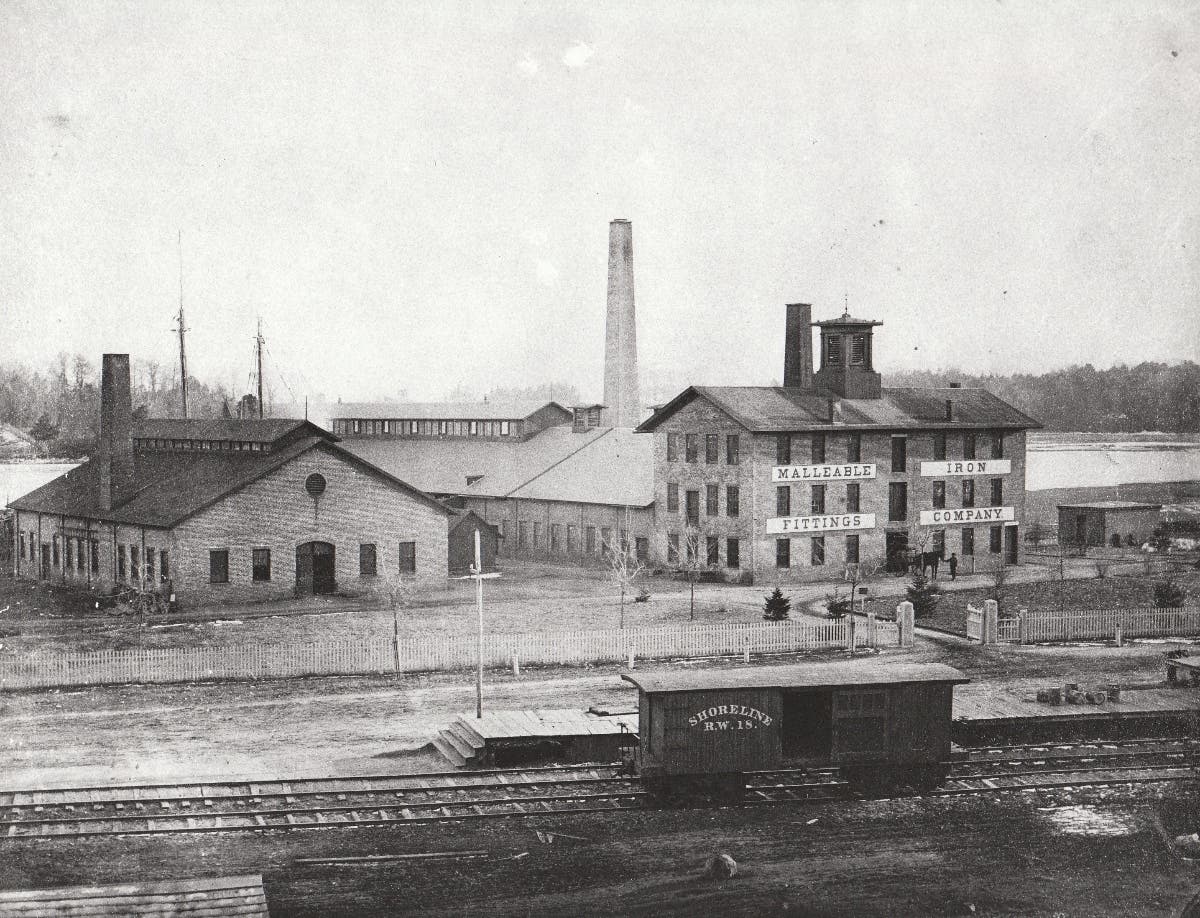
Then fifty-two and in need of a job, he called on a former schoolmate. "I went up to see Alfred Hammer to get a job." Alfred was the son of the founder of Malleable Iron Fittings, (M.I.F.), a major Branford industry. It produced pipefittings for many applications. At its peak it employed over 1,000 people. Only a few weeks after his last day at the Lock Works, he “commenced to work down to the M.I.F. Co. It is a long walk for me." The MIF plant was on the opposite side of town along the Branford River where currently is located the Stony Creek Brewery and Nellie Greens.
Find out what's happening in Branfordfor free with the latest updates from Patch.
At M.I.F he worked on “a big turret lathe." which he described the "Mankiller”. Getting used to the new machinery provided him some challenges. "Spoiled a set of dies with hard fitting. Had a hell of a time generally.” He penned this insight,“Anger destroyeth the foolish man but gentleness buildeth up the meek."
Fortunately for him perhaps, less then a year later he got off the "mankiller" and moved to another department. "This is my first day working in the Pattern room at the MIF Co shop." The pattern shop produced replicas of the item to be forged. Molds were created from the pattern. Molten metal was poured into the mold's cavity to reproduce the pattern. It was difficult, exacting work and patterns often wore down and needed replacement. Llewellyn was “regating pattern for Livermore.” The “gate” was where the molten metal entered the mold cavity. He reported his progress. “It took me 15 hours to do the first one and 10 1/2 hours to do the second one."
Find out what's happening in Branfordfor free with the latest updates from Patch.
He had a strong opinion when "Mr Jim Farnham was layed off because he was too old. I would like to have my hands on Noack for a little while". Llewellyn continued to work at M.I.F. as long as he could. On his last day of work in 1931 he wrote that he “road down to the shop with Martha (his daughter) who brought home my tools from the pattern room. They don’t want Old men”.
Llewellyn was eighty-one when he met Jim Farnham’s fate in 1931. Combined with his previous work at the Lock Works, he had labored for sixty-two years. He had no choice. There was no pension. There was no Social Security until four months after his death in 1937.
_ _ _ _ _ _ _ _ _ _ _ _
Ted Braun's book "The Barkers of Branford: Life in America Through a Local Lens" is available for $30 at the Blackstone Library in Branford. Details at www.BarkersOfBranford.com