Community Corner
Thin Blue Lie: Former Branford Cop, FBI Whistleblower's New Book
"The Thin Blue Lie: An Honest Cop vs. The FBI" is Greg Dillon's account of what happened after he disclosed FBI misconduct.


BRANFORD, CT — Before joining the FBI in 1985, Greg Dillion had been a Branford cop. He was hired as a supernumerary officer after graduating from the University of New Haven in 1978 and spent three years working mostly weekends, he said, until being hired as a full time officer in 1981.
"I enjoyed my time at the Branford Police Department and am still friends with several of the officers I worked with," Dillon, who lives in North Haven, told Patch. "It was great preparation for my eventually becoming an FBI agent in 1985."
Dillon would end up being a whistleblower, disclosing FBI misconduct.
Find out what's happening in Branfordfor free with the latest updates from Patch.
Once he went to the FBI, he was assigned to the Criminal Reactive Squad in Virginia and was then a member of the Violent Crime Squad in Washington, D.C.
In 1990, he returned to Connecticut when he was hired as an inspector for the Connecticut office of the Chief State’s Attorney in 1990.
Find out what's happening in Branfordfor free with the latest updates from Patch.
Assigned to an FBI fugitive task force, Dillon said he discovered that fellow FBI agents were "falsifying affidavits and attributing the false information to Dillon," as well as two investigators he supervised.
Dillon, "realizing the mistakes were intentional and ongoing," told his boss, then Chief State's Attorney John “Jack” Bailey, Jr.
That's when things took a 180.
An honest cop versus the FBI
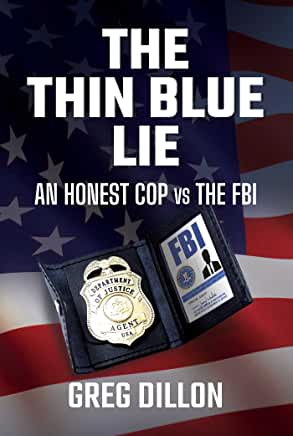
In his just-published book, "The Thin Blue Lie: An Honest Cop vs. The FBI," whistleblower Dillon shares his story.
Dillon said that after he reported that FBI agents "were submitting falsified arrest warrants to federal judges, and that the 'enhanced' probable cause was attributed to me and the other two inspectors," he told Bailey.
And he had the evidence of the agents' misconduct, he said.
"We were ordered in writing to not discuss our concerns with anyone, and told if we were to speak with the media, we would have to first resign," Dillon said.
After being dumped from the task force, demoted, transferred and denied another post, he said he began receiving "harassing anonymous telephone calls at my home and at work."
Shocked by the "lack of accountability and unfair treatment," he filed a federal civil action against Bailey in 1998, and after Bailey retired, subsequent Chief State's Attorney Christopher Morano in 2007.
Dillon told Patch that the harassment he endured "actually came from both Chief State’s Attorneys, ironically."
The trial, described as "contentious," included testimony from forensic scientist Dr. Henry Lee, founder of the University of New Haven's Henry C. Lee Institute of Forensic Science. And, as he's referred to by Dillon, "the most famous police whistleblower of all time, former New York City detective Frank Serpico."
Dillon ended up with a courtroom victory in his suit against Bailey, one he called a "landmark decision," but filed a second one against Morano for "retaliation stemming from the original lawsuit. "
The whistleblower's motivation
Dillon said he became a whistleblower, and wrote his book chronicling the fallout, because he believes in honesty, and integrity, he said.
“If I come across as bitter at times during this account in The Thin Blue Lie, it is because I still am,” Dillon is quoted as saying in a news release about his book. "If you are like me, you may believe your honesty will be fairly received, only to learn you are now the problem. It did not go the way I expected. Not by a long shot. When I look back, I don’t regret my actions, but I do lament the consequences of the reactions to my actions."
Dillon said his book is "sometimes brutally blunt," but was written from his heart and importantly, it's "accurate."
"And that is the beauty of the truth: it was true thirty years ago, is still true, and will be thirty years from now,” he said.
Ten percent of book sales go to Shepherds Mentors
Dillon is on the board of Bridgeport-based Shepherds Mentors, a nondenominational, nonprofit organization that assists inner-city high school students by providing an adult mentor, academic and life skills, and financial support for a college preparatory education.
He joined Shepherds in 2002 and is currently mentoring his ninth student, scheduled to graduate this May with high honors. Shepherds currently works with two schools, he said, "my alma mater" Notre Dame of West Haven, and Kolbe Cathedral in Bridgeport.
He said that the non-profit not only provides financial support to families that would not be able to send their child to a college preparatory private high school.
"We match the student with a mentor for their 4-year term. We find this critical to the academic success and social growth of the 'mentee.' The mentor is there to support their student, monitor their progress, and expand their horizons by engaging with their student outside of school."
Dillon quoted Wayne Dyer in an email to Patch to illustrate his philosophy on giving back.
“'The more you give away, the more you get back,'" he wrote. "And that is certainly true with Shepherds. If I did not feel that way, I would not have stayed on for 20 years. Ten percent of my book profits will be donated to Shepherds."
"The Thin Blue Lie: An Honest Cop vs. The FBI" was published last month and can be purchased through Dillon's website here.
Get more local news delivered straight to your inbox. Sign up for free Patch newsletters and alerts.