Business & Tech
A.J. Tuck Co.: 'Job Shop' with Tiffany Roots
Tucked away — yes, it really is — near Four Corners, the A.J. Tuck Co. does modern engineering in a seemingly old-fashioned way. You won't see its products in stores... but you use them everyday, nonetheless.


When Alvin Tuck, IV, starts talking about his grandfather's long-gone factory building, which was located just north of Four Corners, you're drawn back into the early years of the 20th Century. Grandfather Tuck bought the old Lenox Shear Factory, which had a log dam on the Still River, in the 1920s, and installed a turbine and generators so he could produce his own electricity. In 1936 the dam washed away, so he put in a concrete dam, still standing today. To build his house he imported wood from Long Island, and brought it in by train rather than patronizing a Brookfield lumberyard operating next door, because he got a better price. The company didn't have a phone until 1960, because the founder of A.J. Tuck Co. didn't think it necessary — doing business via letter, or in person, was just fine.
"It was a neat old factory," says the grey-haired grandson, himself nearing retirement age. "I can still hear the slap of the belts that drove the machines, it's ingrained in me." Adds his sister and co-owner Lois Hunt [my neighbor on Obtuse Road North] from her desk at the business at 32 Tuck Road, "The place was alive!"
Don't let the nostalgia fool you. The Tuck company may be small, its setting rustic, its buildings modest, but it makes very modern devices that affect your life every day. Ever use a cell phone, a television, a GPS? Tuck makes many of the waveguides — devices that direct electromagnetic waves — inside communication satellites. Ever had an MRI or CT scan? Chances are the machine uses a capacitor electroformed by Tuck.
Find out what's happening in Brookfieldfor free with the latest updates from Patch.
Ever marvel at the ability of unmanned aircraft to pinpoint terrorist targets in Afghanistan? "Every Predator aircraft has our part in it," says Tuck proudly, "and all the helicopters in Iraq and Afghanistan have our radiation shields" (which eliminate interference in infrared sighting and imaging systems). Tuck parts are also in Lockheed, Raytheon and Northrop Grumman aircraft and missiles, which tells you that Tuck, despite appearances, "plays with the Big Boys."
Although Connecticut has been known for defense work since 1801, when Eli Whitney convinced president-elect Thomas Jefferson he could
Find out what's happening in Brookfieldfor free with the latest updates from Patch.
mass-manufacture muskets using interchangeable parts, Tuck's presence in Brookfield is almost coincidental. Alvin Tuck, Sr., was more artist than businessman: near the turn of the last century, he made lamps for Tiffany & Co., probably the company's most famous product. No doubt chafing at having to implement others' designs, Tuck Sr. started his own company in Flushing, Queens, in 1914. He hired a German craftsman who knew "electroforming" (essentially electroplating), by then a well-known reproduction process, but more expensive than Tiffany's typical technique of casting lamp bases in bronze. He ended up in Brookfield because, like the other small manufacturers that gravitated toward the Danbury area (Lenox Shear, for example, and so many hat makers), access to water-power gave him independence.
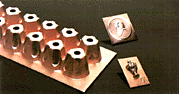
Tuck — himself an art-school graduate, and once an assistant art director in a Manhattan advertising shop — shows off some of his grandfather's original lamp-base molds, and they are intricate and flowery, very much in the Art Nouveau style. And the intricacy lent itself to electroplating because, as Tuck puts it, "it's the most accurate way in the world to reproduce something, because there's no shrinkage or distortion — you get all the internal cavities and surface details." Why? Because — unlike casting, forging, stamping, deep-drawing, basic machining, and so on — it can be controlled on the molecular level. Forms and "mandrels" of the object to be duplicated are immersed in various electrically charged baths, with the form slowly "plated," molecule by molecule, with copper, nickel, and sometimes gold. (For you "techies," I quote the Tuck website: "The positively charged electroformed metal source (anode)...is broken down (ionized) in the copper electrolyte solution and is attracted to the negative charged mandrel (cathode). Build-up is achieved over all mandrel surfaces at an approximate deposition rate of .001" per hour.")
And it's defense work — perhaps 80 percent of Tuck's business — that will ensure its longevity. Tuck notes there are two other electroform companies in the area — in Danbury and Bethel — but probably no more than 20 around the country, and only five, perhaps, compete with A.J. Tuck Co. And "offshoring"? International competition? Not likely: though scores of electroformers have started up in China, for example, national security issues ensure that Defense Department contracts remain in the U.S. Moreover, says Tuck, the experience, and sophisticated understanding of the electroforming process, just isn't present in most foreign manufacturers. Look over some of the mechanical schematics for the products Tuck makes, and you'll know why: the "how" of creating a mandrel, or form, is as complex an engineering process as the design of the end-product itself.
"I could do this from anywhere," says Tuck, "but I like it here." Many of his 29 employees have been with the company 20, 30 years; he owns the company with his sister; and New England is known for its precision engineering, for being, in Tuck's words, "a machine-shop, craft-y kind of place." He calls A.J. Tuck Co. a "broad job-shop," but don't believe it; it's a bit of history, a company that, against the odds, has managed to evolve with the times.