Business & Tech
David & Goliath, Continued
A local man wants to revolutionize the energy business by bringing to market a power generator that "multiplies" inputs. Yes, it breaks the laws of thermodynamics... but Fred Ball says those laws, in this instance, don't apply.
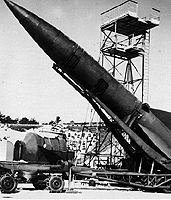


Brookfield's Fred Ball likes to talk about scientist and inventor Robert Goddard... but doesn't want to end up in the same boat. In 1920, the New York Times ridiculed Goddard for his belief that rockets could be sent into space. "Goddard," an editorialist wrote, "seems to lack the knowledge ladled out daily in high schools," and effectively "den[ied] a fundamental law of dynamics..."
Goddard launched his first rocket six years later, 33 more rockets over the next 15 years, and after his death would be recognized as the "father of modern rocketry." NASA's Goddard Space Flight Center is named after him, though the U.S. Government did little to support his research... and quite possibly stole it, as evidenced by the $1 million paid to Goddard's estate, 15 years after his death, for patent infringement.
Ball thinks he's onto an idea as revolutionary as Goddard's, and of even greater significance, because — if the technology proves out — it could solve the world's energy problems. But he's running into significant resistance, as it sounds, well... far-fetched.
Find out what's happening in Brookfieldfor free with the latest updates from Patch.
"I understand the skepticism," says Ball, "because it doesn't make sense if you're looking at our concept as a thermodynamic process — it isn't one. Man has been using thermodynamic processes since we were cavemen, from steam power to nuclear power. Our technique is different, it's a multiplier of inputs that results in ultra-high efficient use of input energy while providing high energy output — it's a new paradigm."
So how does it work? Glad you asked... and I can't say, and neither can Fred, because it's hush-hush for both business and scientific-complexity reasons. Like Goddard, Ball and his partners at Independent Energy worry about media ridicule and intellectual thievery — Goddard often worked alone to avoid seeing his research sensationalized and to thwart competitors (he believed the scientists responsible for Germany's World War II V-2 rocket somehow "stole" his ideas). But Ball — whose expertise is in marketing, the "tech" side is based in South Carolina — says the "Power-6 Generator" is basically five distinct "energy-conserving technologies," set in a frictionless "black box," that harness mechanical advantage, magnetism and centripetal force.
Find out what's happening in Brookfieldfor free with the latest updates from Patch.
"You know the David and Goliath story," says Ball. "He killed Goliath with a marble, by using the power of acceleration. We're capturing centripetal force and using it to add to the equation — which no one has done before."
Ball and his colleagues now want to build a working model of the device, but as with Goddard, funding has proved an uphill battle (Goddard found his "angel" in the Guggenheim family). "I've written Ted Turner, Al Gore, Bill Gates, a lot of major players," Ball says, but so far, without success — he guesses the company's project gets stuck in the "thermodynamics" category, where it looks impossible. Without such pigeon-holing, Ball thinks the Independent Energy device has a future. "People who really look into this sign on," he says, noting that one Connecticut man, initially skeptical when his son took an engineering internship with the company, ended up investing $5,000.
The next step? Entering General Electric's Ecomagination Challenge, an online "bake off" in which companies and individuals compete to get energy-system ideas validated, and possibly funded. "We'd love to win that," says Ball, noting that the contest (in which the public can vote, "American Idol"-style) ends September 30. "And we'd be thrilled to get GE involved."
As Goddard would have been, back in the day... but rocketry didn't take off until after his death in 1945, and the V-2 had shown that space travel was within man's grasp. In 1969, after Apollo 11 was launched, the New York Times published a "Correction" to its 1920 editorial, noting that both Issac Newton and Robert Goddard were right in saying "a rocket can function in a vacuum as well as in an atmosphere. The Times regrets the error."