Community Corner
Let's Get Stonewalled: If These Stone Walls Could Talk
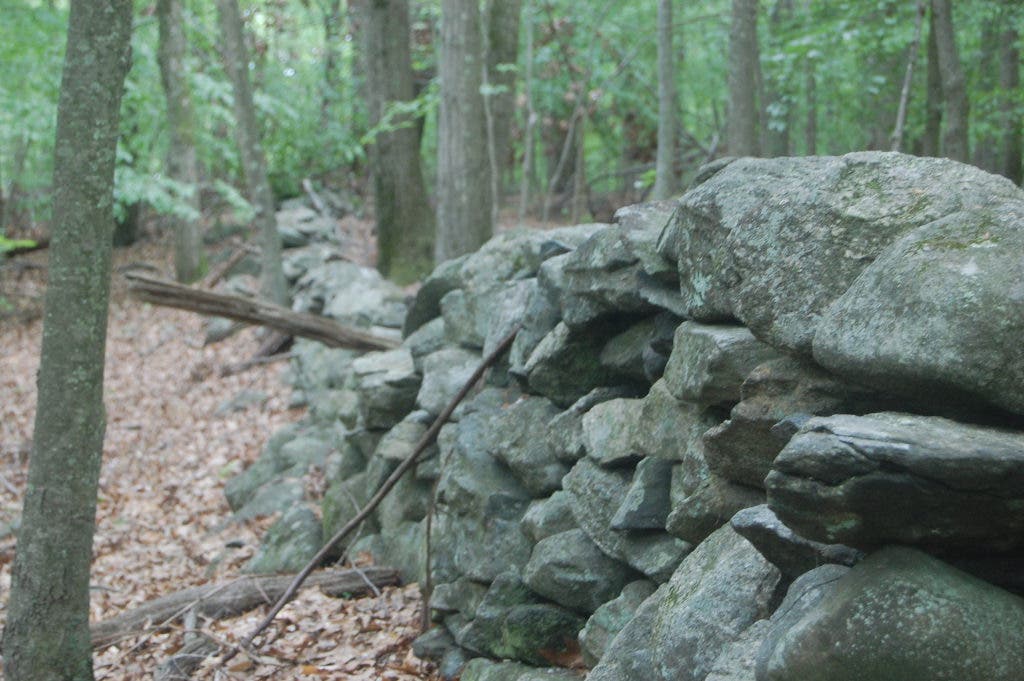
What secrets do Connecticut's stone walls hold? Did our Colonists hide behind these walls fighting Redcoats?


"The universe is full of magical things,
Patiently waiting for our wits
To grow stronger."
Eden Phillips
A stone wall found in the woods, a meadow, or along a road is one of these simple yet magical things. Go anywhere else in this country and most often a stone wall is merely an entity used in landscaping , erected most frequently by professional stone masons. In New England, however, these fences of stone are a secondary creation compelled by the demand for tillable farmland.
I am convinced that many individuals survey these loosely constructed barriers in bewilderment speculating why a person would take the time and huge effort to erect such an outwardly impractical structure in the middle of the forest. Who would ever appreciate the handiwork and what purpose could it possibly serve?
Find out what's happening in Brookfieldfor free with the latest updates from Patch.
One needs only to look back to the early to mid-17th century to fathom the origin of such drudgery. Early settlers in the New England and Northeastern New York colonies found it impractical and unfeasible to rely on shipment of produce and dairy from Europe or even the other colonies. These resilient "yankees" needed to grow their own food and raise their own meat and dairy producing animals.
Therefore there was a considerable demand for farmland. The Northeast area, however, was mostly old growth forest at this time. This triggered an urgent necessity to clear the land.
Find out what's happening in Brookfieldfor free with the latest updates from Patch.
As individuals and families cleared and laid claim to acreage, the inevitable disagreements and conflicts over property boundaries and keeping one's livestock off of adjacent property arose. By 1650 many of the colonies passed legislation mandating farmers to build 4-5 foot barriers indicating his or her property lines. Towns even employed "fence viewers" to enforce these laws.
By the mid-18th century up to 70 percent of the land had been cleared. With this rapid deforestation erosion became the new glitch. Erosion led to deeper and deeper frosts which in turn led to more and larger frosts heaves.
These frost heaves generated huge quantities of stones to the surface. Thus came the "golden age of stone walls" in New England, often dated from 1775-1825 (Stone to Stone, Robert Thorson).
Plowed fields were littered with stones from golf ball size to basketball size. With the fencing mandate still in effect, property owners realized stone (free for the "harvesting") to be much more economical than wood for these fences. Not until the completion of the Erie Canal did this frenzied building of stone walls subside.
The opening of the canal allowed for cheap transportation of produce from the huge farms of the Midwest. This let New Englanders pursue other interests and vocations and many ceased their farming all together. Through time, these farmlands have gradually converted back to forests hiding the stone fences among the trees.
I often find myself daydreaming as I hike our local new growth forests envisioning our ancestors hauling stone after stone out of their fields, piling them to create these once useful barriers. It is difficult to picture crops growing when the heavily canopied land now sits covered with wild plants and flowers and rotting branches and trunks of the fallen giants. The walls take on many sizes and lengths.
Some are straight as if engineered. Some gently curve around a slope or zig zag randomly for no apparent reason. Some are very precisely constructed as if built by a master mason with each stone occupying its specific space in the wall fitting perfectly with its neighboring rock. Other walls seem to be an agitated mixture of stones of varied size and shape held upright only by will power.
I have experienced walls connected and intersected, knowing that each segment was built by a different character because of the varied methods of construction. One was obviously done in haste, the builder simply ridding his fields of these New England potatoes, the other, a work of art, the farmland of this builder simply a supply source of material for his creation. I have located walls where I straddled the rocks and watched the wall disappear far in the distance through the trees seeming to run into the next state without interruption.
Take a moment to observe the individual members of these elongated piles of rocks. Note the different types of stones collected and how they rest upon one another; how they hold each other up.
I speculate if removal of one key stone would cause the wall to collapse as a row of dominoes would. Then consider the spaces between its members, and imagine the homes that exist within. A space may be a fox den or a squirrel or chipmunk nest. Down deep could be the cave of a turtle or even a bee's nest. This cool, damp environment is perfect for snakes. Be aware, however, if the smell of cucumber is present. This is a sure sign of a resident copperhead.
However you look at this almost natural barrier (unnatural only because it is human made) always remember its history.
That wall may very well have been protection for a small band of Colonial soldiers sniping at several Redcoats during the Revolutionary War.
It could have been the barrier between two territories. It may have survived numerous hurricanes and the blizzard of '88.
It could have been the resting place for the in the late 1800s.
It could have been built by John Adams or one of your ancestors.
And for this historical connection we need to protect these walls of stone from the indifferent dismantling during construction of new housing on undeveloped land.
Accordingly next time you wander into any of our forests, have fun envisioning the lives and events that transpired 200 years ago on that very location where you rest on an innocuous pile of rocks. Let those rocks talk to you and whisper their secrets, share their lives. Then just smile and say "I hear you".
If you are interested in more reading about these walls of stone try:
"Stone by Stone: The Magnificent History in New England Stone Walls" by Robert M. Thorson