Arts & Entertainment
The voice of Manhattan and Stratford
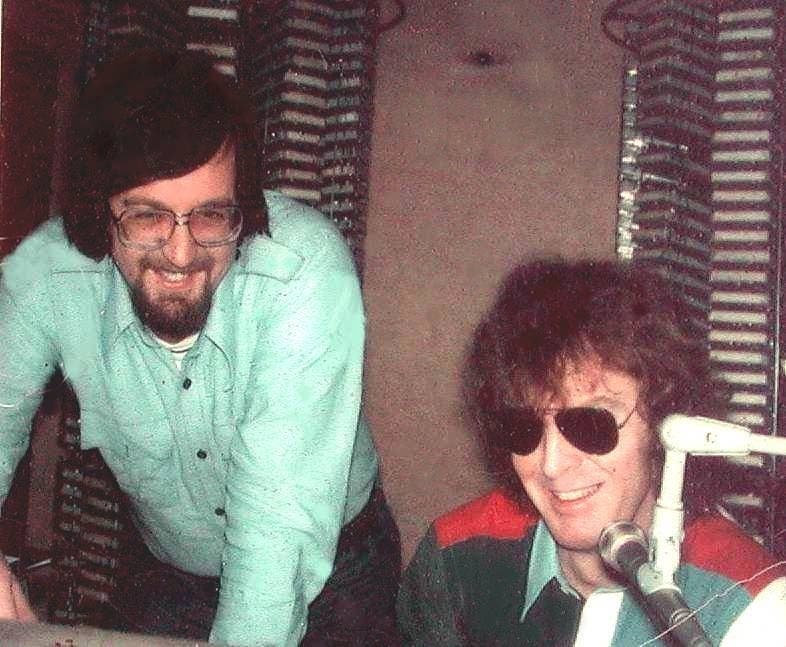
Once a part-time air personality at Hartford's Big D, Bill Rock is now heard around the globe on television and radio



By Scott Benjamin
Shouldn’t Bill Rock be as much a part of Manhattan as the Port Authority bus station or the Empire State Building?
After all, he spent high school and college in northern New Jersey and developed an interest in working in the media capital across the Hudson River.
Find out what's happening in Brookfieldfor free with the latest updates from Patch.
No less of an authority than the admired Charlie Parker – the WDRC, Hartford program director - once told him he was destined for the Big Apple.
Lo and behold, Rock became an air personality and then the program director at 66 on the AM dial in Gotham, when it played the Bee Gees and K.C. & The Sunshine Band and was known as WNBC and not WFAN
Find out what's happening in Brookfieldfor free with the latest updates from Patch.
Thus, for a short time he was Don Imus’ and Cousin Brucie’s boss.
Rock was the “dedicated announcer” for John R. Gambling’s WOR show.
And he was the announcer for a raft of NBC News broadcasts, including winning the sweepstakes against an all-star line-up to get the gig at “Nightly News.”
Rock now voices the sponsorship billboards for NBC entertainment shows and is the announcer for a number of radio specials.
Heck, he once was known as Radio City Bill.
However, Rock was doing work from home before Zoom was part of the vocabulary.
And home is in the Land of Steady Habits, near Long Island Sound. He spends so much time in that home studio and doing volunteer work in the town that you could call him Stratford Bill.
Rock has served on and chaired the local Waterfront and Harbor Management Commission over 23 years. He helped get the river dredged for the first time in 40 years. He also has served on the commission that produced Stratford’s 10-year plan of Conservation & Development and on the Long Island Sound Assembly Council.
As a 5 year old he lived in Bloomfield, across from the WDRC tower. And it would be at Hartford’s “Big D” that he would get his initial break.
Rock - then 19, and a student working at WSOU-FM, the Seton Hall campus station- arrived at WDRC on Main Street in Hartford with his audition tape one day for an appointment with Parker, who was busy. Parker exited his office at 11 p.m. and saw that Rock was still sitting in the lobby.
He said that Parker took “a liking” to him. The Big D has a distinct sound and Rock provided an audition tape to Parker that showed that he could capture it. He worked weekends and relief shifts in 1968.
In a phone interview with Patch.com, Rock said of Parker, “He was very creative and excellent at production. He also was able to recruit talented people.” Parker was noted for developing a friendly rapport with his staff.
Jim Nettleton, who worked at WDRC in the mid-1960s and later was an air personality at Musicradio77 WABC during its heyday, told Musicradio77.com in 2004 that Parker created contests that were copied across the country.
Rock said that Claude Hall, who wrote the radio column for Billboard magazine, stated that Parker “could have worked in any major market in America. He was the best-kept secret in the industry.”
Rock said that after working in the mid-1970s in Pittsburgh Cleveland, and Boston I thought I’d like to come back to Connecticut so I went to see him; He looked at me and smiled. Then he said quote “you’re too good for Hartford. I'll have you for few months and you'll leave me for New York". He was very humble, I laughed and within 2 months I received a call from WNBC in New York and was hired that same day.”
In 2003 Rock became the imaging voice on the WDRC sounders and promos, which he did for many years.
In the early 1970s, to some listeners, Imus In The Morning sounded subversive. Imus was criticized for his racial humor.
The station aired a television commercial in which it asked, “Did you hear what he said this morning?” Imus did segments featuring the Rev. Billy Sol Hargis and imitated David Brinkley in his Imus In Washington newscasts.
“Imus was the original shock jock,” said Rock. “If you didn’t know him, he might have been misunderstood. He wasn’t a bigot. He was a good person.”
He had such a rapport with Imus that he produced the radio promo for one of his comedy albums and at the request of his friend - Connecticut School of Broadcasting President Dick Robinson - persuaded Imus to give a talk to one of the classes at the school.
Is he surprised that Imus transformed into a broadcaster who interviewed U.S. senators and television news reporters? That in 1992 Lowell Weicker made Imus Connecticut’s governor for a day?
“Somewhat,” Rock said.
However, he added, when Imus was hired a second time at WNBC in 1979 he told him that the “topical political humor that he was doing was the key to his rebirth. [WFAN] picked up on that too. Besides Imus had great marque value and they needed something more than just sports in the morning. He also had loyal advertisers. As he put it "I carried the station"
ESPN.com reporter Rich Coutinho wrote in his 2017 book, “Press Box Revolution,” (Sports Publishing, 259 pages), that, “In all honesty, had Imus not arrived in 1988 I am not sure we’d be talking about how successful WFAN became. He bridged the sports fanatic with the casual sports fan in a way that no other person was capable of doing.”
In 1981 Rock gave up his position as the vice president of programming for a chain of eight radio stations and decided to get behind the microphone by building an audio studio at his Stratford home and establishing his own production company doing radio commercials, slide show narrations and voice-overs for television. He has won “a bunch” of television production awards.
Through the years, the studio was modernized. In the late 1980s, he installed Integrated Services Digital Network (ISDN) and in the 1990s bought Telos Zephyr that transmitted studio quality sound. After he started doing the voice-overs for NBC News productions he introduced the news division to ISDN and was the first “to do remote announcer connected studio to studio recording, which saved 20 hours a week in commuting.” Around 2005, broadband allowed him to do his four Sirius/XM satellite radio shows from his home studio.
He also is one of the few voice-over announcers who writes some of his own material.
Rock explained, “When people signed on my production company they were buying me. In many cases like corporate video I would hire writers and any other professional in certain specific cases. When I did ad agency work they did the writing. If I worked directly with a client I often wrote but consulted with their experts for facts and technical info .When I produced my TV shows they were my creation that I sold to advertisers as a finished product. When I do voice work for NBC I just read their copy. “
Rock – an avid Elvis Presley fan – was the first voice heard on the Sirius/XM satellite channel dedicated to the King.
Why was Presley so popular?
“His stage presence left an impression,” Rock said. “He also had such a vast catalog of recordings. He could do pop, rock, country and rockabilly.”