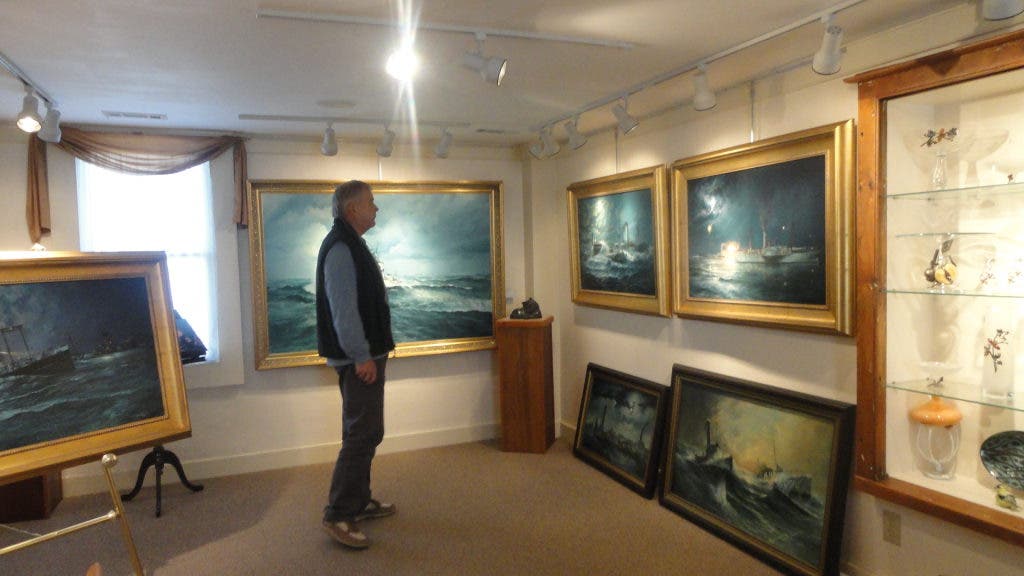


It's been 11 years of long hours and hard work for M. Sarba Fine Art Cafe owners Marek and Barbara Sarba.
"Marek wants to paint and concentrate 100 percent on his work," said Barbara Sarba. "Since the cafe is a 24-hour job, we have decided to close."
Find out what's happening in Clintonfor free with the latest updates from Patch.
It has been a wonderful adventure for the two who came to the United States from Poland in 1981.
"We will not miss the work but we will miss the customers," said Sarba as she and her husband prepare to the close the gallery and cafe they created.
Find out what's happening in Clintonfor free with the latest updates from Patch.
They purchased the 4,000 square foot building at 95 East Main Street in 2000 and performed an extensive renovation. The building, built in 1807, is for sale for interested buyers. Please contact the Sarba's directly at 860-395-0029.
Barbara Sarba said everything is for sale including the kitchen equipment, tables, chairs, jewelry, and of course the art. Certain items are deeply discounted (not the art).
They will be open on Fridays, Saturday, and Sundays, 9am to 3pm for all of June for the clearance sale.
The Sarba's journey:
Did you know that the Sarba's and their two young daughters crossed the Atlantic Ocean in 1981 on a bulk carrier, landing in a completely strange country, unable to speak the language, with just a few suitcases of clothes?
Not many of us can say we have experienced a journey as such, but Barbara and Marek Sarba certainly can relate – it was their life.
The couple, who immigrated to the United States from Poland in 1981, now live in Old Saybrook.
Their journey from the Baltic Coast, to Pennsylvania, to Florida, and on to Connecticut, is a fascinating story of courage, determination, and the desire for freedom.
Barbara grew up in Gdynia, Poland, along the Baltic coastline. Through its location on the sea, the city was an important port for Poland, as well as the hub of maritime industry.
Her father was an officer in the Merchant Marine. Barbara’s uncle was a high-ranked naval officer, who, when she was in her late teens, organized a small party on one of his ships. It was there she met her future husband, Marek, a native of Poland like herself.
Marek was born on Christmas Day in Warsaw, a large and tough city of 200,000 residents at the time.
His father was a railroad engineer, his mother worked in a hydraulic press factory. The time was post World War II where having food on the table was everyone’s priority.
As a child, Marek liked to draw. Not unusual for many children, but unusual for Marek because he was born with an incredible gift – an artistic gift. But art would have to wait for the time being. Marek, like many young Polish men, entered the Navy at age 19, and thus began a long career in the overhauling of ocean liners and ships.
The couple’s two daughters were born in Poland. Katarzyna now lives in St. Petersburg, Florida with her family; Joanna lives in South Carolina with her family.
In 1981, times were tough in Poland. The political system dictated what you could buy, where you could live, what you could eat.
“My husband could not display his art because he was not classified at an artist,” says Barbara. “Because of this, we couldn’t buy brushes or paint.”
The Sarba’s then made one of the most important decisions of their life – to escape the political restrictions in Poland and come to America, the land of freedom.
“We quietly sold our home, our belongings, our car,” remembers Barbara. “We had a very good life, we owned our home and a car, and had nice things.”
They practically gave everything away.
Marek, who was an officer on a bulk carrier ship, was able to board his family on the ship, which was headed to Erie, Pennsylvania.
“The four of us walked off that ship and into a brand new life, knowing nothing,” says Marek.
The next night, they boarded a Greyhound bus headed to Tampa, Florida.
“We wanted to get away as far as possible from the ship,” states Marek.
When they arrived in Tampa, they began the slow, but gratifying process of acclimating themselves into life as an American family.
The girls, age 11 and 13, at the time, attended Catholic School. Marek went to the immigration department and received a work permit and temporary green card. He worked for a month for a construction company, then found work in what he knew best, at a shipyard overhauling boats.
“I couldn’t speak English, but I could read a blueprint,” says Marek. “I would point to an area on the blueprint and look at one of my guys and nod. They knew what I meant – that’s the area that needed to be worked on.”
Marek, who at 25 years of age in Poland had over 300 people reporting to him, soon learned to adjust to a crew of 5, then 30, then 40 men.
Barbara was unable to get a temporary green card, but with the help of the area’s social programs, first got a job in a shrimp factory, and then in a plating shop, then at Johnson & Johnson Bristol Meyers.
“We were just happy to be here,” says Barbara. “No one invited us to the country, we came on our own.”
After living in Florida, the Sarba’s came to Connecticut. In 2000 they bought a decrepit building at 95 East Main Street in Clinton, of which they began a seemingly never-ending journey of its restoration and renovation.
The 1807 building, which was a beauty in its hey-day, was the homestead of Major General Horatio G. Wright, an important military figure in the Civil War.
Get more local news delivered straight to your inbox. Sign up for free Patch newsletters and alerts.