Crime & Safety
Fentanyl: Prince's Killer, 50 Times Stronger Than Heroin and Causing Thousands of Overdoses Across Country
Suspected pure fentanyl caused at least three deaths and 17 overdoses within a single day in Connecticut. Its death toll is skyrocketing.


New Haven, CT — New Haven’s three fatal and total of 17 overdoses in one day became an acute reminder of how even experienced drug dealers and users don’t know what or how much is contained in a dose.
Many of the overdose victims believed they were buying cocaine, a powerful stimulant, according to an arrest warrant affidavit. Instead they got what is suspected to be pure fentanyl, a drug that is 40 to 50 times more powerful than heroin and claiming the lives of thousands across the country.
Fentanyl overdoses are becoming a growing epidemic not only in Connecticut, but the nation.
Find out what's happening in Darienfor free with the latest updates from Patch.
Some of the victims interviewed by police said they had regularly purchased cocaine from one or more of the three arrested individuals; one person conducted as many as 50 transactions over two years with his dealer, according to the affidavit.
The substance that led to the overdoses “caused havoc to patients’ lungs,” said Dr. Gail D’Onofrio, chair of the Department of Emergency Medicine at the Yale School of Medicine. Many victims that survived were put on artificial respiration due to very low oxygen levels, D’Onofrio said.
Find out what's happening in Darienfor free with the latest updates from Patch.
Opioids were involved in 28,647 deaths nationally in 2014, and overdoses have quadrupled since 2000, according to the Centers for Disease Control and Prevention.
Connecticut had 568 drug overdoses in 2014, 729 in 2015 and is on track to have more than 800 by the end of 2016, according to the Office of the State Medical Examiner. The vast majority of deaths involved opioids.
New Haven had 24 drug overdose deaths in 2015. While the number is at the higher end for municipalities, many other towns and cities in the state fare worse when population size is taken into consideration.
Opioids continue to ravage families and fill obituary pages across the state and country. The drugs don’t discriminate; age, gender, race and socioeconomics mean nothing to them. Its victims range from the the residents of Connecticut’s rich Gold Coast to the state’s poorest cities and smallest rural towns.
Fentanyl and its extraordinary potency present a new and growing problem that is challenging health care providers, emergency responders and policymakers.
Related:
- Tainted New Haven Heroin Could Be Anywhere in State: PD
- Overdose Deaths Overwhelm Connecticut Medical Examiner's Office
- CT Heroin Epidemic: Interactive Map of Deaths by Town
- Fentanyl Responsible for Increasing Number of CT Overdoses
- CT Heroin Dealers Put on Notice: Overdose Deaths Turn to Arrests
Fentanyl has become a growing danger across the U.S.
Fentanyl was first synthesized around 1960 and is used legitimately as a pain reliever. It is 40 to 50 times more powerful than street- level heroin and about 80 times more powerful than morphine.
“Fentanyl is one of the more potent opioids, and as such it alleviates pain in a lot of different conditions,” said Victoria Richards, associate professor of medical sciences at the Frank H. Netter MD School of Medicine at Quinnipiac University. “...even a small increase in the dose may lead to an overdose situation.”
The drug’s downsides grabbed national interest after Prince died from an accidental overdose. How Prince got the drug hasn’t been revealed, but the entertainer had reportedly dealt with hip pain for years, according to the New York Times.
While its potency can help those in severe pain, it’s also caught the eye of drug dealers. It is often found mixed with heroin in an effort to boost heroin’s effects. Often non-pharmaceutical fentanyl comes from Mexico or China, according to the DEA.
More than 300 people are projected to die from fentanyl-related overdoses in Connecticut this year. It's a sharp increase from the 18 cases in 2012.
Connecticut isn’t the only state that has seen large jumps in fentanyl overdose deaths over the past few years. Ohio had 514 reports in 2014 compared to 92 in 2013. Massachusetts and Florida were among other states that saw a large jump during that timeframe.
The DEA issued a nationwide alert in 2015 about the public safety threat of fentanyl. Several states began to see spikes in fentanyl-related overdoses between late 2013 and 2014. During that timeframe there were more than 700 fentanyl-related deaths reported to the DEA. The number is likely higher because many coroners and medical examiners didn’t test specifically for the drug.
Law enforcement officials in Connecticut recently seized 2.5 kilograms of fentanyl during a raid, according to the U.S. Attorney District of Connecticut office.
The fentanyl was purchased over the darknet, a part of the Internet only accessible with certain software. The supply came from China, according to the office.
Unfortunately, fentanyl’s strength combined with the less-than-stringent quality control employed by drug dealers has led to numerous overdoses in recent years.
It’s not only a danger to drug users, but also to law enforcement agents that collect the substance as evidence. The Drug Enforcement Agency warned evidence collectors to handle the substance with care. Two drug task force officers in New Jersey inadvertently inhaled a small amount of fentanyl that escaped an evidence bag while being sealed.
They both became extremely disoriented and had breathing difficulty. The officers described feeling like their bodies were shutting down.
“Please don’t field test it in your car, or on the street or take it back to the office,” Jack Riley, DEA deputy administrator, said in a warning video. Instead, the substance should be sent to a laboratory for safe testing.
Timeline of Mass Overdoses
The three New Haven defendants appeared before U.S. Magistrate Judge Sarah A. L. Merriam Tuesday. Arrested were Frank Pina, 57, Jerome Clay Sr., 55, and Steven Whalley, 48. All are charged with possession with intent to distribute a controlled substance. Clay and Pina are additionally charged with conspiracy.
Whalley is a night shift janitor at Lincoln-Bassett school in New Haven. The school is in the Newhallville neighborhood where many of the overdoses occurred.
It is alleged that the three supplied drugs to at least 12 of the overdose victims on June 23, including two who died.
The Fire Department started responding to overdose reports at 10:30 a.m. Thursday, said Assistant Fire Chief Matthew Marcarelli. There were a few cases where individuals went into respiratory arrest and were able to be revived using Narcan, the brand name of Naloxone.
Around 3:30 p.m., multiple 911 calls came in about overdoses. It started at two in Newhallville and quickly increased to five victims in that community, Marcarelli said.
Police Chief Dean Esserman said he responded to a call for two people who were overdosing in a car near Bowen Field. About 100 yards away, three other people were overdosing in the same parking lot, he said. He called the work of first responders extraordinary.
"Most of the cases originated in the city’s Newhallville/ Dixwell community," said Officer David Hartman, police spokesman. “Others victims were discovered downtown and in the Annex. West Haven and Shelton have also reported a case or cases."
Newhallville overdoses included locations on Crescent Street, Lander Street and Dixwell Avenue.
Police seized a lottery ticket with a white powdery substance at the Crescent Street overdose location. A subsequent test determined the material was fentanyl. A lotto ticket along with a razor blade and two cut straws with a powdery substance were seized at the Lander Street location.
Overdose reports began to slow down around 10 p.m. after the city declared a public health emergency and sent out a call to residents using the Everbridge call system.
A police source contacted investigators and said that Pina supplied the drugs that led to the overdose, according to the affidavit.
Pina typically sells "twenties" and "fifties," which are $20 and $50 quantities of cocaine, in the area of the Reliable Package liquor store near Brewster Street and Dixwell Avenue, according to the affidavit.
The source told police that Pina was hospitalized after trying his own product, and police confirmed that Pina was treated at Yale-New Haven Hospital for a drug overdose on June 19. He was released June 22.
A confidential informant also confirmed Pina sold cocaine wrapped in lottery tickets, according to the affidavit.
Police learned through interviews with victims that Pina and Clay, aka "Romie," packaged cocaine in lottery tickets and would refer customers to one another if their own supply was low, according to the affidavit.
One victim interviewed days after the overdose said that “Romie” had sold him/her cocaine at least 20 or 30 times and on occasion he or she bought from Pina as well.
Another victim said that he/she bought cocaine from Steven Whaley on at least 50 occasions.
Police also seized phone records that showed multiple calls between victims and some of the arrestees.
Connecticut Senators Richard Blumenthal and Chris Murphy are urging Congress to provide Connecticut and other opioid-ravaged states with immediate support for drug treatment and law enforcement efforts.
“We have a crisis on our hands, and Connecticut families should not have to wait any longer for us to fix it,” Murphy said.
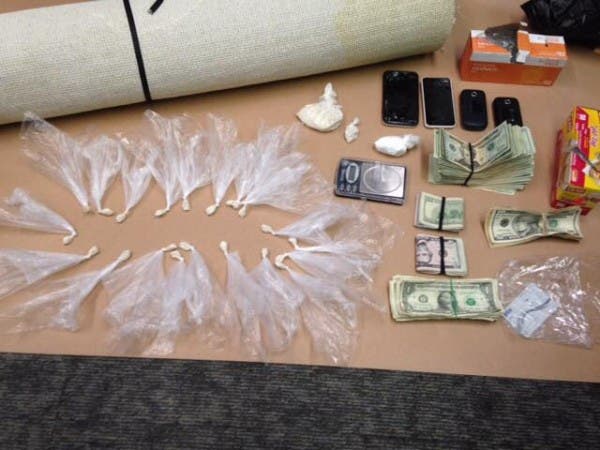
Image via Groton Police Department from a March seizure of suspected heroin/fentanyl
Get more local news delivered straight to your inbox. Sign up for free Patch newsletters and alerts.