Business & Tech
Pete Hamill Talks 'Tabloid City,' Murdoch Scandal at Darien Library
The author also touched on the evolving nature of journalism, which plays a key role in his latest novel.
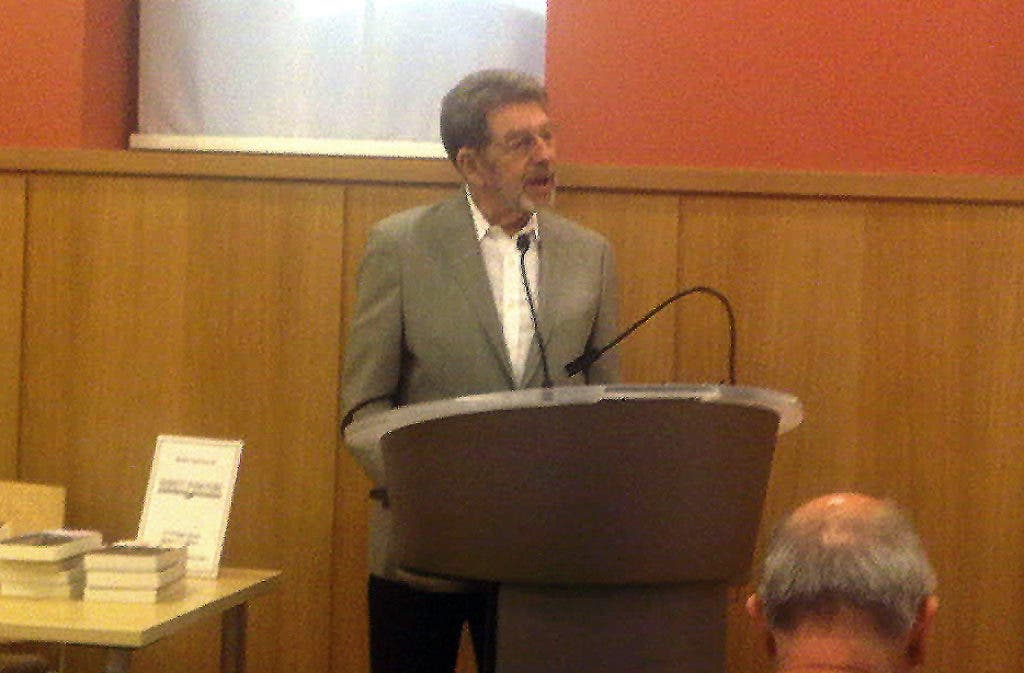
Author, journalist, editor, and consummate New Yorker Pete Hamill dropped by the Thursday evening to promote his newest book, Tabloid City — and to comment on a few current events in the process.
Appearing before an enthusiastic crowd, Hamill read passages from this, his 11th novel, which is set in his beloved city and involves a double murder being covered by a failing newspaper as it converts to a new life on the internet.
"I'm melancholy about the newspaper business," said Hamill, "But I'm optimistic about journalism."
Find out what's happening in Darienfor free with the latest updates from Patch.
Calling the transition from print to online "the biggest change since Gutenburg," Hamill said that much of his optimism for the future comes from observing his students at New York University, where he holds the title of Distinguished Writer-in-Residence.
Though he dropped out of a Jesuit high school at age 16, Hamill said his chosen profession of journalism was like "a graduate school from which you never graduate."
Find out what's happening in Darienfor free with the latest updates from Patch.
"As a member of the press I was a privileged witness to so many things that happened in our time," he said.
During his career, Hamill has worked at the New York Post, the Daily News, Village Voice, Newsday, New York Magazine, and Esquire. But it's his days at the tabloids which he seems most fond of.
Asked about the News Corp. scandal unfolding in the United Kingdom — and whether Fleet Street's ethical standards were ever matched by the New York papers he'd worked at — Hamill said that Rupert Murdoch's standards of journalism never "worked" at the Post. (Hamill's time at the paper preceded Murdoch's takeover.)
"The Post has never made money," Hamill said. "You can't do an in-your-face tabloid and hope to get a lot of women readers. The advertisers know that most consumer decisions are made by women, not men. If you've got a paper so crude you can't bring it home, where do you [see the ads]?"
Still, the author praised some of the changes Murdoch has brought to the Wall Street Journal since acquiring it in 2007.
"I think what [Murdoch] has done for the Wall Street Journal is actually very good," Hamill said. "It's much more readable. What happened on Wall Street and the stock market in general was a failure of the media. [Wall Street] created a language and we didn't know how to read it. And neither did the regulators. It turns out they were running a casino."
Hamill speculated that much of the anger against Murdoch in the UK pertains to his American citizenship (he was naturalized in 1985 as part of his acquisition of the Fox network). And as a US citizen, Hamill added, Murdoch may be prosecuted for offering bribes to foreign officials.
"I guess bribing [Afghan President] Hamid Karzai is not bribing an official," he added. "It's like bribing the butler".
"[But] I know that at the papers I worked at, including the Post, if you said ‘I need approval on expenses for paying off a cop,' you'd be thrown out. At [pre-Murdoch Post publisher] Dorothy Schiff's paper you couldn't spend more than $2. If there was a murder in Queens you had to take the subway."
"Murdoch is in trouble," Hamill added. "Not just for the offenses of good taste like going after [former Prime Minister] Gordon Brown's infant son ... [who has] cystic fibrosis. What's the hell does that have to do with the politics of Britain? Nothing. Just snarkiness. Murdoch and the people who work for him might pay a big price. I wouldn't be surprised to wake up one morning and find that the Post is gone."
Hamill appeared at the library as part of its Adult Summer Reading 2011 program.