Community Corner
RTM Tours Darien Hot Spot
I tag along with the Public Works Committee on a special tour of Darien's hot-spot for socializing, political maneuvering and discontent: the Dump.
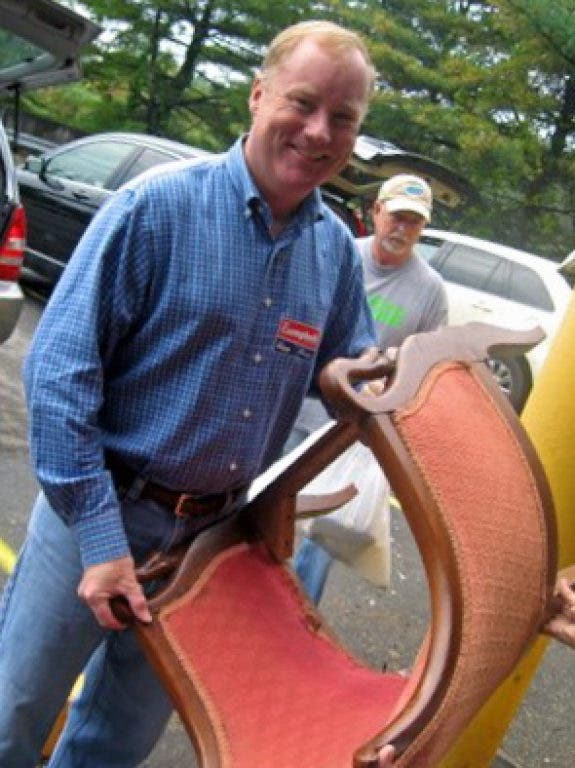


Saturday, October 17, 2009: I was pleased to tag along with the Public Works Committee of the Representative Town Meeting on a tour of The Dump led by the Assistant Director of Public Works, Darren Oustafine, P.E.. On this tour Oustafine tried to explain to all of us “why things are they way they are” at the dump.
It turns out that the Darien Dump is a hot spot; and not just for socializing and dumping garbage, but for political maneuvering and discontent.
As a newbie to the whole Dump thing in the first place (I am in the process of abandoning my most wonderful but now, at least for me, unaffordable Darien Disposal Service and dumping my garbage myself), the tour was most edifying. I wonder how people new to the dump find their way around all of its wonders without a special tour like the one I had.
Find out what's happening in Darienfor free with the latest updates from Patch.
We began with a detour to the Public Works Garage. Lots of large shiny yellow trucks for salting roads and picking up storm debris and even a street sweeper were in there. Who knew? They have the facilities to maintain all the vehicles, and they can do everything except change a transmission, Oustafine said. There were also diesel gas pumps; the Town’s fire trucks get their gas here tax-free.
After this impressive beginning, we walked outside—the committee enduring the cold—to learn about the facility.
Find out what's happening in Darienfor free with the latest updates from Patch.
There is a giant salt hut. We learned from Oustafine that salt prices were down eight percent this year—a very unusual event. He explained that the town no longer uses sand on the roads, because sand makes a mess and clogs up sewers. It was decided that salt was more effective, melting ice above 20 degrees and serving as an abrasive below 20 degrees when the ice becomes too cold to melt. This information provoked a series of questions from the ever-alert Committee about the environmental safety of using salt. Oustafine said that really the “jury is still out” on that topic, but unless the salt went right into drinking well water, it was considered safe.
Next, Oustafine showed us the new “scale house," the little structure at the entrance to the dump where they examine your sticker. This little building is complete with computer facilities and heat and air conditioning for the attendant and cost about $70,000. We learned that luckily some truck had bashed into the old scale house, so the insurance from that accident paid for much of the new scale house. Yippee!
The reason for such an elaborate house is because it’s connected to an enormous flat scale that weighs trucks as they come in and out to determine how much garbage they’ve dumped. The driver tells them what they’re carrying: brush, grass clippings, MSW (don’t know what that is? I didn’t either; it’s Municipal Solid Waste), the attendant punches it into the computer, and Violà! A bill. It’s also useful so the attendant doesn’t freeze to death while checking dump passes.
Oustafine said that we could weigh the Public Works Committee on the scale, and I asked them if we could please do that for a Darien Patch photo, but some members of the committee refused. I am hoping they will reconsider for next year’s tour, since I think the weight of the committee would be useful information, both literally and metaphorically. This will probably require some deliberation and a vote. I’ll keep you posted ...
While examining the scale house, I learned that dump passes were a valuable commodity in Darien and that some people try to accelerate past the attendant without a pass, or try to borrow their neighbor’s pass, or otherwise engage in shenanigans in order to avoid the $110 dump annual fee (for those who do not use a commercial garbage company), $34 annual fee (for those who also use a commercial company), or $50 fee for senior citizens. (This fee covers all vehicles in a household, but does not cover neighbor’s vehicles). Right now the attendant takes down license plates when people speed past, and the police are dispatched to the person’s house. A story was told about a man who was nearly led away in handcuffs, because he cursed out the police when they arrived.
To discourage these transgressions, the dump is in the process of putting a guard gate in front of the scale house.
Inspired and bursting with ideas, the committee discussed the possibilities of using EZ Pass or a "Pay as You Throw" plan, both of which had been considered and rejected, said Oustafine.
Then we viewed the maw of the compactor in the Transfer Station house. This is where you dump your regular garbage. When you throw your garbage into the compactor, it gets crushed and then put into a trailer and sent to Bridgeport where it's burned. The heat generated from the burn process runs a turbine which creates electricity.
The etiquette of the whole idea of dumping your own garbage was also considered. The compactor sits behind a four-foot-high wall, over which you must hurl your garbage. There is an attendant there, but he is not required to help. That would involve a whole additional level of liability insurance for the town, said Oustafine. Standard practice is that if you want to dump your own garbage then you should be able to dump your own garbage.
“If you can’t do it, pay somebody or get someone else to help,” said Oustafine.
But then he added that if an elderly person came and had trouble, it would just be rude to not offer to help.
“We don’t want to be the dump Gestapo,” he said.
The committee brought up the issue of oversized items, such as couches. These should not go into the “hole,” beccause they're "noncombustible" and might block up the compactor, Oustafine said.
Oversized items can be left in an area right past where the Swap Shop (more about that later) will be, and to the left of the sand pile. This is the “oversize, noncombustible area" for C&D, (Don't know what that means? Construction & Demolition material), oversize bulk waste, and noncombustible waste. This would include treated lumber or a toilet bowl that won’t burn.
The committee criticized the blocking off of a parking space right in front of the compactor building, which was taken up by a little shack (again, with heat) for an attendant. The Committee considered where this shack might be moved to make that parking space available. They also complained about only one of three garage doors into the dump being open. On a busy rainy Saturday, these small inconveniences can become large inconveniences, and the committee expressed this to Oustafine.
The Committee also asked about the dump hours (the dump is opened from 7 a.m. to 2:45 p.m. Monday through Saturday). Members agreed that it created an agony of haste for people to have to mow their lawns on a Saturday and then get the clippings in by 2:45 p.m. Those hours are more accommodating to commercial garbage companies than town citizens, they said. Oustafine responded that if they changed the time, others would object and that it has been a politically charged issue for years and that such inflammatory issues must be taken up with the First Selectman and the Board of Selectmen.
Exciting Dump News: I learned that a "Swap Shop" is in the process of being organized just past the entrance on the right side of the dump. (I heard a story about people battling over a discarded red wagon a few years ago; such battles will be a thing of the past!).
And a plethora of Dump Do's and Don'ts:
- There is a place to dump your oil if you change your own car oil.
- Envelopes can now be mixed in with magazines and newspapers. Only cardboard must be separated.
- Grass clippings must be dumped separately from leaves and brush. They cannot be composted because there’s too much nitrogen in them and it causes too much odor.
- To dump a used air conditioner or refrigerator you must pay a $15 chlorofluorocarbon fee.
- You can dump tires (off rims) at the dump (One time someone went through the dump when it was closed, cut a hole in the fence, went into the BMW dealership, jacked up a bunch of cars and stole their tires. We happened to be standing near the tire area of the dump when this story was told, and a Committee member joked “Well, the sign says tires!”).
- Dump logs and stumps in a separate area.
- Compost. Take from the pile on the left (100% leaves). When it decomposes it’s about one seventh of the volume of the original leaves, which, while really neat, has no minerals and must be mixed with soil for plantings.
- Wood chips are there too. Help yourself.
- The sand heap at the right side of the dump (old sand from when they used to use sand on the roads) is no longer used.
- Behind the sand are the remnants of an old concrete incinerator. They used to burn the garbage right there. Now there’s a centrally-located spot (Bridgeport) for environmental reasons.
- Behind the concrete ruin is a privately leased cell tower.
- Leaves are stored in rows, squirted with a fire hose to get the microbes working and then regularly flipped so they decompose. There is a big empty area behind the dump that’s all ready for this fall’s leaves.
- The dump takes metal refuse, and it’s actually a “big source” of revenue for the town, per Oustafine, because they sell it.