Politics & Government
Patch Candidate Profile: Jaime Foster For 57th House
The Democrat discusses energy costs, affordability and her priorities for the 57th House District, which includes Ellington.


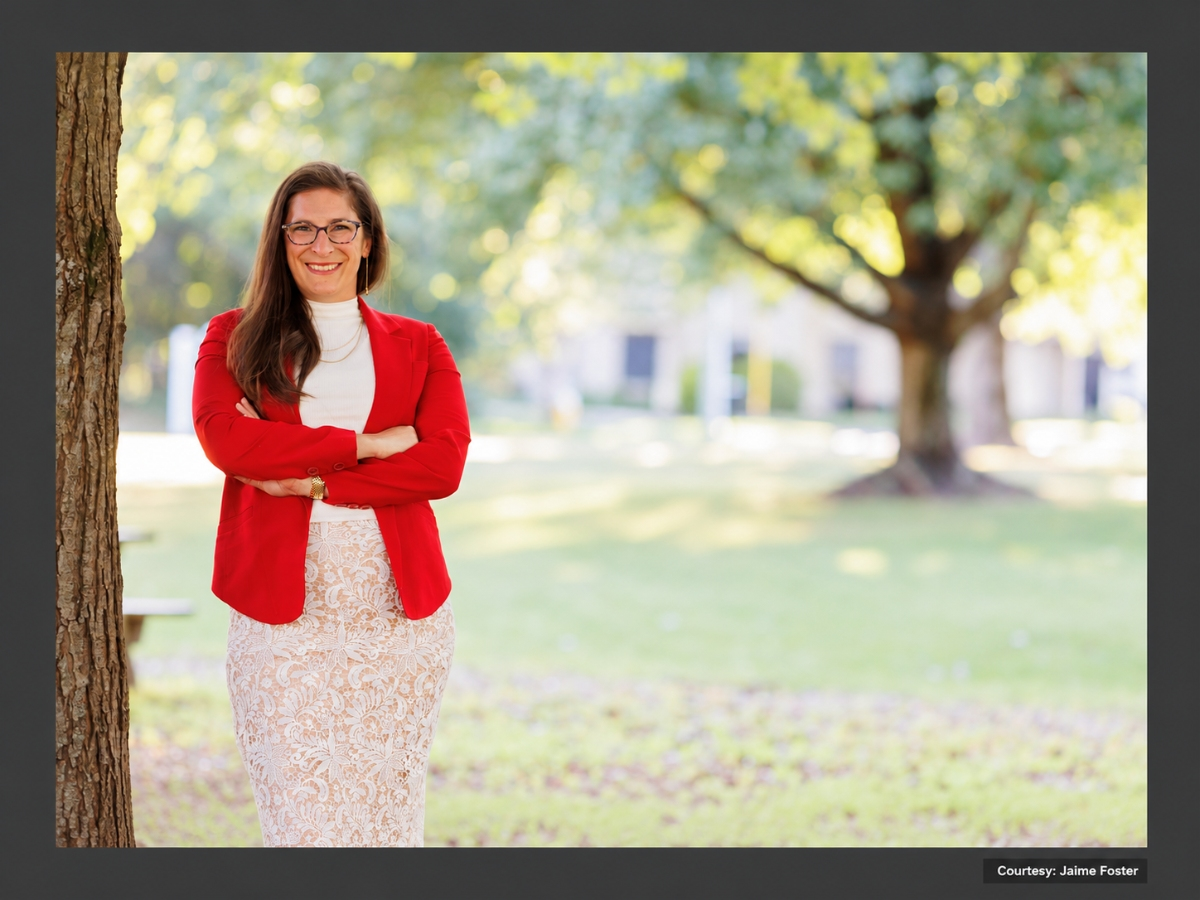
ELLINGTON, CT — Democratic state Rep. Jaime Foster is seeking another term representing the 57th House District in the Nov. 3 election.
Foster, a researcher and program evaluator, identifies affordability as the state’s top issue and outlines proposals to reduce energy infrastructure costs. She is the only printed candidate for the office on Ellington’s sample ballots, as detailed in Patch’s Ellington and Somers voter guide.
Here are the candidate’s responses to Patch’s questionnaire:
Find out what's happening in Ellington-Somersfor free with the latest updates from Patch.
Candidate's Name:
Jaime S. Foster
Find out what's happening in Ellington-Somersfor free with the latest updates from Patch.
What office are you seeking?
State Representative
Age:
36
District:
57
Party:
Democrat
Campaign website:
Occupation:
Researcher and Program Evaluator
Family:
I am married to my best friend and husband of 12 years, Aaron, a civil engineer and we have 2 beautiful children, an 8 year old daughter and 3 year old son. Have 2 dogs, 3 fish and 2 bee hives.
Does anyone in your family work in government?
No
Previous public office:
Ellington Human Services, State Milk Promotion Board and Ellington Board of Ed
Why are you seeking this office?
I am deeply committed to learned about our communities needs and finding meaningful solutions for our community’s problems. From improving schools, services for seniors, child safety, access to clean drinking water, improved technology to keep first responders safe and ready. I believe that I can help make a difference for our community.
What do you believe is the No. 1 issue facing Connecticut, and how do you plan to address it?
The answer I hear consistently, is affordability.
Whether it’s utility bills, childcare, prescription medications, groceries, or gas, Connecticut families are being squeezed from every direction. People are looking for relief wherever they can find it, and they want to know that their hard-earned dollars are being spent wisely.
But affordability isn’t simply about cutting costs. The people I represent also expect excellent services for what they pay. They want strong public schools that provide their children with a great education. They want safe neighborhoods and law enforcement officers who have the tools and resources they need to do their jobs effectively.
What they don’t want is to pay more without getting more in return.
That distinction matters, especially as we look toward the upcoming legislative session.
One area I’m particularly focused on is the growing cost of our electric infrastructure. Infrastructure investments are an increasingly significant component of utility bills, and we need to take a hard look at how those investments are proposed, evaluated, and ultimately paid for by ratepayers.
We need a reliable, resilient electric grid that can meet Connecticut’s energy needs today and into the future. That requires investment. But it also requires accountability.
We should be asking whether proposed investments are necessary, whether they’re cost-effective, and whether they actually improve reliability and access to energy. We also need to make sure we’re not asking families and businesses to shoulder the cost of infrastructure that delivers little meaningful benefit.
Affordability and quality shouldn’t be competing priorities. Our responsibility is to make sure Connecticut residents receive real value for the dollars they’re already spending.
That’s the lens I’ll be bringing to our work in the next legislative session.
Energy costs have been soaring in Connecticut. What are your plans to help address this issue?
As a member of the Energy and Technology Committee, I’ve focused on reducing unnecessary utility costs, strengthening accountability, and ensuring that investments in our electric grid provide meaningful value to ratepayers.
What I’ve Championed So Far:
Protecting ratepayers from inappropriate utility expenses. I’ve supported efforts to prevent utility companies from passing lobbying expenses, certain trade and professional association dues, and other corporate advocacy costs onto customers. I’ve also advocated for greater scrutiny of expenses associated with preparing and presenting materials before the Public Utilities Regulatory Authority (PURA), including costs related to challenging regulatory decisions. Ratepayers should not automatically be responsible for financing activities that primarily advance utility companies’ financial interests.
Strengthening utility oversight and consumer representation. I’ve advocated for stronger regulatory accountability and greater resources for the Office of Consumer Counsel to represent Connecticut residents in utility proceedings. I’ve also raised concerns about utility ownership structures, market concentration, vertical integration, and whether regulatory frameworks adequately protect consumers.
Improving transmission planning and controlling infrastructure costs. I’ve championed grid-enhancing technologies, including dynamic line ratings, advanced power flow controls, and topology optimization, that can increase the capacity of existing transmission infrastructure. Before asking ratepayers to finance expensive new construction, we should evaluate whether existing infrastructure can be used more efficiently. I’ve also advocated for greater scrutiny of transmission spending, utility returns on investment, and regional cost allocation through ISO New England and the Federal Energy Regulatory Commission.
These priorities are reflected in my previous legislative work and public commentary:
- My CT Mirror op-ed on utility accountability and corporate spending
- 2025 HB 7017: Transmission Planning and Grid-Enhancing Technologies
- 2023 SB 7: Utility Cost Recovery and Ratepayer Protections
- My remarks supporting stronger Office of Consumer Counsel resources
My Priorities for the 2027 Legislative Session
My next phase of work builds on utility accountability but expands the conversation to address why infrastructure becomes so expensive in the first place.
Influenced in part by Ezra Klein and Derek Thompson’s Abundance, I’ve been examining how unnecessary delays, fragmented government processes, poor coordination, and inequitable infrastructure cost allocation contribute to rising utility bills. While strong oversight remains essential, we also need to recognize that excessive bureaucracy and poorly sequenced investments can create costs that ultimately fall on ratepayers.
1. Accelerating permitting and reducing unnecessary infrastructure costs. I want to examine state permitting requirements and fees associated with energy generation and transmission projects, particularly those that do not directly support municipal tax revenue or essential public safety functions. We should streamline duplicative approvals, establish accelerated pathways for qualifying projects, and allow agencies to conduct reviews simultaneously rather than sequentially. Reducing unnecessary delays can lower financing costs and help bring needed infrastructure online sooner.
2. Establishing executive-branch accountability for infrastructure delays. I’m interested in creating a small, coordinated function within the executive branch or Office of Policy and Management to identify regulatory bottlenecks, resolve interagency conflicts, and track procedural improvements. Government should be able to identify when its own processes are making essential infrastructure more expensive and take responsibility for correcting those problems.
3. Expanding virtual power plants and distributed energy storage. Building on research presented by UConn engineering faculty, I want to explore how battery storage, electric school bus fleets, and other distributed energy resources can work together as virtual power plants. These technologies could reduce peak electricity demand, improve reliability in communities experiencing frequent outages, and defer costly infrastructure upgrades where appropriate.
4. Requiring large data centers and other major electricity users to pay their fair share. As large commercial facilities create substantial new electricity demand, Connecticut must ensure that existing residential and small-business customers are not subsidizing the infrastructure needed to serve them. I want to explore requirements for large energy users to develop load-management plans, invest in on-site generation or storage where feasible, and pay the appropriate costs of interconnection and system upgrades. We should also examine when direct connections to the regional transmission system are technically and economically appropriate.
READ MORE:
- What Ellington And Somers Voters Will Decide Nov. 3
- Here Are Recent Home Sales In Ellington, Somers
- Ellington Daycare Plans Closure; Gordon Questions State Help
5. Reforming interconnection planning to prevent inequitable cost burdens. Connecticut’s current approach can leave later participants in distributed generation responsible for substantial grid upgrades simply because available capacity has been exhausted. I want to explore a more proactive statewide planning framework that anticipates future generation and electricity demand, improves the accuracy and timeliness of utility interconnection capacity data, and distributes shared infrastructure costs fairly among those who benefit. Access to clean energy should not depend on who happened to enter the interconnection queue first.
6. Developing a long-term energy affordability and resilience roadmap. Connecticut needs a more comprehensive approach to evaluating the costs of our energy system over the next 20 and 50 years. This should include strategic battery storage deployment, transmission investments, future electricity demand, emerging technologies such as small modular nuclear reactors, and the risk of stranded or unnecessary infrastructure assets. Existing state energy planning processes provide a foundation, but I believe we need a more explicit focus on long-term ratepayer affordability and the financial consequences of decisions made today.
My approach to energy affordability is evolving from a focus primarily on scrutinizing utility expenditures to a broader effort to prevent unnecessary costs before they occur.
That means continuing to challenge inappropriate expenses on utility bills, ensuring utilities are held accountable for their investments, and protecting ratepayers from unfair cost allocation. But it also means recognizing that faster permitting, better government coordination, strategic infrastructure investments, and thoughtful long-term planning can be important tools for lowering costs.
Connecticut needs reliable, resilient, and increasingly modern energy infrastructure. The question should not simply be how much we’re spending, but whether we’re spending wisely, whether projects are delivered efficiently, and whether the people benefiting from those investments are paying their fair share.
My goal for 2027 is to advance an energy affordability agenda that combines accountability with efficiency: eliminating unnecessary expenses, maximizing existing infrastructure, accelerating worthwhile projects, and planning for the long-term needs of Connecticut families and businesses.
Affordability has been a major topic across the country and here in Connecticut. How do you plan to address this issue?
For the last six years, both as a candidate and as a State Representative, affordability has been one of the most consistent concerns I’ve heard from the people I serve.
When we talk about affordability, I often start with the most direct way state government can help: lowering taxes. We’ve made meaningful progress by cutting taxes for seniors, expanding exemptions for Social Security and certain retirement income, increasing the Earned Income Tax Credit, and providing additional tax relief for families with children.
We’ve also worked to ease the pressure on municipal property taxes by increasing state education funding and securing as much state aid as possible for necessary school construction projects. Every dollar we can bring back to support our schools and communities is a dollar that local taxpayers don’t have to shoulder alone.
But the affordability challenges families are facing today are broader and, in many ways, more difficult than those of previous years.
People are being squeezed from every direction: electric bills, property taxes, childcare, groceries, gasoline, healthcare, and prescription medications. For middle-income families like mine and yours, it’s death by a million cuts. No single expense may be responsible for the financial strain, but together, they’re making it increasingly difficult for families to get ahead.
And there isn’t one quick fix.
That’s why I believe our approach to affordability must be both comprehensive and practical. We need to continue identifying opportunities for meaningful tax relief, but we also need to examine the underlying costs of the essential services families rely on. That means scrutinizing utility spending, addressing childcare availability and costs, supporting excellent public schools, and making sure government investments are efficient and deliver measurable value.
The people I represent don’t simply want fewer services or lower costs at any expense. They want excellent schools, safe communities, reliable infrastructure, and public services that work. They want to know that their hard-earned dollars are being spent wisely.
My priority has always been, and will continue to be, making sure we’re getting the greatest possible value for every taxpayer dollar, eliminating unnecessary costs, and ensuring that public spending reflects the needs and values of the communities we serve.
Affordability isn’t one policy or one tax cut. It’s a responsibility that needs to inform every decision we make in state government.
What accomplishments in your past would you cite as evidence you can handle this job?
One of my proudest accomplishments to date is one that is just beginning to become visible: we’ve officially broken ground on waterline expansions to serve the School Hill Water Association and Park Hill communities in East Windsor. These projects will address two longstanding public health and safety concerns: access to safe drinking water and adequate water infrastructure for fire suppression.
For decades, residents of Elaine and Helen Drives have lived without potable drinking water, a problem that has affected their quality of life and diminished their property values. Meanwhile, the Park Hill community has faced longstanding challenges with inadequate water infrastructure for fire protection.
These were the kinds of problems that had become so entrenched and complicated that they were often viewed as nearly impossible to solve.
And frankly, those are my favorite kinds of problems to tackle.
Making these projects possible required collaboration across municipal, state, and federal government; public and private partnerships; and expertise in engineering, public health, infrastructure financing, and community planning. It took persistence, creative problem-solving, leadership, and a willingness to bring people with different expertise and responsibilities to the same table.
I’m incredibly proud to have been part of the team that helped move these projects from longstanding problems to tangible solutions.
While these projects directly affect a relatively small number of households, their significance extends beyond the number of people served. For those families, access to safe drinking water and adequate fire protection isn’t a small issue. It’s fundamental to their health, safety, property values, and peace of mind.
And to me, this accomplishment reflects something larger about public service.
Not every meaningful accomplishment comes from passing a major piece of legislation or making headlines. Sometimes it’s about identifying a problem that has frustrated a community for decades, understanding why previous efforts have stalled, bringing the right people and resources together, and methodically working toward a solution.
I believe some of the most meaningful work in public office happens at the intersection of persistence, creativity, collaboration, and attention to detail.
These are the kinds of sticky, tricky problems I genuinely enjoy solving. Whether the issue affects a handful of households or communities across the state, I approach it with the same curiosity, determination, and willingness to think differently.
That’s the kind of thoughtful, creative, and methodical work I’m proud to have contributed to our district, and the kind of work I hope to continue doing.
Is there anything else you would like voters to know about yourself and your positions?
Although I am the only candidate on the ballot for the 57th house district I am still working hard to earn your support and prove to voters and the community that I am the right person for the job. I’m honored to serve and hope to earn your support!
For more Northern Connecticut news, follow Patch editor Jay Kenney.
Editor’s note: Connecticut Patch asked candidates to answer questions about their campaigns and the issues facing the state. The responses below were submitted by the candidate and reflect the candidate’s views. Responses are presented as submitted, with formatting added for readability.
Get more local news delivered straight to your inbox. Sign up for free Patch newsletters and alerts.