Community Corner
A History of the Purple Heart
Daughters of American Revolution Provides History on Focus of This Year's Theme for the Memorial Day Parade


Editor's note: The following history on the Purple Heart, which is the focus of this year's theme for the Memorial Day Parade, was submitted by Pamela Huth of the Eunice Dennie Burr Chapter of the Daughters of the American Revolution, which is based in Fairfield.
Origin of the Purple Heart Award and its Connecticut Connection
As we approach Memorial Day, the town of Fairfield will again honor all Americans who have died in war with its traditional colorful Memorial Day Parade. The theme of the parade is the Purple Heart Award. The Eunice Dennie Burr Chapter of the Daughters of the American Revolution (DAR) participates in the Parade. The mission of the DAR is to promote education, historic preservation, American history and patriotism.
Find out what's happening in Fairfieldfor free with the latest updates from Patch.
Few people know that the award we know as the Purple Heart dates back to the Revolutionary War and its greatest leader, General George Washington. Washington’s greatest challenge, upon assuming command of the Continental Army in Boston, on June 26, 1775 was to take an inexperienced rag-tag band of men from all walks of life - farmers, merchants, and even adventurers - and forge them into an army of disciplined soldiers. He succeeded, not as a military tactician, but as a great leader of men.
The Army’s encampment at Valley Forge during the harsh winter of 1777 to 1778 was the testing ground. Undernourished, poorly clothed, living in crowded, damp quarters, ravaged by sickness and disease, 2,500 men would not survive the winter. Those who did were drilled, marched, trained and formed into a fighting force that could stand up to the British Army.
Find out what's happening in Fairfieldfor free with the latest updates from Patch.
On June 19, 1778, six months after its arrival, a united American Army marched away from Valley Forge in pursuit of the British, who were moving toward New York. The war would last for another five years, but for Washington, his men, and our fledging nation, this was a great victory of survival and transformation.
Washington felt that it was important to recognize every soldier, not just officers, for his service. Recognizing the common solider was a new step in military history. A "badge of service," or chevron, would be worn on the left sleeve by any enlisted or non-commissioned veteran who had served for three years with “bravery, fidelity and good conduct."
Taking it one step further, Washington established an individual award for “singularly meritorious action” and “extraordinary fidelity.” This award, our first military medal, would be called the Badge of Military Merit and was formalized in Washington’s General Orders of August 7, 1782, at his headquarters in Newburgh, N.Y. The badge was made of cloth or silk in the form of a purple heart. It could be worn either suspended from a ribbon placed around the neck or sewn to the left breast pocket of the uniform. Washington’s close friend, M. Pierre Charles L’Enfant, who later designed our Nation’s Capitol City in Washington, D.C., designed the award.
In 1783, Washington personally presented the Badge of Military Merit to three soldiers from Connecticut: Sergeant Elijah Churchill of Enfield, a member of the 2nd Continental Dragoons, who was cited for gallantry in action at Fort St. George, N.Y. in November 1780 and a year later for action at Tarrytown; Sergeant Willliam Brown of Stamford, a member of the 5th Connecticut Regiment Continental Line, also cited for his gallantry during the siege of Yorktown; and Sergeant Daniel Bissell of East Windsor, a member of the 2nd Connecticut Regiment Continental Line who posed as a deserter and acted as a spy among the British troops in New York.
The award fell into disuse after the American Revolution. It was felt that the practice of wearing medals was too reminiscent of European aristocracy. Certificates of Merit were created during the 1847 Mexican-American War for those soldiers who distinguished themselves in action. However, early in the Civil War, a Medal of Honor was created to recognize enlisted sailors and petty officers and included commissioned officers 50 years later.
Before the war ended, the Army awarded the medal to enlisted men and non-commissioned and commissioned officers who distinguished themselves. Awards of the Medal of Honor in the late 1800’s, earned by members of the U.S. Army, Navy, Marines or Coast Guard, and by Civil War veterans for services almost half a century earlier began to draw attention.
Veterans now began to covet military medals as an American tradition. In the floodgate that followed, an array of medals for valor, service, and campaign ribbons were created.
In the process, the Badge of Military Merit began to get a second look. The first effort to revive the Badge in 1927 by Army Chief of Staff General Charles P. Summerall failed, but as the bi-centennial celebration drew closer, General Summerall was replaced by General Douglas MacArthur, a military hero in Mexico and World War I and the son of a Civil War Medal of Honor recipient.
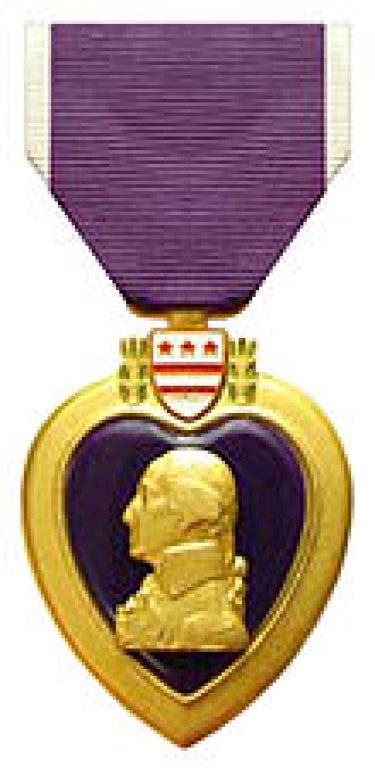
Throughout 1931, the Army began work on a new design. The badge would be turned into a heart-shaped medal and, in honor of the Father of our Country, would bear the profile of Washington on its face. Above the heart is a white shield of the coat of arms of George Washington (a shield with two red bars and three red stars in chief) between sprays of green leaves.
On Feb. 22, 1932, the 200th anniversary of George Washington’s birth, the Purple Heart came into being by Executive Order of the President of the United States, Herbert Hoover.
MacArthur did make one significant change. He recommended the criteria be changed to include the combat wounded or killed in the line of duty and made the honor retroactive to World War I. Having been injured in battle, he received the first Purple Heart medal. The Army was quick to embrace the medal, the Navy less so.
However, on Dec. 3, 1942, President Franklin D. Roosevelt issued an Executive Order authorizing the Purple Heart to sailors and Marines wounded or killed on or after December 6, 1941, thus making those injured or killed in Pearl Harbor eligible.
Later, President Truman extended the time period for the award back to April 5, 1917, allowing Naval and Marine Corps veterans of World War I to receive the award. In October 2008, U.S. soldiers who died in Prisoner of War camps as long ago as Word War II became eligible to receive Purple Heart medals.
The Purple Heart, although it ranks below the Bronze Star, is one of the most widely recognized and respected medals. It cannot be earned by courage or meritorious service alone, but by one thing – sacrifice – as it represents either a combat death or a combat wound.
With increased terrorist activity in the last few decades, more than 30,000 Purple Hearts have been awarded since 2001. The Purple Heart, above all, represents the blood that has been shed in defense of liberty.
Submitted by Pamela Huth of the Eunice Dennie Burr Chapter of the Daughters of the American Revolution, based in Fairfield
Get more local news delivered straight to your inbox. Sign up for free Patch newsletters and alerts.