Politics & Government
Fairfield First to Go 'Live' with Microgrid Project
Fairfield received a grant to fund the project and is the first town in the state to use the technology at its public safety facilities.


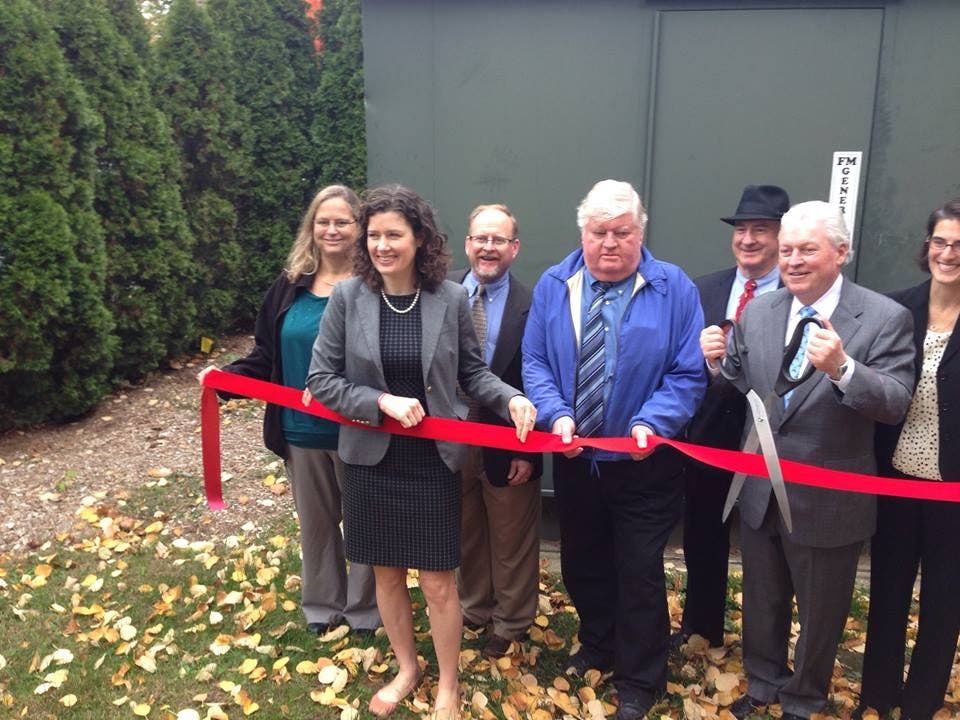
Connecticut’s Department of Energy and Environmental Protection (DEEP) Deputy Commissioner Katie Dykes today joined Fairfield First Selectman Mike Tetreau, federal, state, and local officials to help power up the first municipality microgrid project to come online through the statewide microgrid pilot program.
During the event at Fairfield Police Headquarters, Dykes announced that a third round of microgrid grants will soon be launched
“Fairfield’s microgrid project is an example of how a municipality can help protect public safety and minimize hardships to their residents and businesses during power outages,” Dykes said in a press release. “During an emergency, the microgrid will provide electricity for critical services at Fairfield’s Police and Fire Headquarters, the Emergency Communications Center and nearby Cell Phone Tower, and Operation Hope’s Homeless Shelter which is located behind Police Headquarters.”
Find out what's happening in Fairfieldfor free with the latest updates from Patch.
Fairfield’s microgrid project was installed at a cost of $1.2 million, including $1.1 million in grants from the state program.
“As the first municipality in the state to use this new technology at our town’s public safety sites, Fairfield continues to be on the forefront of seeking and receiving important grants like this one to maximize the reliability of our critical infrastructure during power outages,” Fairfield First Selectman Mike Tetreau said. “This grant allows Fairfield to save taxpayer dollars by using the greenest and most economic electricity. I want to thank Fairfield’s DPW Assistant Director Ed Boman who has sought millions of dollars in clean energy grants over many years that not only lowers our electricity bills, but helps our environment. I also want to thank DEEP for awarding Fairfield as one of only a handful of communities in the state with this generous grant that our town will reap benefits for years to come.”
Find out what's happening in Fairfieldfor free with the latest updates from Patch.
Microgrids provide electricity to critical facilities and town centers on a 24/7 basis. They include a system of “trips” and “transfers” to isolate the microgrid and provide power within its network even when there is a large-scale outage, such as the ones the state experienced between 2011 and 2013 – during Storm Irene, Super Storm Sandy, and the October Blizzard.
The microgrid program was created as part of Governor Dannel P. Malloy’s storm legislation in 2012, which included a number of initiatives to enhance the ability of the state, municipalities and utility companies to better prepare for and respond to natural disasters and intense weather situations.
In the first two rounds of grants, 11 microgrid projects were awarded $23 million in funding primarily through DEEP.
The projects will provide power for government services and businesses that are critical during extreme weather events such as police, fire, and emergency response teams, hospitals and health care facilities, state and town emergency response centers, grocery stores, and gas stations.
“We’re proud to help ensure efficient, clean and reliable energy for the residents of Fairfield even in the event of a natural disaster,” said Chris Bleuher, Microgrid Program Business Development Manager, Schneider Electric. “Fairfield has established itself as an early leader in microgrid development and serves as a model for other municipalities wishing to protect their critical facilities.”
On March 6, 2014, Wesleyan University in Middletown became the first of the CT microgrid projects under the grant program to come online. The project provides power to campus facilities that will also be available to the community in the event of an emergency.
Pictured: DEEP Deputy Commissioner Katie Dykes (second from left) joined Fairfield First Selectman Mike Tetreau (with scissors) and other officials on Wednesday to cut the ribbon for the first municipal microgrid funded by the state’s microgrid program to come online.
CT DEEP photo
Get more local news delivered straight to your inbox. Sign up for free Patch newsletters and alerts.