Politics & Government
RTM 'At A Standstill' On Fairfield Fill Pile Fix
Fairfield representatives debated for hours how best to handle oversight of the town's contamination crisis, but in the end, took no action.


FAIRFIELD, CT — Fairfield representatives spent hours Thursday debating who should manage the aftermath of the contamination controversy involving the discovery of contaminants at public sites across town and the arrests of two Fairfield employees and a former contractor.
But after a night punctuated by applause, shouting and many suggested amendments, members of the Representative Town Meeting agreed to disagree and dispersed, ending the special meeting without approving either the Republican or Democrat contamination oversight proposal.
Both plans called for an independent party to evaluate the history of the public works yard where the contaminants originated and review town rules regarding oversight and contracting as well as Fairfield's standards of ethics. The proposals also suggested that whoever is in charge of oversight work with an environmental consultant to examine contamination testing and remediation already done for the town and offer recommendations.
Find out what's happening in Fairfieldfor free with the latest updates from Patch.
The proposals diverged on the question of who should accomplish these goals. While Republican representatives felt the Board of Selectmen should hire an independent firm to guide the oversight plan, the Democrats believed a nonpartisan resident commission established by the board was more appropriate.
Both proposals were advisory recommendations, and their passage would not have required the Board of Selectmen to take action.
Find out what's happening in Fairfieldfor free with the latest updates from Patch.
'An independent, non-political group'
Democrat representatives argued that a resident commission was the less political choice.
"It's very important to us that this be an independent, non-political group that runs this," said Majority Leader Karen Wackerman, D-District 7.
Bill Gerber, D-District 2, was concerned that the Board of Selectmen would influence the independent firm, which would be employed by the board. Alex Durrell, R-District 3, suggested that town officials like commissions because it gives them somewhere to cast the blame.
Kerry Berchem, D-District 8, said the contamination crisis affects the entire community and is not political.
"We don't live in DC, we live in Fairfield, Connecticut," she said.
Doubt, faith and the Board of Selectmen
Wackerman was one of several town meeting members to comment on the Board of Selectmen's failure to act on the controversy.
"There's just been a lot of yelling," she said.
The Town Charter gives the board the power to take many of the suggested actions in the Republican resolution, Gerber said.
"This is essentially asking them to do something they could have done all along," he said, later referring to the idea that the board would handle oversight properly as "a fantasy" and becoming visibly upset over what he said was a lack of flexibility from the Republicans.
Deputy Minority Leader Michael Herley, R-District 10, said that comments about the Board of Selectmen being incapable of providing overview showed an absence of faith in government and could set a bad precedent for the town meeting. He encouraged representatives to follow the checks and balances of the charter.
"I still have faith in our town government," he said.
Minority Leader Pamela Iacono, R-District 8, also deferred to the charter.
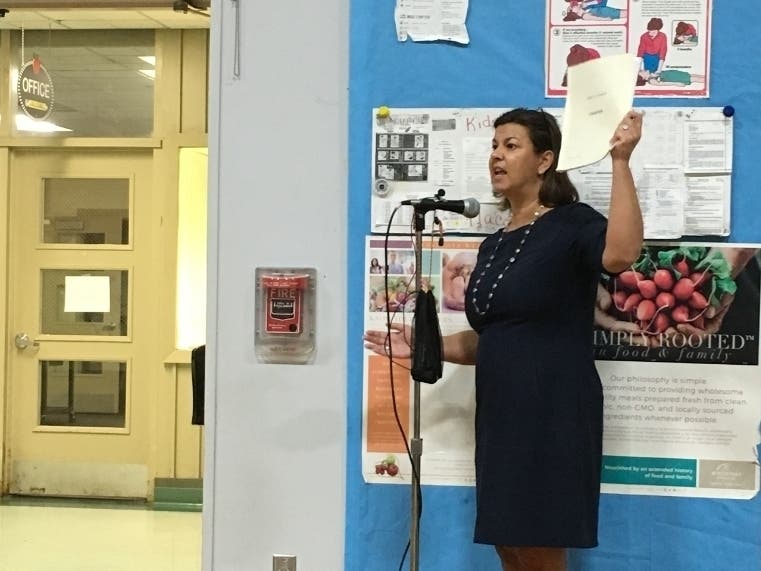
"We have nothing if we don't have this," she said, holding the charter aloft and saying that a volunteer commission would be accountable to no one but the Board of Selectmen.
Republican Selectman Ed Bateson briefly addressed the town meeting, saying he was not against an independent commission as long as the responsibilities of the Board of Selectmen were retained.
"I don't want unelected people running this show," he said.
Gerber said the commission would have to request funding from the board, so selectmen would keep some control of the process.
Calls for compromise
As the evening wore on, representatives repeatedly took to the microphone to seek compromise and suggest combining both parties' proposals.
Gerber suggested amending the Republican plan by adding language that originated in the Democrat proposal requesting the creation of a resident commission. That vote passed 22-14. Another amendment put forth by Gerber to give the commission many of the supervisory responsibilities the Republican proposal originally granted the Board of Selectmen also passed, 20-15, with one abstention.
As midnight crept closer and numerous amendments came before the body in addition to those proposed by Gerber, the question arose as to whether a vote on the revised Republican proposal should happen Thursday.
"I'm not really sure what's in there now," said Herley.
Members of the public, who earlier in the meeting were divided about establishing the resident commission, largely spoke in favor of postponing the vote, although one person told the representatives they "drag everything out."
"Procedurally, we're at a standstill," Iacono said.
The meeting concluded with Iacono and Wackerman standing together, acknowledging that consensus was reached on some topics, but requesting the representatives adjourn and take no action, which they did at about 11:30 p.m., after more than three hours of discussion.
Origin of the contamination crisis
Fairfield's contamination controversy happened after the town hired contractor Julian Development in 2013 to operate its public works yard and reduce the size of a pile of unused project material by 40,000 cubic yards. Over the next three years, the pile more than doubled in size, and days before the agreement was set to end, PCBs and lead were discovered on the property.
Former director of public works Joe Michelangelo, former superintendent of public works Scott Bartlett and Julian Companies Owner Jason Julian were charged this summer with crimes including larceny, forgery and dumping in connection with the pile, which was a source of fill material used all over town.
Of 60 areas in Fairfield that have been evaluated for contamination, 50 have been deemed safe. Contaminants found at sites that tested positive for exceedances include arsenic, asbestos, lead and PCBs. Up to 42 more locations may still be tested.
Get more local news delivered straight to your inbox. Sign up for free Patch newsletters and alerts.