Politics & Government
Sentiment Appears To Grow Against Reducing Fairfield RTM
Speakers during a Charter Revision Commission public hearing Thursday evening were overwhelmingly against reducing the legislative body.


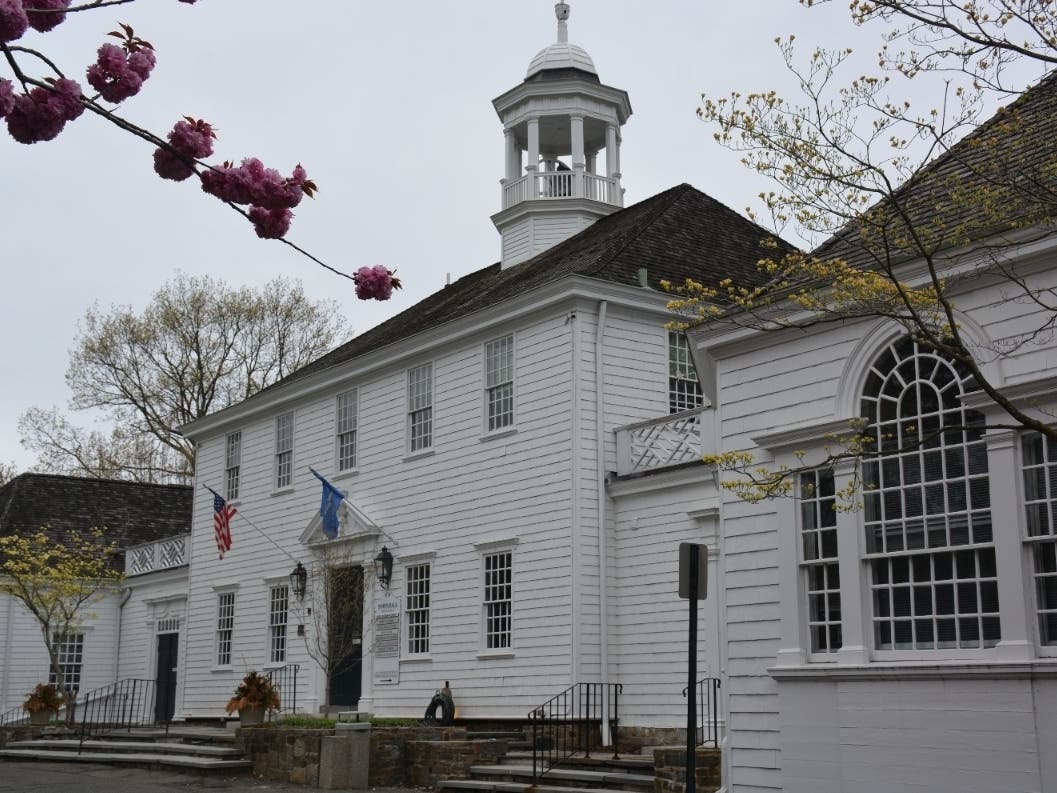
FAIRFIELD, CT — Leave the Representative Town Meeting alone was the overwhelming message from Fairfield residents who spoke during a Charter Revision Commission hearing Thursday night on proposed changes to the Town Charter.
The commission has recommended reducing the RTM, the town's legislative body, to 30 members, down from the current 40 members, which in recent months has become a controversial suggestion. Under the current charter, the RTM can have as many as 56 members.
"Why are you reducing the maximum size of the RTM by 46 percent from 56 to 30?" asked Fairfield Democratic Committee Chair Steven Sheinberg during Thursday's hearing. "Where is the data to support your votes to radically change the size of the RTM?"
Find out what's happening in Fairfieldfor free with the latest updates from Patch.
Sheinberg's comments echoed those made by virtually all of the more than a dozen speakers Thursday night.
"RTM members represent their individual districts," Sheinberg continued. "Four members per district means one member per 1,000 voters and 1,500 citizens. It is hard enough for four members to cover the district now."
Find out what's happening in Fairfieldfor free with the latest updates from Patch.
Two current Selectpersons, Republican Tom Flynn and Democrat Nancy Lefkowitz, have said they have not yet been convinced that a smaller RTM is needed, though First Selectwoman Brenda Kupchick supports the recommendation of reducing the group.
"Representation is important, and the more members we have, the more expertise we have to draw upon," said Marcy Spolyar, deputy moderator of the RTM. "Four members allow us to share the work within our districts."
Added resident Valerie Wilkie, "I know my RTM representatives, I trust them, and I would be very saddened by a reduction."
"How, in good faith, could you keep this in the recommendations [reducing the RTM] when you see so many people against the reduction," said RTM member Laura Karson.
Commissioners Pamela Iacono and John Wynne, who support the reduction, said that when the RTM went from 50 to 40 members several years ago, absenteeism dropped by more than 25 percent.
"There has been no less legislative work when the RTM from 50 to 40 members," said Iacono, who is also an RTM member, adding that accountability would likely improve. "Change opens up great opportunity."
Iacono and Wynne presented a list of pros and cons on the issue to the commission, portions of which can be viewed below.
The commission is scheduled to meet again on Monday to wrap up deliberations on the recommendations and vote on what to send back to the Board of Selectpersons for more review.
Portions of the Iacono and Wynne presentation:
Pros
Improved Accountability – There seems no question that less RTM members will result
in more focus on individual views and individual votes which will lead to more ownership
and accountability and therefore, better outcomes for the TOF.
In fact, an evaluation of RTM attendance from 2010-2015 (when the RTM was a body of
50) compared to 2016 - 2022 (when the RTM was a body of 40) indicates a decrease in
average absenteeism from 14.5% to 10.6% overall (a significant 27% decrease). So, one
might conclude that a smaller body might actually result in more robust involvement.
Improved Relationships and Better Outcomes – A smaller group will enhance the
ability of the RTM to develop better, more collaborative relationships amongst the
members, which will hopefully, result in members crossing party lines and working
together. It seems obvious, but to state the obvious, we seem to have a true partisan
problem in Fairfield.
Improved Quality of Members – Some have said it is important for voters to know their
reps. By definition, 30 is less than 40. However, there has been difficulty in getting
people to run, resulting in less involved, less committed people. A smaller RTM would
result in “the cream rising to the top” with increased knowledge by each member of town
government and personnel. Also, may increase competition for RTM seats.
A Stepping Stone to a More Effective Government Model – It was evident that the
CRC could not convince the TOF that a more effective gov’t model should be considered
– even though many of the members support this. So, to move in this direction will help
future commissions see the benefits of smaller legislative bodies. Big change is not
readily accepted. Incremental change (with resulting incremental benefits) can be
accepted as we have accepted the positive move from 50 to 40.
Recognized research studies conclude that smaller bodies have been proven to be more
effective than larger ones –
(a) Smaller legislative bodies are more effective instruments for the development of
programs and conduct of municipal business than large local legislative bodies 1
(b)In the United States, large municipal legislative bodies, only in exceptional
situations, can discharge their responsibilities promptly and effectively1
(c) Large legislative bodies, whose members represent relatively small districts,
frequently result in narrow views which distracts attention from problems of the
whole municipality.2
Footnotes:
1 National Civic League Model City Charter, 9th edition
2 National Civic League, Model City Charter, 9th edition
3 National Civic League, Model City Charter, 9th edition
No Diminution of Legislative Results - No less legislative work is going to be done by
the Body with 30 vs 40. The RTM moved from 50 to 40 without any public complaint or
shortened agendas or less accomplishment of legislative work.
In fact, a review of ordinances enacted for each year shows a normal level of ordinances
crafted and there does not seem to be any cessation of ordinances enacted, after the
movement of the RTM from 50 to 40 members by 2016.
In Today’s World, We Don’t Need 40 Members To Address Individual Constituent
Needs - With the advent of technology, email, social media platforms, electronic citizen
request forms, etc. residents have direct access to department heads and town
administration. Each State Representative district has 1 Representative, US Congressional
District has 1 representative, the RTM will have three representatives per district to handle
constituent issues without any added burden for the rep or constituent. This increases
visibility and accountability for those three reps.
Increase Availability of Civic Minded Individuals To Serve On Other Boards – The
current 10 RTM members who would not become future candidates, might be willing to
serve on other boards and commissions which might benefit from their specific knowledge
or expertise. These more narrowly focused boards could be of more interest to such
individuals.
Following Leading Practices – The majority of towns in CT have moved from larger
legislative bodies to smaller ones. No town has moved in the opposite direction. While
staying at 40 members is not moving to a larger body, this fact highlights a trend and
indeed, what is now the norm in the U.S., of smaller, more effective legislative bodies (but
still messy!).
Cons
Potential Difficulty in Communicating Benefits – There has been a large contingent of
(mostly current) RTM members who up to now have been the most vocal in their fear that
this change will result in less representation. If this item were sent to the voters, it would
be incumbent on the BOS to provide significant, effective education and explanation of
this improvement to alleviate fears.
Change is Difficult – Any sort of change requires understanding and steps to remove fear
and miscommunication particularly when it involves matters of voting and representation.
However, change also presents great opportunities for growth and learning.
Change is a Process – All change comes with uncertainty and adjustment to new
conditions. If present, this should be a temporary discomfort.
Perception That More Is Better – Information is good. When looking for good ideas,
more people contributing may lead to more options. In our current RTM, we frequently
find many folks not contributing, so despite the fact that we HAVE more, we don’t
necessarily benefit from it. In addition, contribution from the public is always welcome,
so good ideas are not restricted to coming from the body.
It’s a Change From History – “We’ve always done it that way”. Well, not exactly true.
We used to have more RTM members, and until 1947, we didn’t even have an RTM. Is it
in our best interest to stay the same forever? Looked at another way, history has given us
the perspective to evaluate best practices and make positive changes. We are not the same
town we were in the 1800’s and maybe it’s time to govern more effectively.
No Analysis – Some who oppose this idea state that there was a lack of analysis for this
recommendation. Analysis is defined as “detailed examination of the elements or
structure of something.” A conclusion on RTM sizing is not an empirical science. One
must rely on the research, analysis and insights of academic and municipal research, which
provide indicators with which to make decisions. The existing research and information as
well as the input of outside expertise was gathered, evaluated and used as part of the CRC
discussions. We met that standard.
Get more local news delivered straight to your inbox. Sign up for free Patch newsletters and alerts.