Politics & Government
Town Officials Report $2m Surplus From 2009-10 Budget
Town Fiscal Officer Paul Hiller Calls It "High-Water Mark" For Adding Money to Town's Rainy Day Fund

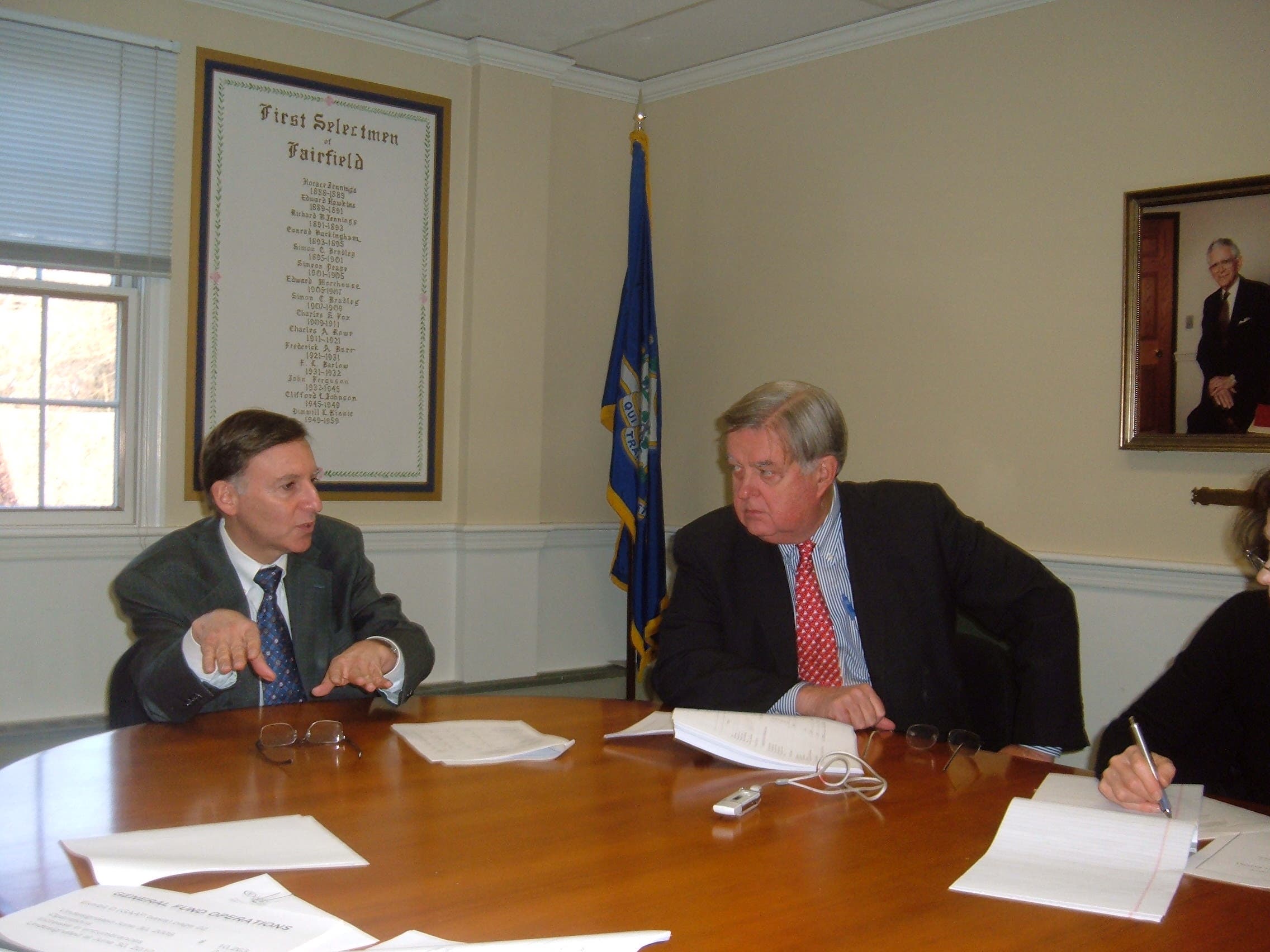
The town's 2009-10 budget ended with a $2 million surplus, which boosted the town's undesignated rainy day fund to $12.3 million, town officials announced Monday afternoon.
"It looks like 2010 was the high-water mark as far as this was concerned," Town Fiscal Officer Paul Hiller said during a press conference in Sullivan-Independence Hall.
First Selectman Ken Flatto said, "I'm really, really happy to say we achieved one of the best surpluses and highest surpluses, to my knowledge, in the Fairfield County area and possibly throughout the state."
Find out what's happening in Fairfieldfor free with the latest updates from Patch.
Bond rating agencies had expressed concern about the level of the town's "undesignated fund balance," which is often called its "rainy day fund" or "surplus," saying it should be at least 5 percent of the town's operating budget.
The $2 million undesignated surplus achieved when the town closed its books on the 2009-10 fiscal year boosts the cumulative surplus from $10.3 million to $12.3 million, which is 4.79 percent of the 2009-10 town operating budget, said Town Controller Caitlin Bosse. Flatto said the percentage increase in the cumulative surplus in comparison to the town budget was about one-half of 1 percent from June 30, 2009.
Find out what's happening in Fairfieldfor free with the latest updates from Patch.
"We have been under scrutiny from the rating agencies to increase our fund balance to levels consistent with a triple-A rating, and we feel we've had great success in that area," Hiller said.
The town has had a AAA bond rating since the mid-1970s and that bond rating, which is the highest possible, has enabled Fairfield to borrow money at lower interest rates than municipalities with lower bond ratings.
Bosse said the $2 million surplus from the 2009-10 budget was mostly due to lower-than-projected expenses and not higher-than-expected revenue.
Hiller said the Board of Education wasn't able to give the town any surplus money from its 2009-10 budget. Flatto said $1.5 million of the $2 million in surplus from the 2009-10 budget was due to town departments saving money, while $500,000 was due to lower-than-projected expenses at the town's Solid Waste & Recycling facility, which also saw lower-than-projected revenue.
"I would say it was a lot of small things department managers did to not go over-budget," Flatto said, adding that the library cut back on weekend service and the town held off on hiring part-time workers at the H. Smith Richardson Golf Course and employees in Flatto's office and the town's Finance Department. Flatto said the town's Department of Public Works didn't fill four vacant positions in 2009-10 and that those positions also weren't filled in the current 2010-11 town budget. He said a $250,000 grant from the Federal Emergency Management Agency to reimburse the town for expenses associated with a signficant storm last March also helped, as did savings from converting town vehicles to natural gas and performing some town services, such as filling potholes and cutting grass, less frequently.
Flatto said the town's goal is to have an undesignated fund balance above 5 percent of the town budget next June 30.
"Our policy is 5 to 8 [percent], and that's consistent with some of our peers in Connecticut," Hiller said.
Flatto said the report released Monday was a draft report but there wouldn't be changes to the report that would affect numbers reported Monday. He said results of the audit, which was performed by Kostin, Ruffkess & Company, LLC of Farmington, would be presented to the town's Board of Finance on Jan. 4.
Hiller said the town hadn't borrowed any money from the accumulated surplus to balance the 2009-10 town budget or the 2008-09 town budget. At one point, the town was borrowing up to $3.5 million from the accumulated surplus to offset the need for higher taxes, but most, if not all, of that money was unused and returned to the surplus when the town closed its books on a given fiscal year.
Meanwhile, Flatto said town officials remain in negotiations with unions that represent town employees. Employees in all seven unions are working without current contracts right now because they all expired on June 30, 2010. "We've been working hard to negotiate with all our units, including those that didn't succeed at the RTM," Flatto said.
The RTM, or Representative Town Meeting, is the town's legislative body, and it rejected proposed labor agreements last summer with unions representing town firefighters and Town Hall employees.
Flatto said he didn't think the $2 million surplus from the 2009-10 town budget would hurt town officials' negotiating position since costs associated with employees, including health insurance and pensions, "has been unrelenting. It continues to go up."
Get more local news delivered straight to your inbox. Sign up for free Patch newsletters and alerts.