Politics & Government
Farmington Residents Write to Siting Council Opposing Proposed Tower
Some residents have performed and published signal tests. The claim is that signal strength in the area is already strong.


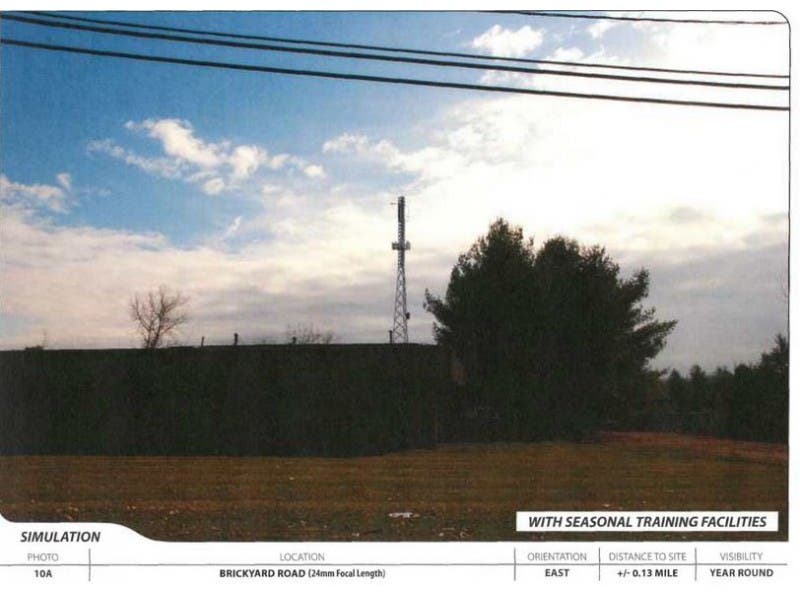

The following letter was written by Farmington residents Joshua and Meredith Davidson to the Siting Council regarding the proposed 180-foot cell/training tower.
Council Members:
The purpose of this letter is to voice our strenuous opposition to the above referenced pending application, which is proposed to be located in the town of Farmington, in which we reside.
Find out what's happening in Farmingtonfor free with the latest updates from Patch.
We opposed the proposed tower for the following reasons, detailed below:
1. Independent RF Signal Measurements refute the need for an additional AT&T transmission site in the area.
Find out what's happening in Farmingtonfor free with the latest updates from Patch.
2. Frequency-specific coverage maps (e.g. 700 MHZ, 1900 MHZ) are a poor indicator of a user’s experience
3. AT&T considers service in the area good enough to show full coverage in their marketing
4. Lack of public need or benefits
5. The lack of data provided by the Applicant to support the coverage need assertions or the benefits of any such lack of coverage is shocking in its absence.
6. Failure to fully comply with General Statutes, Section 16-50i(g)(1).
7. If approved, limit the height to the intervener’s needs (140 ft)
Independent RF Signal Measurements refute the need for an additional AT&T transmission site in the area.
Tests at 40 sites in the vicinity of the proposed tower show that all areas were served with 4 out of 5 bars or more. The data refutes AT&T’s claims that service is poor in the area. Without a demonstrated need, any tower built at the proposed site would be considered unnecessary and therefore not in the interest of the people or the State of Connecticut.
Note check top of article for signal strength chart
The above measurements were taken on April 12, 2015 from inside a vehicle, similar to the tests made by AT&T.
Frequency-specific coverage maps are a poor indicator of a user’s experience
The petitioner provided a total of 4 maps in their proposal; 2 showing signal strength in the 700 Mhz range and two showing the signal strength in the 1900 Mhz range. Cellular phones today include multiple radios and multiple antenna. These radios and antennas, coupled with advanced microprocessors allow phones to operate seamlessly on many frequencies or bands seamlessly. Therefore, any map showing coverage for only one frequency or another is an antiquated and irrelevant view. A single frequency view of the coverage does not in any way reflect real world performance of typical consumer devices.
If you review the maps provided in Attachment 5 of the petition, you will see that in many areas, where there appear to be gaps in one frequency, coverage is available in the other frequency. Therefore, in order to properly evaluate the true consumer experience of coverage, you must look at the combination of frequencies that are used in real-world use by consumers. Failing to do so could result in an incorrect determination of need and therefore a Siting Council decision that could be challenged under the terms of its Charter.
AT&T considers service in the area good enough to show full coverage on their website
AT&T provides coverage maps on their website as a tool to sell their service. These maps in AT&T’s own words are an approximation of coverage. “Approximation” is defined as “a value or quantity that is nearly but not exactly correct.” AT&T is confident enough of its services in the area to show the area as fully covered but then has the audacity to come before the Council, the Town of Farmington, and the residents and say that coverage is insufficient. So, I ask, would AT&T like to stand by their RF coverage results submitted to the Council to justify the building of this tower or would they like to go before the FTC and the FCC to explain how they are making false advertising claims showing coverage while simultaneously showing purported RF levels that contradict their own claims.
Lack of public need or benefits
The standard of proof required to provide a certificate of public need, must surely demonstrate some measure, evidence, or proof that a public need for an additional transmission site for AT&T in this location exists. The proposal describes a need for AT&T specifically to provide coverage on Wildwood Rd, at the intersection of Brickyard and Harris Rd and in the North Central parts of town which equates to essentially the area immediately surrounding the proposed Tower. Even if AT&T’s coverage maps are to be taken at face value (to which I say they should certainly not), this does not in any way prove that a public need exists. No single independent party provided any testimony or data as to the need for additional AT&T coverage or any additional cellular coverage in the area.
Installation of “other communication equipment” including that of Dunning, Marcus, and WBMW should not be taken into consideration. None of these entities chose to intervene in the proceedings. No questions could be asked of these participants as to their need or the public good that may or may not come from their inclusion on the proposed tower. Therefore, the Siting Council should not include any of these needs or potential benefits, if any, in their opinion and determination of public need for the facility.
The statement of benefits provided by the applicant is generic and provides no specific benefits for this tower in this location. Simply stating that people use cell phones and the government encourages the development of cellular networks, in no way justifies the need for an additional tower, let alone, one in this location, at this height, or with the lattice structure.
Additionally, multiple long-term residents who are also customers of AT&T in the area have reported no problems with signals in the area in which AT&T purports to need coverage.
The lack of data provided by the Applicant to support their assertions is shocking
In similar applications before the Siting Council, applicants including AT&T have provided data regarding how much coverage will be provided and details on the effects of alternate heights of a tower on the covered area. For example:
1. The number of miles of main and secondary roads that have no coverage and will receive coverage as a result of the proposed tower. No such data was provided in this application.
2. The area, in square miles, that a proposed site would cover at varying heights (e.g. 4.52 square miles at 146 feet and 4.31 square miles at 136 feet). Again, no such data was provided in this application.
Failure to fully comply with General Statutes, Section 16-50i(g)(1).
As the applicant states in Section VI(B) of its narrative application, the Applicant must comply with General Statutes Section 16-50i(g)(1) regarding the location of the facility with regards to schools and commercial child day care centers. The only school discussed by the Applicant with regards to this statute was Farmington High School. The Applicant has failed to comply with General Statutes by not evaluating the following schools and commercial day car centers.
1. Joni’s Child Care and Preschool – Brickyard Rd
2. Kids Corner Nursery School at Farmington Farms – Brickyard Rd
3. The Goddard School – Bridgewater Rd
The failure to comply with this provision of the General Statutes would be violation of CT law. The pertinent statute is cited below.
CT General Statute 16-50i(G)
In the case of a facility described in subdivision (6) of subsection (a) of section 16-50i that is … (ii) proposed to be installed on land near a building containing a school, as defined in section 10-154a, or a commercial child day care center, as described in subdivision (1) of subsection (a) of section 19a-77, that the facility will not be less than two hundred fifty feet from such school or commercial child day care center unless the location is acceptable to the chief elected official of the municipality or the council finds that the facility will not have a substantial adverse effect on the aesthetics or scenic quality of the neighborhood in which such school or commercial child day care center is located, provided the council shall not render any decision pursuant to this subparagraph that is inconsistent with federal law or regulations; and
If approved, limit the height to the intervener’s needs
If the proposed tower is somehow approved, we request that any such tower be limited in height to the height of 140’ at which AT&T, the only intervener requires. Allowing the tower to go beyond this height short-changes the Council and citizens ability to evaluate and question the providers who claim some benefit from height above 140’.
We strongly voice our opposition to this application, and would respectfully request the Council to deny the proposal outright.
Thank you for your consideration of this correspondence and for your cooperation in this matter.
Sincerely,
Joshua and Meredith Davidson
Get more local news delivered straight to your inbox. Sign up for free Patch newsletters and alerts.