Community Corner
Historic Connecticut River Ferry Still Making Crossings After 361 Years
The Connecticut River Ferry is the nation's oldest continuously operating ferry.




GLASTONBURY/ROCKY HILL, CT - The ride takes just four minutes.
But it is arguably one of the coolest nautical journeys in the country.
Especially when you factor in the history.
Find out what's happening in Glastonburyfor free with the latest updates from Patch.
Welcome to the Connecticut River Ferry between Glastonbury and Rocky Hill. It is the nation’s oldest continuously operating ferry, dating back to 1655.
“I’ve been a captain on a lot of boats, even some old style river boats, in Connecticut,” said Steven Lee, who was piloting the ferry on a sunny, breezy day last Wednesday. “I have to say this is a short ride, but it is a nice one.”
Find out what's happening in Glastonburyfor free with the latest updates from Patch.
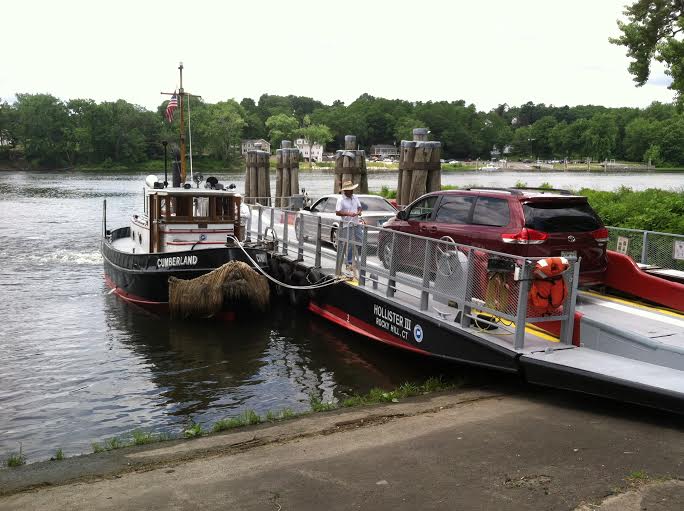
The ferry operates on what Lee, a 12-year veteran of the run, described as a tug-and-tow system with a small tugboat - the Cumberland - pulling a barge - the Hollister III. The rig accommodates three cars and about 15 motorcycles.
As Lee was describing the system, a small truck from an appliance repair company pulled toward the ramp. Mate Joe D’Amico waved the vehicle onto the barge. The gates were closed and Lee revved up the tug’s engine. Lee backed up the Cumberland, maneuvered the craft so it was alongside the barge, and was off.
The driver of the van seemed to be in a hurry. He did not get out of the vehicle and checked his schedule the whole time.
“It’s a vital part of the area because of vehicles like that,” Lee said, pointing to the van. “It can save a lot of people a lot of time. If you have to go through South Glastonbury and then cross the river, it is much more convenient than driving around.”
Lee admitted that a river crossing over the many bridges in the Greater Hartford area along the state’s highway system could seem faster than the four minutes it takes on the ferry, but from those parts of Rocky Hill and Glastonbury, an extra 16 miles could be added to a trip to go the “main route.”
Officials from the state Department of Transportation, which runs the ferry, like to point that out. Technically the ferry IS state Route 160 between the two towns. The road ends at both ferry docks on each side of the river.
“The Ferry is a unique element in the region's transportation plan,” the DOT said in promotional literature. “The ferry plays a special role in serving local vehicular traffic between Rocky Hill and Glastonbury, and it plays an important role for bicyclists.”
Indeed. Motorists traveling between parts of South Glastonbury and Rocky Hill can cut nearly 8 miles each way off their trips if they use the ferry.
For cyclists, access to the Putnam Bridge on Route 2 between Wethersfield and the northern part of Glastonbury is not allowed. That means the ferry is the only crossing for cyclists between Hartford and Middletown, DOT officials said.
Without the ferry, cyclists face a “barrier” with no other way to get across the river, Lee said.
“We get a lot of bicycles,” Lee said. “Clubs will use the ferry as part of a course. We will also get a lot of motorcycles, especially on the weekends.”
When asked how many bikes can get on the barge, Lee joked, “a lot.”
At one point, it was the only route across the river, especially back in the 1600s.
“It was an Indian trail back then,” Lee said. “Then, the trappers came and needed a way to get across the river. When the area became settled, the ferry was for both people on foot and horses. Then, the cars came.”
The original ferry was a small raft pushed across the river using long poles.
Lee said another past system was a rope through which the barge was pulled. There was also a horse on a treadmill supplying the power, he said. In 1876, the ferry was “modernized” into a steam-driven craft, DOT officials said.
The Cumberland was commissioned in 1955 and there have been three versions on the Hollister, Lee said. The tug is propelled by a 6-cylinder John Deere engine installed two years ago, he said.
During the week, it is mostly cars, light trucks and vans on board, Lee said. But on the weekends, it is not uncommon for the barge to be filled with cars, motorcycles, pedestrians and cyclists with the Cumberland being navigated amid a plethora of different pleasure craft on the river.
“I just watch out for everything and make my way across,” Lee said, adding that the mate on duty watches the “blind spot” on the other side of the barge.
If things get too loud, or the wind muffles verbal communication, a series of hand signals are employed between captain and mate, Lee said.
“I love this job. I love operating this boat,” Lee said. “It’s a fun trip and the scenery is pretty nice. This is something everyone in the state should try.”
The ferry runs from April 1 to Nov. 30 from 10:30 a.m. to 5 p.m. on Saturday and Sunday and from 7 a.m. to 6:45 p.m. during the week. Early or late seasonal ice on the river could alter the schedule.
There is no service on Thanksgiving Day.
The cost is $5 per vehicle on weekdays. It is a dollar more on the weekend. A commuter book of 20 tickets can be purchased for $60.
Pedestrians and cyclists pay a $2 fare to cross.
Signs direct motorists to the ferry dock on both sides of route 160.
For more information on the ferry, visit here.
Photo Credit: Chris Dehnel, Connecticut DOT (aerial)
Get more local news delivered straight to your inbox. Sign up for free Patch newsletters and alerts.