Business & Tech
Farm readies for Irene's wrath
West Granby's Holcomb Farm moves to protect crops, livestock and structures




For the average homeowner, preparing for the arrival of Hurricane Irene can be tough enough. Houses need to be secured, evacuation plans mapped out, and essential supplies such as water and batteries must be acquired.
But consider, for a moment, area farms, where even the smallest of which has many more structures, acreage, livestock and crops to consider.
At Holcomb Farm in West Granby on Saturday morning, manager Sam Hammer was finishing last-minute preparations for the impending storm.
Holcomb is mostly a produce farm that grows about 40 different types of crops, including tomatoes, peppers, squash, potatoes, raspberries and kale.
With that, difficult decisions had to be made.
The remaining tomato crop, for instance, is likely going to be lost after six workers and volunteers took 10 hours on Friday to remove the protective plastic around the greenhouse to save the structure.
“We’re basically sacrificing the tomato crop,” Hammer said, noting that it was late in that crop’s season. “There’s a chance that we won’t get as many tomatoes as we had hoped.”
Hammer said that if the heavy winds don’t do the tomatoes in, then the increased exposure to water will, as the crop is susceptible to disease when hit with too much moisture.
As for the other crops, Hammer said he was less worried about them because they are grown low to the ground.
What’s more, losses to, say, a tomato crop are more palatable because of Holcomb’s community-supported agriculture business model, in which customers buy into a year-long membership that spreads the risk instead of having it lay solely on the farm.
“If we do have a bad crop, the customers tend to roll with it,” Hammer said.
Anyway, Hammer and his staff were working feverishly on battening down the farm’s other greenhouses, tying down or rolling up plastic as the case may be and covering their vents with plywood.
Any losses or damages to the structures are covered by insurance, Hammer said. Irrigation pumps have been removed from streams to prevent flooding.
In addition, plans were in place to protect what little livestock the farm has.
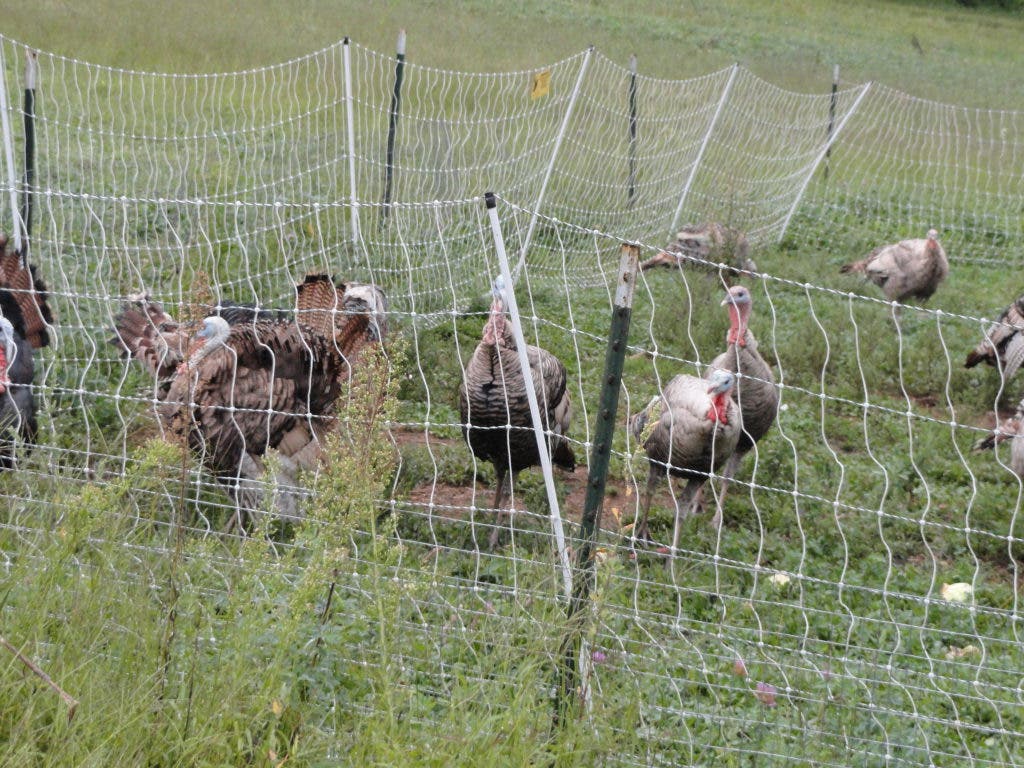
The farm’s 12 turkeys and 100 chickens will be locked away in separate greenhouses, though the turkeys appeared to be having a loud union meeting as to whether they were on board with the plan.
“They’re very vocal,” Hammer said with a laugh.
The farm’s pigs are housed in mobile structures that will be tied down.
For all the planning and preparations, Hammer said he had no idea whether enough has been, or can be, done to minimize Hurricane Irene’s impact.
“This is a new situation that we’re not used to dealing with,” Hammer said. “We’re going on the advice of some farmers who have done this before, and following their precautions.”
Hammer said that one farmer on the Rhode Island coast has been through severe weather and has shared his knowledge of such situations.
Three early-rising customers - Kerry and Evan Anderson, and Michelle Kidwell - were spotted picking in Holcomb’s raspberry patch prior to the rain and heavy winds.
“This is one of the only fruits that [Holcomb] has,” said Kidwell. “I’m worried that the crops outside will be totally damaged.”
Get more local news delivered straight to your inbox. Sign up for free Patch newsletters and alerts.