Politics & Government
George P. McLean: Governor, Senator and Conservationist
The life of a man who left our community a magnificent natural resource, the McLean Game Refuge.
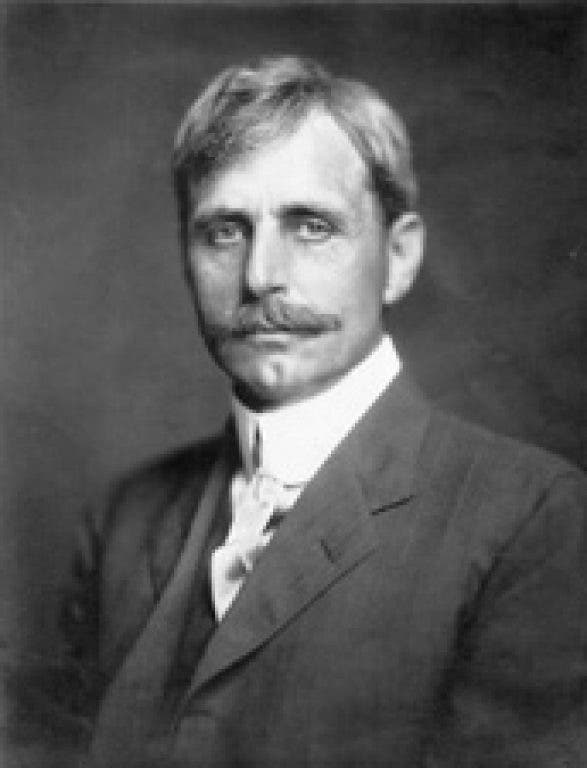

George Payne McLean, one of the most highly respected men in Connecticut's history, was born in Simsbury on October 7, 1857. From Colonial days, his forefathers were counted among the preeminent men of Simsbury and Connecticut. His father, Dudley, is remembered as a prosperous and influential farmer and his mother, Mary Payne, was a daughter of Solomon Payne, one of the principal leaders in Windham County and a direct descendant of William Bradford, the first Pilgrim Governor of the Plymouth Colony.
Like so many of Connecticut's foremost sons, George spent his early days as a sturdy country boy working on his father's farm during the busy summer months and attending school during the winter. The McLean farm, known as the "Homestead," was located on Firetown Road. It was built in 1809 by the Rev. Allen McLean, a pastor of the Simsbury Congregational Church for 50 years. What is now Hopmeadow Country Club's clubhouse was the homestead barn, and the residence, called Holly Hill, is now the Governor's House nursing home.
After acquiring all the advantages offered by the public schools of Simsbury, he went to Hartford to attend the high school. This was to be the end of his school education and he took full advantage of his opportunity. In his junior year he received the distinction of being chosen editor of the school paper. He graduated in 1877.
Find out what's happening in Granby-East Granbyfor free with the latest updates from Patch.
Having received his high school diploma, he started out in his 20th year to earn his own livelihood. It was doubtless his experience on the school paper which turned his immediate thought to journalism. He became a reporter for the Hartford Evening Post at a salary of $7 a week. Having been determined to join the legal profession, he left the Hartford Post and entered the law office of Henry C. Robinson in Hartford. While studying, he supported himself by keeping books for Trinity College. He studied his law books with understanding and enthusiasm and, in 1881, he was admitted to the bar in Hartford.
As he prospered in his profession, his influence grew in the political world. In 1883, two years after he was admitted to the bar, he was chosen to represent the town of Simsbury in the State House of Representatives. His career in the legislature was active from the start and he soon earned a place of prominence in the General Assembly. He was made clerk of the Board of Pardons, a position he held until he was elected governor.
Find out what's happening in Granby-East Granbyfor free with the latest updates from Patch.
In 1885, Gov. Henry Harrison appointed McLean, as a member of the commission, to revise the statute laws for the state. The same year of his appointment on this important committee he was urged to take the Republican nomination for state senator from the Third District. He was elected by a large majority and took his seat in 1886. In the presidential campaign of 1888, he did effective work for the national ticket, making speeches to appreciative audiences throughout the state, and it was in no small degree due to his efforts that Connecticut gave such a large majority of the vote to William Henry Harrison. In 1892, on the advice of the entire Congressional delegation from Connecticut, President Harrison appointed McLean United States Attorney.
In 1900, the Republican State Convention nominated McLean for governor. He was inaugurated as Connecticut's Governor on Wednesday, Jan. 5, 1901, and held office for two years.
In 1903, McLean returned to his family farm and began purchasing land. In 1905, he received a $3 million inheritance, which he immediately put to work increasing his land holdings, which he continued to do until his death.When he became a Senator in 1911, he served as chairman of the Committee on Forest Reservations and Game Protection. He subsequently helped pass the Migratory Bird Treaty Act of 1918, and eventually served three full Senate terms. He often brought political colleagues, including United States Presidents Coolidge, Taft and Hoover, to visit his game refuge.
In his will, he created the McLean Fund, which helped create the McLean Home Care and Hospice in Simsbury; but McLean's love of nature and wildlife also led him to establish a game refuge so that, as his will states, "others might find there, the peace of mind and body that I have found".
Be sure to read next week's Historically Speaking and find out how McLean Game Refuge became what it is today.