Community Corner
Greenwich Proclaims Feb. 24 As 'Rare Disease Awareness Day'
Members from the community gathered at Greenwich Town Hall Thursday to raise awareness about rare diseases.


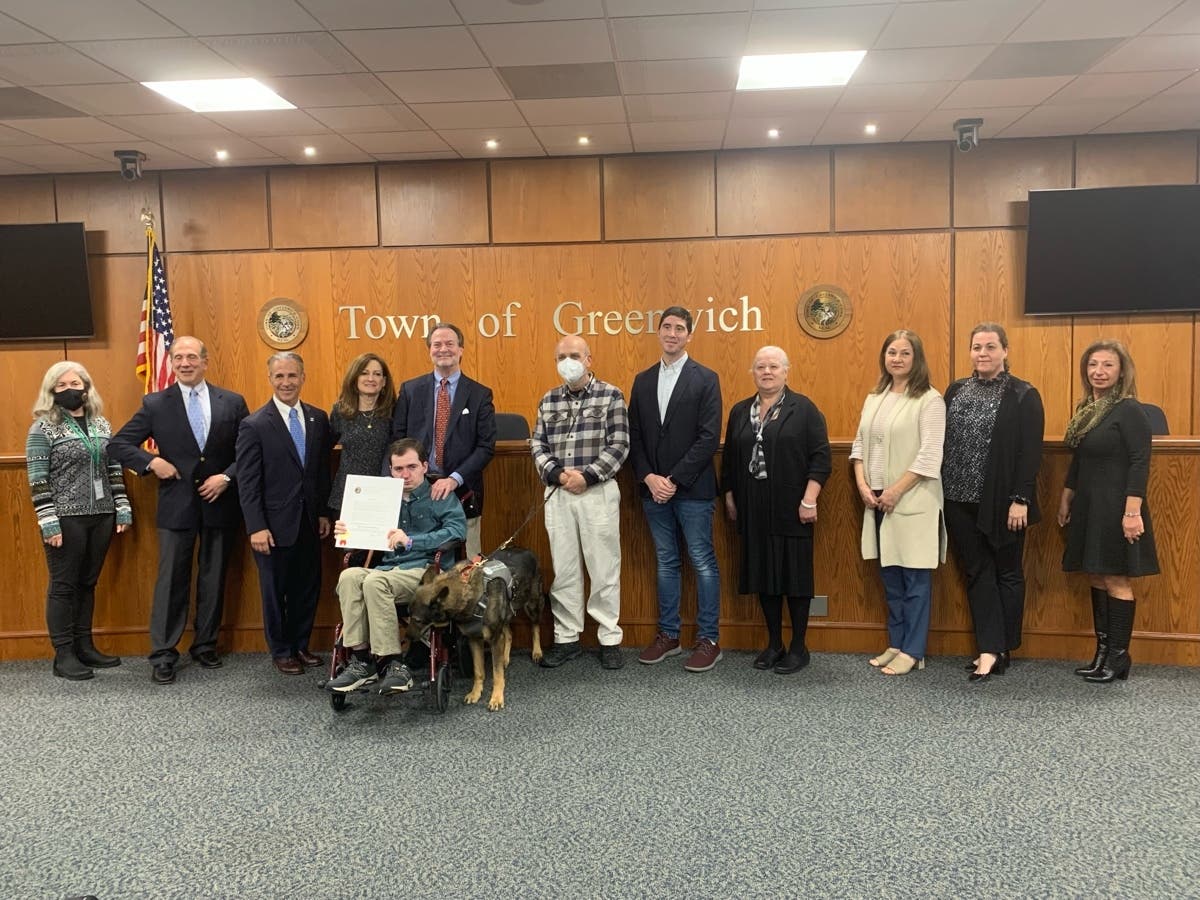
GREENWICH, CT — As the COVID-19 pandemic continues to march on, the town of Greenwich paused on Thursday to shed light on some of the more rare diseases that are impacting people every day.
First Selectman Fred Camillo proclaimed Feb. 24 as Rare Disease Awareness Day in Greenwich during an event at Town Hall, which featured several speakers from local rare disease organizations.
This is the third year Greenwich has held suich an event. The hope is to raise awareness and urge residents to recognize the impact rare diseases have on members of the community, especially because funding is scarce.
Find out what's happening in Greenwichfor free with the latest updates from Patch.
There are over 7,000 identified rare diseases, and one in 10 people is living with a rare disease, Camillo said in his proclamation. The number of people living with a rare disease is equivalent to the population of the world's third largest country, Camillo added.
"It really does touch all of us," said Camillo, whose sister, Donna Marie, died at age 11 from leukemia on Feb. 26, 1968. Today, her form of leukemia has a 90 percent survival rate, but more work needs to be done to combat rare diseases.
Find out what's happening in Greenwichfor free with the latest updates from Patch.
"Things are going in the right direction, but we've got to keep doing this until we get that 100 percent mark," he said.
John Hopper, president of the Fibrolamellar Cancer Foundation and co-chair of the NORD Rare Cancer Coalition, said large organizations like the Chan Zuckerberg Initiative, the Food & Drug Administration and the National Institute of Health are working on addressing rare diseases.
"All of us together, the louder we are, the more we're heard, the more recognition there is and the more funding there is to be had," Hopper said. "My request today is simple. Help us save lives by supporting rare diseases in any way possible through education and awareness, through funding, through networking and asking your local and state and national representatives to support more rare disease initiatives."
Several other speakers from various local rare disease organizations spoke about their experiences and how their organizations have helped people.
When Gregg Pauletti's daughter, Willa, was 3 years old, she complained of stomach pain one night. A few days later, she was still experiencing discomfort.
"We didn't think anything of it," Pauletti said. "We went to the doctor at 9 a.m. to her pediatrician. By 1 p.m., we were at Memorial Sloan Kettering Cancer Center. We didn't leave MSK for 25 days."
Willa had neuroblastoma, a form of pediatric cancer, which has only about 800 diagnoses per year. About 25 percent of all cancers are rare, and every pediatric cancer case is rare.
Luckily, Willa is in complete remission now.
Pauletti said there have only been 10 drugs developed to treat pediatric cancer since 1980, and the average hospital stay for a child with cancer costs $40,000.
Also, less than 4 percent of the National Cancer Institute's research dollars goes toward pediatric cancer, Pauletti noted. He and his wife formed the Golden Lights Foundation, which looks to connect donors directly to the research project.
"The hallway your children walk down is probably full of other people going through similar experiences," Pauletti said. "There are people that need a voice, and that is our foundation's goal."
Andrea and Phil Marella, the founders of the Greenwich-based Dana's Angels Research Trust (DART), spoke about their daughter, Dana, who was diagnosed at age 8 with Niemann-Pick Type C Disease.
It affects one in 120,000, and is characterized by an inability of the body to transport cholesterol and other fatty substances inside of cells.
Dana died 11 days short of her 20th birthday.
The couple's youngest child, Andrew, was also diagnosed with NPC. But advances in medicine and drug trials, which have been fostered by DART, have allowed him to survive and thrive.
Since 2002, DART has raised $5.5 million to help with research and drug trials for NPC.
Andrew receives a drug through a spinal tap once per month. Phil said the experimental treatment will be expanded soon to more patients.
Greenwich resident Alan Gunzburg, who has been a part of the First Selectman's Advisory Committee for People with Disabilities, spoke about his diagnosis of Retinitis Pigmentosa in his 30's.
After wanting to learn more about it, he found out he had Adult Refsum Disease, a rare genetic disease in which the body can't process a long chain fatty acid called phytanic acid, which is found in milk products, red meat and other foods.
ARD causes vision loss, hearing loss, loss of sense of smell, ataxia, peripheral neuropathy, skeletal malformation and other issues.
Gunzburg said that looking back on his journey to find an answer for what was ailing him, he felt he was underdiagnosed.
"If properly diagnosed, I could have made changes to my diet at that time that might have saved more vision, more hearing and possibly kept me driving," he said.
Gunzburg is on the Board of Directors of the Global DARE Foundation, which is looking to find a cure for ARD. Over the last few years, the organization has started various food studies to help those affected with the disease. They also have a mouse model study underway at Johns Hopkins University.
Gunzburg said the Chan Zuckerberg Initiative and their Rare As One Project, which was established by Facebook founder Mark Zuckerberg and his wife Priscilla Chan, recently issued a donation of $50,000 to the Global DARE Foundation.
Lesley Bennett, the Connecticut State Ambassador for the NORD Rare Action Network, spoke briefly as well.
She said her organization has held public events around the state with the hope of making Connecticut lawmakers more aware of the needs of the rare disease population.
Bennett said the formation of a newly-approved rare disease advisory council at the state level will help raise that awareness.
Get more local news delivered straight to your inbox. Sign up for free Patch newsletters and alerts.