By Linda Ziac
February 24, 2015
Find out what's happening in Greenwichfor free with the latest updates from Patch.
The topic for today’s article is the issue of hoarding, a phenomenon that is increasingly being discussed in the media.
Hoarding is an under recognized problem that exists in most communities and adversely impacts the health, welfare, and safety of humans, animals, and the environment.
Find out what's happening in Greenwichfor free with the latest updates from Patch.
Hoarding is a very complex and multifaceted issue.
The purpose of today’s article is to provide a brief overview of hoarding, and this article is not meant to be all inclusive, or to serve as clinical advice.
It’s important to note that each person is unique, but there are some common elements seen in hoarding.
- A person often begins “saving things” in childhood around the age of 13
- It’s common to have a family history of hoarding
- Hoarders are known for low marriage rates - high divorce rates – and they tend to live alone
- Hoarders have a wide range of educational levels, and on average they don’t usually seek treatment for their hoarding behavior until around the age of 50
Another important finding is that 92% of people who hoard, are believed to have one or more underlying mental health issues, such as:
- Depression
- Generalized Anxiety
- Obsessive Compulsive Disorder
- Social phobias
According to the new edition of the Diagnostic and Statistical Manual of Mental Disorders
(DSM 5), people with a hoarding disorder have a conscious, ongoing urge to accumulate possessions, as well as corresponding feelings of anxiety or mental anguish whenever those possessions get thrown away.
It’s important to point out that there is a difference between Collecting, Cluttering and Hoarding.
Collecting
When we look at collecting, we see that collectors typically keep their possessions well organized, and each item differs from other items, to form interesting and often valuable groupings.
An important purpose of collecting is to display the items for personal as well as other’s enjoyment, and to appreciate their value.
Collecting may include items such as dolls, sports memorabilia, or coins.
Cluttering
The concept of cluttering falls somewhere in between collecting and hoarding
Cluttering lacks the organization usually associated with collectors, and it also lacks the “mass” or “volume” associated with hoarding
A key factor is that cluttering doesn’t interfere with the person’s daily life.
Also, although clutter is the most easily visible marker of hoarding, a home can be cluttered for a variety of reasons.
Only when the clutter results from excessive acquisition and difficulty getting rid of things, and it interferes with the person’s daily functioning does this behavior constitute hoarding.
Hoarding
Now looking at hoarding - hoarding is the compulsive purchasing, acquiring, searching and saving of items that have little or no value.
This behavior usually has negative effects which can be emotional, physical, social, financial, and even legal; which we know not only impacts the hoarder, but their family as well.
Hoarding Consists of 3 components
Component 1
This is the acquisition of and the failure to discard possessions that appear to be useless or to have limited value.
This may include:
- Junk mail
- Old catalogues and newspapers
- Things that might be useful for making crafts
- Clothes that might be worn one day
- Broken things
- Trash
- “Freebies” picked up by the hoarder
Component 2
This Involves cluttered living spaces.
Keep in mind that having cluttered storage areas in the basement and attic doesn’t necessarily make someone a hoarder.
Only when the clutter impinges on the living areas of the home, or when it creates other problems like the financial strain of paying for storage areas can it be considered hoarding.
Examples of hoarding may include:
- Beds that can’t be slept in
- Kitchens that can’t be used for food preparation
- Refrigerators filled with rotting food
- Stove tops covered with items such as junk mail and old food
- Tables that can’t be used for dining
- Chairs or sofas that can’t be sat on
- Filthy unsanitary bathrooms, or piles of human feces around the home
- Some people also hoard animals they can’t even care for
Component 3
This stage involves significant distress or impairment in functioning, caused by the hoarding behavior.
- Family and friends may not be allowed to visit, because the clutter embarrasses the hoarder
- The shades may be drawn so no one can look inside
- There’s often repeated family arguments about the accumulating debris
- Most importantly, there is an elevated risk of fires, falls, infestation of bugs and rodents, or there may be a threat of eviction
The end result is that the hoarder and family members often feel embarrassed, depressed and anxious because of the clutter.
A Case Example
I’d like to highlight one of the cases that I worked on with a local attorney Donna.
Mary
67 year old female
Never married
Lives alone in an apartment building
Donna received a referral from Mary’s landlord due to neighbors’ complaints about the odors coming from the apartment. Donna in turn brought me in on the case, because of my previous experience of working with hoarders.
When Donna and I arrived at Mary’s apartment we had trouble getting in the front door, because of the sheer volume of debris stacked in the apartment.
As we opened the door we were greeted by swarms of flying insects.
Once inside we saw the classic signs of hoarding:
- There were piles of newspapers, plastic bags, discarded food wrappers, and broken appliances
- A maze was created between piles of trash to serve as a walkway
- Beds and furniture were covered with debris, making them unusable
- Trash was piled on the stove, sink, and counter tops
- The refrigerator smelled of spoiled food
- The water in the apartment was turned off, making the sink and toilets non-functioning
It took Donna and I quite a while before Mary finally allowed us to call EMS, in order to have Mary checked out medically.
Among the findings, Mary was found to be:
- Malnourished
- Dehydrated
- In poor health
- In need of assistance with personal hygiene – for starters
This may sound like an extreme case to our readers, but unfortunately what I’ve just described is all too common, as the result of:
- Hoarders not acknowledging a problem
- Family members not knowing how to help
- Landlords or professionals turning a blind eye to the problem, because they don’t want to get involved
Some Reasons People Hoard
People who hoard share a variety of reasons for their behavior.
1. The most frequent motive for hoarding is to avoid wasting things that might still have value.
Often people who hoard believe that an object could still be usable, or might be of interest or value to someone else.
The process of deciding if they should discard an item often leaves the hoarder feeling guilty about wasting a potentially valuable object.
“If I save it, I might never need it, but at least I have it in case I do.”
2. The 2nd most frequent motive for saving is the fear of losing important information.
Many hoarders describe themselves as information junkies who save newspapers, magazines and other sources of information.
They report they save these items so when they have time, they’ll be able to read all the valuable and useful information.
For most hoarders, having the information in their home seems crucial, whereas knowing that the information exists on the internet or in a library, does little to help them get rid of their often out dated materials.
Hoarders are often intelligent and curious people for whom the physical presence of information is almost an addiction.
3. The 3rd motive for saving is the emotional meaning of objects.
This often includes the sentimental association of things with important people, places, or events. Something almost everyone experiences, but not to the same degree.
Another frequent form of emotional attachment concerns the incorporation of objects as part of the hoarder’s identity. Getting rid of a possession feels like losing a part of themselves.
For many people who hoard, possessions offer a sense of comfort and security.
4. Other people say they hoard because they appreciate the aesthetic appeal of objects, especially their shape, color, and texture.
Many people who hoard describe themselves as artists or craftspeople, who save things to use in their art projects.
Unfortunately, having too many supplies can get in the way of living, resulting in the art projects never getting done.
How can individuals and family members assess if there is a problem with hoarding?
If a reader or someone they know may have a problem with hoarding, here are a few questions that they may want to ask.
- Are you able to resist the urge to collect items, even those you know you’ll never use?
- Do you often avoid throwing things away because it’s too upsetting?
- What percentage of your house is unusable because of clutter?
- Are your possessions disorganized?
- How much does the clutter in your home embarrass you?
From what I’ve outlined in this article, it seems unlikely a person struggling with a hoarding issue
is going to seek help on their own.
When is it time to seek professional help?
As I’ve discussed, hoarding ranges from mild severe.
In some cases, hoarding may not have much effect on a person’s life; while in other cases it may impact them on a daily basis.
- Usually the 1st symptoms of hoarding are clutter and difficulty throwing things away
- It’s common for the 1st symptoms to surface during the teenage years (age 13)
- By middle age, symptoms are often severe and may be more difficult to treat
- This is why early detection and treatment is so important
- The prevalence and severity of this disorder appears to increase with age
If you or a loved one has symptoms of hoarding, talk with a doctor or mental health provider as soon as possible.
For friends and family members, as hard as it might be, you may also need to contact local authorities for help such as social services, the police, fire, public health, or animal welfare agencies; especially when a person’s health or safety is in jeopardy.
Although hoarding can be embarrassing, many people report that they feel relieved after discussing their behavior and feelings with a doctor or therapist.
It’s important to note that the diagnosis of hoarding should only be done by a qualified mental health professional, such as a psychiatrist, psychologist, or licensed professional counselor.
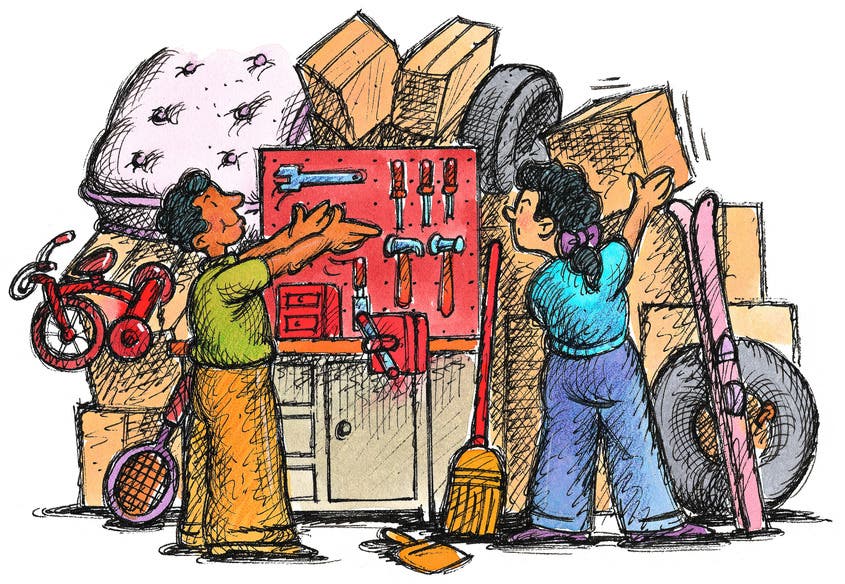
Photo from The Printshop
The information in this article is provided as an information resource only, and is not to be used or relied on for any diagnostic or treatment purposes. This information is not intended to be patient education, does not create any patient provider relationship, and should not be used as a substitute for professional diagnosis and treatment.
The appearance of hyperlinks does not constitute endorsement by The Caregiver Resource Center (TCRC). TCRC does not promote, support, condone, advocate, or abide by any third party web site, sentiment, or the information, products or services contained therein. TCRC does not exercise any editorial control over the information you may find at these sites and other Internet locations. TCRC does not affiliate with or contract with any third party websites, associations, parties, or proxies, except where clearly designated and subsequently confirmed by an authorized representative of TCRC.
Please consult your health care provider for an appointment, before making any healthcare decisions or for guidance about a specific medical condition.
____________________________________________________________________________
Linda Ziac is the owner and founder of The Caregiver Resource Center. Linda founded her company in October 1990, and provides concierge case management and advocacy services for seniors, people with special needs and families.
Linda’s professional career spans 39 years in the health and mental health field as a CT Licensed Professional Counselor, CT Licensed Alcohol and Drug Counselor, Board Certified Case Manager, and Board Certified Dementia Practitioner.
Linda’s role is to work with the client, their family and healthcare professionals to help assess, plan for and implement ways to allow for their greatest degree of health, safety, independence, and quality of life. We are often asked to help when a person is taken to the ER, is in the hospital, or there is a need to help assess and implement a plan to address a person’s day to day needs.
This process involves identifying a client’s abilities and needs, and helping to design a care plan (road map) that is composed of a spectrum of services, that best meets the unique needs of that particular client. A client and their family select the services that they want, and they only pay for those services.