Arts & Entertainment
Groton Author Debuts Novel About Race Rock Lighthouse
'Legacy of the Light' Is Historcial Thriller


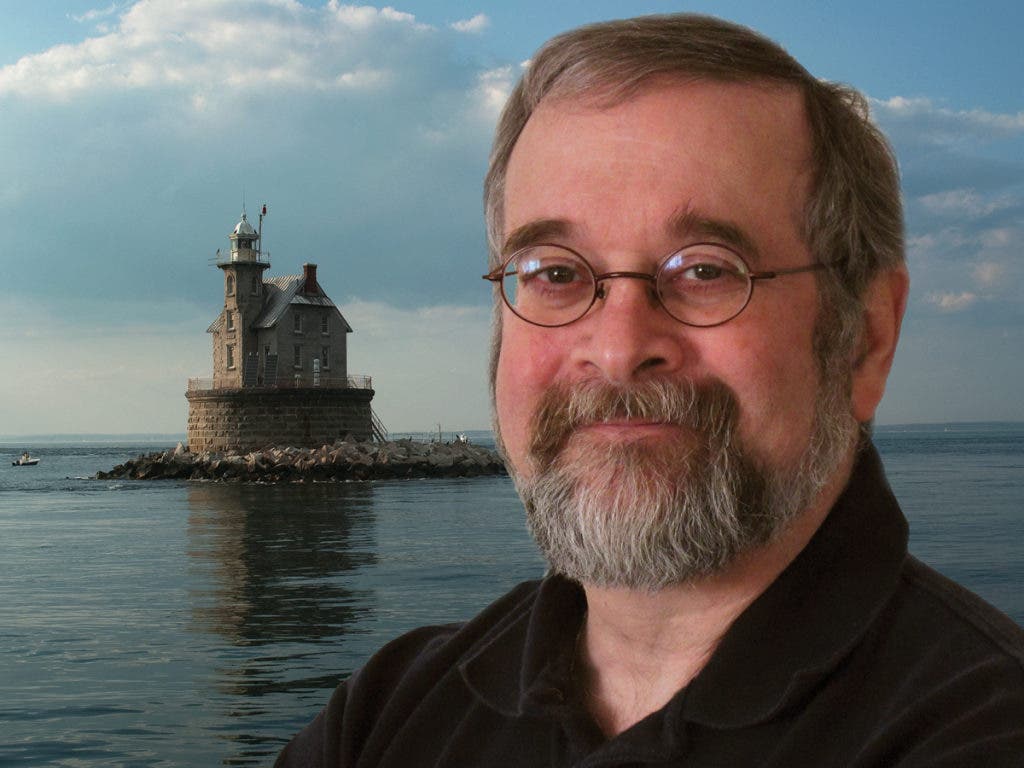
Todd Gipstein is an accomplished photographer, producer, and lecturer whose work has been featured in National Geographic and Time-Life Multimedia.
He studied writing and film at Harvard University, where he graduated with honors in 1974.
A year later, he founded Gipstein Multimedia of Boston, and has since produced freelance work for museums and corporate clients.
Find out what's happening in Grotonfor free with the latest updates from Patch.
Gipstein, a New London-native, moved to Groton in 2005. In 2009, he filmed a documentary on the Ledge Light lighthouse, its history, design, restoration, and ghosts.
Until recently, Gipstein’s writings had included manuscripts, magazine articles and columns. This year, he adds another title, having debuted his first fiction novel, Legacy of the Light.
Find out what's happening in Grotonfor free with the latest updates from Patch.
Legacy is an historical thriller that encompasses two generations of lighthouse keepers at Race Rock lighthouse. The story begins in 1907 and continues through 1938, when Connecticut was hit by the hurricane of the century.
Gipstein penned the novel on and off while filming documentaries and pursuing other work in photography. Research from these projects fed into Legacy and continues to inspire his work as a novelist.
Legacy of the Light is available at www.gipstein.com.
What brought you to Groton?
I had grown up in New London, but other than family business, I hadn’t been here in 40 years.
We [Gipstein and wife Marcia] came up for my dad’s 101st birthday and happened to see a listing over at for a home for sale at Eastern Point. We weren’t looking to move, but on a whim came over and saw it. It was a no brainer. It had a beautiful view of the lighthouse and ocean. It was a great house and we said, ‘Yea, let’s do it!’ Two days later, we bought that house and two months later we were living here.
You can pretty much work from anywhere in the world these days and what better place in the world to be in?
How did this topic present itself to you?
Believe it or not, this story actually began in 1971, when I was a freshman at Harvard just doing a writing course. I had taken a picture as a kid of Race Rock in the fog that I liked to have with me in my portfolio. I had to write a short story and I looked at this picture and thought [it] would be interesting topic to do a story about a remote lighthouse, lighthouse keeper, and a storm.
I wrote a pretty bad short story about it, but over the years I liked the idea and kept with it.
In the back of my mind, I was always working on it and getting little tidbits for it. Writing a little part of it here and a part of it there.
It wasn’t until my wife and I moved up to Eastern Point that I really got serious about writing the book, because we were living where the whole story took place.
Why did you set the story at Race Rock?
I always liked it. It’s kind of this weird castle out in the ocean. It was a strange looking building; very gothic—kind of spooky. I was always fascinated by it.
Your background is in photography and filmmaking, largely, and not fiction. Why dive into fiction writing?
I’ve always been a storyteller. The documentaries I did had a storytelling style to them with characters, who were often first-person, leading you through a documentary situation. I think my work was always noted as not being a traditional, dry documentary, but being a little more emotional.
I wanted to write a novel after thirty odd years of writing documentaries. Documentaries were generally short—anywhere from three minutes to twenty five—that’s pretty tough writing. You really have to condense complex topics down to fairly short scripts. A novel I found to be very liberating. It was storytelling where I didn’t have a stopwatch in one hand worrying that in five or ten or fifteen minutes the project was as far as it would have to be. I had no agenda. I had no clients. To me, it was almost recreational. It was kind of my reward to write the book and have fun writing it.
What are your literary influences?
I read a lot of fiction and read a lot of non-fiction—history and so on.
It’s like when I teach photography, I tell people, ‘You can admire great photographs, but don’t try to imitate them. Try to find your own style of photography.’ I think that it’s the same with writing.
I just wanted to write it in a way that brought [Race Rock] to life. I think that the people who have read [Legacy] were very struck by the descriptive quality of it—the kind of visualization of it. They tell me they can feel the storm, they can feel the fog, and all of that.
I think that comes with my being a photographer. A lot of my storytelling comes out in the visual world.
I don’t know that I have a particular author that I can point to and say his or her work influenced me. I think it was my own work in media.
How long did it take for you to complete the book?
I started it in earnest sometime in the spring or summer of 2006. With a busy life and a lot of travel and other projects, it was never anything I could do full-time. It was finished about the end of March of this year.
The one thing I never had was a deadline. Every writer will tell you, when you have a deadline, you get things done. There was never any reason that I had to get it done, until my wife and I came back from Antarctica in January and met with Susan Tamulevich over at the Custom House Maritime Museum. They were having a lighthouse exhibit in July. I mentioned to [Tamulevich] that I was writing a book about a lighthouse and she said, ‘Oh great we can have a book signing. Say, July 1?’
Well, there I had a deadline and within two months of having that deadline it was done.
What were the challenges of writing?
I don’t know that there were any real challenges other than having a deadline and getting it done—finding the time and reason to get it done. I had never had any writer’s block, I never had any problems with wanting to do it.
I think the challenge was in constructing a plot that had some interesting twists and turns, that had some complexity and depth to it, as opposed to a comic book action adventure piece. There were some things about life and dedication and the past and family relationships and all those kind of things that can relate some interest.
But, I didn’t really have any challenges, not compared to documentaries. Try to do the life of Napoleon in eight minutes—that’s hard.
Are your characters based on historical figures?
Not specifically. There are people mentioned by names that were homage to various friends or family. I would say that the characters, by and large, are amalgams of the people that I know—with traits or experiences woven into a character.
As a writer, you collect impression, thoughts, and observations about life and when you need something to flesh out a character or drive out the action you look to that file.
You frame the story between very specific dates (1907-1938). What is it about this time that is so intriguing?
It was partly the mathematics of the generation [of the characters in the novel]. I had to kind of work backwards. I wanted the main character, Caleb, to be at the lighthouse in 1938. I also wanted him to be there as a young boy growing up on Race Rock. 1907 ends up being the date when his father, who is the keeper, has been there for awhile.
Also, 1907 worked out because it was a different world—things were changing a lot and the role of keeper was very important at that time to navigation and the maritime area. The work, dedication, and commitment of the father plays out in more meaningful ways later on, we find out.
How has the reception been so far?
It’s been fantastic! You can go to amazon.com and read the smattering of feedback there. A lot of people said it would make a great movie and they say that once they get into it, they simply cannot put it down.
It’s a little bit like a storm: it starts out calmly and builds and builds and builds. Tension gets ratcheted up and people really get swept up in it and then there’s a resolution—kind of a calm after the storm.
So far, I’ve gotten very, very good reviews and certainly from people in the area who lived through the hurricane.
What’s the next step? Do you hope to continue writing?
The book was a lot of fun to write and people tell me it’s a lot of fun to read and so I hope to continue writing. I’m enjoying the freedom that fiction and novel writing is giving me.
I’m actually writing a second book that is totally different. It’s about performers and magicians in the early 1940s. It’s not a Harry Potter fantasy book. It’s about real magic and the art and history of magic, which I’m interested in and have performed.
It’s going to be about a young magician making his way through the ranks, meeting some of the greats, and having all sorts of interesting experiences in the world of magic. It will also have a good component that takes place in New London and branches off to New York.
I hope to get that one done by next summer.
What is the takeaway of this story?
I’m not sure it’s about one thing. It’s about a number of things. I tried to have different things that people could take.
One of the main themes is that you can’t change the past. You have to accept it and understand it—be mindful of the past—and move on to the future.
Another theme is rising to the occasion when you’re challenged by other people, or nature, or your own demons. You have to confront them and deal with them if you want to move on.
Some of the takeaway, too, is the idea of dedication to the job and the realization that you may be judged on your failures in your job and not on your successes. That’s kind of the way that life works.
Another is: sometimes we control events, sometimes our plans work out; many times they don’t. We are either controlled by events or things that happen casually or serendipitously, which may take effect on our lives. We don’t always realize that. Fate is a funny thing and it drives us in a lot of funny ways that we cannot always predict or control.