Community Corner
One Of Noank's Many Turn Of The Century Celebrities
Prominent Landscape Painter, Henry Ward Ranger Brought Music, Culture and Color to the Area
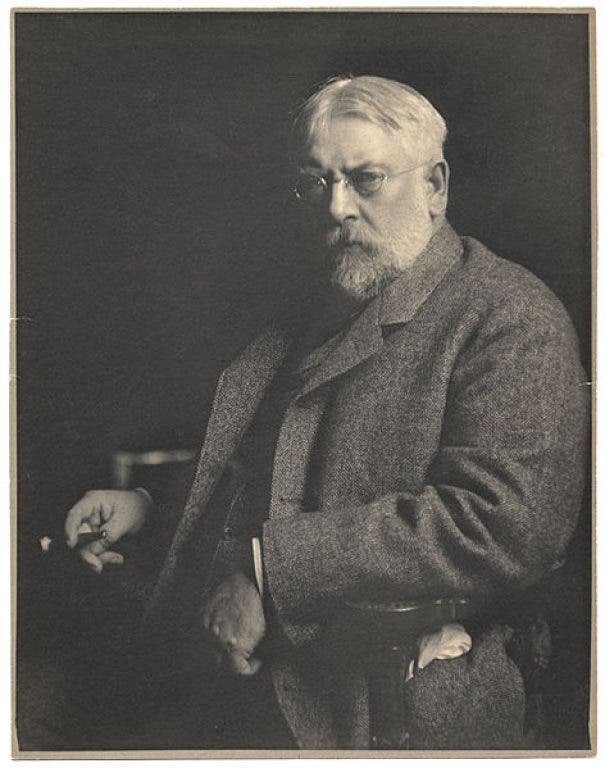
Over the years, many artists with merit have flocked to our naturally scenic landscapes to capture the beauty. Henry Ward Ranger, prominent landscape painter, established Old Lyme as a serious art colony for scenic painters and settled in Noank in the midst of a flourishing career.
Ranger, a New York native born in 1858, attended some classes at Syracuse University but for the most part was a self-taught watercolorist.
According to a lecture about Noank artists given at the Pratt-Wright Gallery years back, Pricilla Pratt said, "(Ranger) has been described by a contemporary as a man of ‘full weight, dressed carelessly for the most part who loved big loose clothes of English or Scotch tweeds.' It was said that 'he slouched in his big easy chairs and talked in a rather suppressed tone and often most entertainingly, the voice coming past the cigarette which was forever literally on his lip.’”
Find out what's happening in Grotonfor free with the latest updates from Patch.
In the 1870’s, Ranger took a studio in New York, followed by more than a decade of working and painting in Europe, where he was deeply influenced by the painters of the Barbazon School - a movement of realism which derived inspiration from nature.
Ranger lived in an era when great painters and artists of like minds gathered in colonies. After experiencing this in Europe, he returned home in 1888 and began searching for suitable locations for an American artist colony.
Find out what's happening in Grotonfor free with the latest updates from Patch.
Touring the coastline, Ranger found Old Lyme to be an ideal spot and in 1899, founded the Old Lyme Art Colony - a shared co-operative for like-minded Barbizon painters.
With a scenic similarity to France, he was able to initiate a strong art movement of painters interested in capturing scenic America. With the assistance of Florence Griswold, the movement lasted more than thirty years and brought over 200 resident artists to the area.
Well established in the art scene of Old Lyme, Ranger had a sudden change of opinion about his surroundings. Although the reason for his departure is unknown, several accounts say his only recorded comment stated the area had become ”too civilized.”
In 1904, after several stays at the Palmer House in Noank where according to Priscilla Pratt, Ranger would sign in and out of the guest log by sketching himself, he purchased property in Noank. He followed by building a coastal house and a portable art studio.
“Mason’s Island was his favorite area and he often painted a stand of trees, what is now called Ranger’s Oaks,” says son of Priscilla Pratt and current Pratt-Wright Gallery owner Tim Pratt.
Ranger kept his studio in New York and traveled between both homes with wife Helen Jennings.
His presence in Noank brought well-known artists into the community such as Impressionist painters Reynolds Beal and Frederick Childe Hassam. He also infiltrated the local airwaves with his music, which was often heard wafting from his studio of the local church.
Toward the end of his life, he spent colder seasons in Jamaica and Puerto Rico. His painting slowed considerably as his health declined.
One year after the passing of his wife, Ranger died suddenly of heart trouble in his New York studio on November 7, 1916, at age 58. Even after his death, he was supporting local art. His estate worth $250,000 was donated to the national Academy of Design to purchase paintings by American artists.