Politics & Government
Hamden Boy, 10, Speaks In Favor Of Playground Bill At State Capitol
The bill prohibits installation of crumb rubber ground cover on municipal and public playgrounds in Connecticut.


By Jack Kramer, Correspondent
HAMDEN, CT — A bill that would prohibit installation of crumb rubber ground cover on municipal and public playgrounds in Connecticut passed, albeit by small margins, two committee votes and now heads to a full vote in the General Assembly.
The bill passed 12-10 in the Planning and Development Committee; earlier it passed 7-6 in the Children’s Committee.
Find out what's happening in Hamdenfor free with the latest updates from Patch.
Last year, Hamden officials reversed course and after approving crumb rubber to refurbish the Hamden High School baseball field, instead went with a mix of cork and coconut. Part of the reason for the change was activists who voiced their displeasure over the crumb rubber plan.
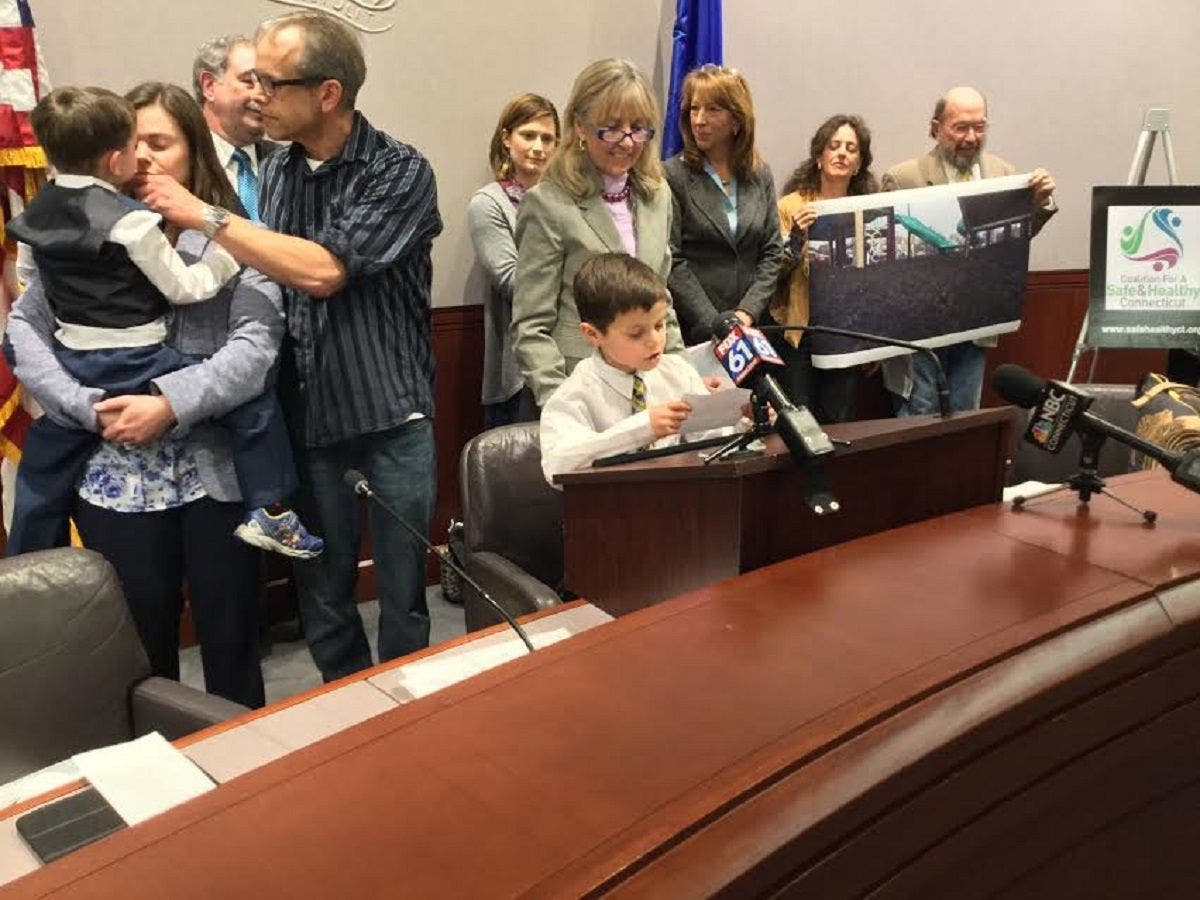
One of the biggest lobbyists for the playground bill at the state capitol was a 10-year-old from Hamden, which has been in the center of the crumb rubber debate.
Find out what's happening in Hamdenfor free with the latest updates from Patch.
“When I go to the playground, I like to run around and play on the monkey bars,” Connor Garrett said. “My little brother is 4 and he likes to play hide and seek. Sometimes he goes under the play structures.
“This is dangerous on recycled tires because tires are toxic and filled with carcinogenic chemicals,” Connor said. “I don’t want my friends, my little brother, or any kids to get cancer.”
Connor wrapped up his presentation by stating: “Please protect the kids in our community by banning shredded tires on our playgrounds. One day we will be in charge and we need to stay healthy to get there.”
Connor was the star speaker at a press conference hosted by Rep. Diana Urban, D-North Stonington, chairman of the Children’s Committee.
“Young children sit, crawl, dig, eat and drink on playgrounds,” Urban said. “There is ample evidence that we should protect our youngest and most vulnerable population from exposure to these proven carcinogen.
“The Icahn School of Medicine at Mount Sinai has recommended that “recycled tire rubber never be used as surfaces where children play,” Urban added.
Urban said young children are “uniquely vulnerable” because their organs and immune systems aren’t fully developed.
Also at the press conference was Louis Burch, of the Citizens Campaign for the Environment, a group of 80,000 Connecticut and New York residents who advocate for issues concerning public health and the environment.
“Children are disproportionately at risk to the adverse health effects associated with these toxins due to their small size, rapidly growing bodies and developing immune systems,” Burch said. “While more research is needed to fully understand the impacts that long-term exposure to these materials can have on children’s health, available science indicates that there is significant cause for alarm, and that the use of crumb rubber around developing children should be avoided wherever possible.”
Despite Urban, Burch and others strong advocacy, the bill barely made it out of committees.
Those opposed it said there wasn’t concrete scientific evidence that the material was dangerous to children. Others voiced concerns about the cost implications of shelving playgrounds already in planning stages.
An attempt to pass similar legislation last year failed.
Opponents testified that much of the information about crumb rubber is “propaganda and hype rather than fact.”
“There is no factual proof that using crumb rubber has or does cause cancer,” Fred Balsamo, executive director of the Connecticut Association of Athletic Directors said in written testimony.
“Without the use of this rubber in the construct of running tracks (it) would move us back into the days of cinder tracks. The development of synthetic fields has made fields safer and has allowed schools to save millions of dollars in maintenance costs and has drastically reduced the use of fertilizers and pesticides.”
Also opposed was Steve Bigelow, president of the Recycled Rubber Council, who contended that playgrounds with rubber mulch are safe.
“Rubber mulch brings significant advantages from cost and safety perspectives,” Bigelow said. “All the available scientific evidence, including dozens of peer-reviewed academic studies and federal and state government analyses, indicates that recycled rubber infill and rubber mulch are safe.”
Department of Public Health Commissioner Raul Pino submitted testimony stating the department was “neutral” on the proposed legislation.
Pino’s testimony referenced two studies, one done in California in 2007 and a 2013 Rutgers University-Robert Wood Johnson Medical School study.
“Both the California and Rutgers studies concluded that any potential exposures from children’s ingestion of these recycled rubber materials would not cause an elevated health risk,” Pino said.
However, “The Department recognizes that these studies have limitations and will continue to monitor the literature as new studies are reported,” Pino added.
Pictured: Connor Garrett, 10, of Hamden, speaks at a press conference in Hartford / Photo by Jack Kramer
Get more local news delivered straight to your inbox. Sign up for free Patch newsletters and alerts.