Schools
Hamden Teachers Participate in Training Program at Quinnipiac University
The teachers recently spent four days at Quinnipiac's School of Education to participate in science education training.


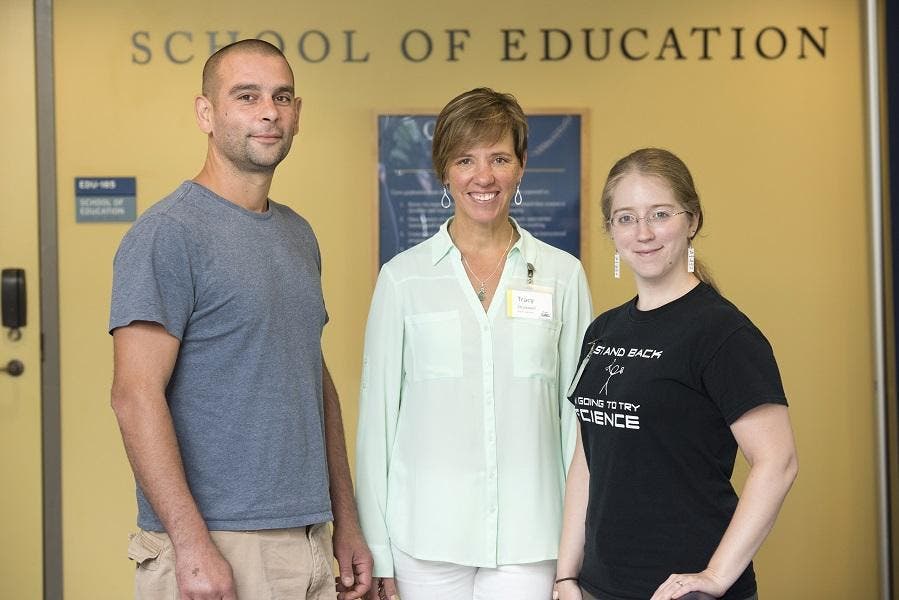
HAMDEN, CT — A group of Hamden educators recently spent four days at the Quinnipiac University School of Education learning how to enhance their lessons using the Next Generation Science Standards.
The standards are state-led K-12 initiatives in science learning developed by the National Research Council, the National Science Teachers Association, the American Association for the Advancement of Science and other critical partners. Finalized in 2013, the standards are rich in content and practice and arranged in a coherent manner across disciplines and grades to provide all students an internationally bench-marked science education.
The training, called Project SING (Science Induction for the Next Generation), was made possible by a Teacher Quality Partnership Grant from the state Office of Higher Education that was awarded to the Bristol-Myers Squibb Center for Science Teaching and Learning at Quinnipiac and the University of New Haven.
Find out what's happening in Hamdenfor free with the latest updates from Patch.
Cindy Kern, visiting professor of education and director of the Bristol-Myers Squibb Center for Science Teaching and Learning at Quinnipiac, and Amanda R. Bozack, formerly of the University of New Haven and currently at Radford University, led the training. Also helping with the professional development program were Courtney McGinnis, assistant professor of biology at Quinnipiac, and university education students Samantha Franzese of Westchester, New York, Chelsea Savage of Pembroke, Massachusetts and Emily Sparago of Cheshire.
The program brought together teams of new science teachers, veteran science teachers and administrators from the Capitol Region Education Council and Notre Dame High School of West Haven, as well as the Bridgeport, East Haven, Hamden, Meriden and New Haven school districts, to learn innovative approaches to teaching science based on the Next Generation Science Standards.
Find out what's happening in Hamdenfor free with the latest updates from Patch.
"This is the second year,” Kern said. “Last year, the teachers spent an entire year really engaging in and understanding the paradigm shift from what science teaching is now to where we want to move to. This year, they’re thinking solely about their classrooms and their students. The goal is to design a unit of instruction that is based on a natural phenomenon and addresses multiple next generation science standards.”
The work will continue throughout the 2016-17 school year. This project is funded in part by a federal grant under Title II of the No Child Left Behind Act (P.L. 107-110) administered by the State of Connecticut Office of Higher Education; $191,068 of the cost of the project was financed with federal funds.
Opinions and findings expressed herein do not necessarily reflect the position or policy of the U.S. Department of Education or the State of Connecticut Office of Higher Education, and no official endorsement by either of these agencies should be inferred.
Pictured, from left to right, are: Raffaele Romano, 12th grade anatomy and physiology teacher at Hamden High School, Tracy Stockwell, director of science for Hamden public schools, and Theresa Hague, eighth-grade science teacher at Hamden Middle School. The teachers recently continued Project SING (Science Induction for the Next Generation) training at Quinnipiac University.
Contributed article from Quinnipiac University
Get more local news delivered straight to your inbox. Sign up for free Patch newsletters and alerts.