Community Corner
Hamden Woman Walks to Fight Breast Cancer
Diagnosed in March, Andrea Esposito's outlook is good because of early detection.
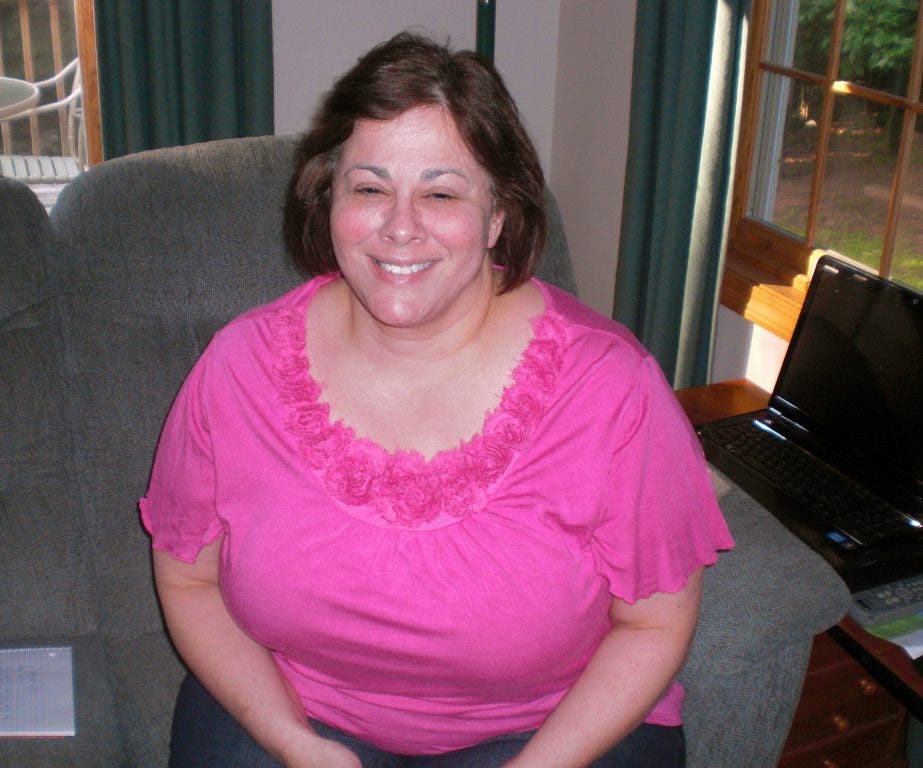
A disturbing diagnosis several months ago has led a Hamden woman on a journey that takes her to New York City in October.
Andrea Esposito, diagnosed with breast cancer in late March, will participate with her family and thousands of others in the annual New York City Avon Walk for Breast Cancer on Oct. 15 and 16.
Esposito’s cancer was detected after a routine mammogram showed calcification in the ducts of her breast. Her type of breast cancer -- Ductal Intraepithelial Neoplasia 2 & 3 -- does not have well-known warning signs such as a lump, she said -- the only indication of a problem was pain in the area and mild tenderness.
Find out what's happening in Hamdenfor free with the latest updates from Patch.
An ultrasound scan in January came back normal because “the calcifications don’t show up on the ultrasound,” she said. Without the mammogram in March, she would never have known about the cancer, she said.
After seeing calcification in her breast ducts, Esposito’s pathologist was concerned and issued tests and biopsies, after which she was diagnosed with Ductal Intraepithelial Neoplasia 2 & 3, or cancer of the breast ducts. According to Smilow’s Cancer Center at Yale, her cancer is in Stage 0 while New York’s Sloan-Kettering Cancer Center puts it at Stage 1, both of which indicate the cancer was caught very early. Untreated, a tumor would eventually form, she said.
Find out what's happening in Hamdenfor free with the latest updates from Patch.
“The recovery and the prognosis wouldn’t be as good for me,” she said.
So far, she has undergone a lumpectomy to remove the affected area and two rexisicions, Esposito said. Her cancer is treated on a cellular level, she said, so if two millimeters around the area of the cancer onset is made up of healthy cells, then she can move on to radiation treatment and will not need chemotherapy or a mastectomy.
According to a 2010 study by the U.S. Department of Health and Human Services, Connecticut has the second highest incidence of breast cancer in the United States, but Connecticut’s breast cancer mortality rate is thirty-fourth in the nation. This indicates that although the cancer is being diagnosed frequently, fewer people are dying thanks to treatment.
Esposito said that her diagnosis has changed her outlook on life.
“I kind of looked upon this time of life as dealing with the fact that my kids [were moving away] and it would be my husband and me. Now we’ve shifted to regaining my health and using vacation time for surgeries so I can continue working [and volunteering],” she said.
“My family and friends have been tremendously supportive,” Esposito said. One of the upsides to her condition is becoming closer to her loves ones, she said. “You get a lot of support from people who love you, which is touching.”
Esposito thinks of her cancer as an opportunity to focus on her well-being.
“It also changes your perspective because you think you have all this time. You get to a certain age and think, oh, I have tons more time. Then, all of a sudden, you get this gentle reminder that life is fragile and you need to be mindful of your health,” she said.
She wants others to know that doctors and researchers are “constantly making strides.
“There are all different types of breast cancer so you can’t be too careful," she said. "I think if you see the doctor regularly and do the mammograms then you can feel like you’ve done everything can do to ensure that you’ve been vigilant with your health.”
Esposito works at Yale-New Haven Hospital and her husband, Ronald, is an employee of Yale University. Her family is fortunate to have good health insurance, she said. The treatments are “tremendously expensive,” she said, but there are organizations willing to assist those who do not have great health insurance.
“I really think it’s important for people to know that, especially in this type of economy that we’re in now where there’s a lot of people who are unemployed and don’t have health insurance and maybe you’re having a little bit of trouble finding resources to get regular healthcare and access to a practitioner,” she said. “You need to be persistent and make sure you explore all avenues in terms of getting what you need for treatment…I don’t want people to think, with the economy being so bad, that they have to forgo their health.”
Those struggling financially can look to organizations such as the American Cancer Society and the Avon Walk for Breast Cancer which both fund special programs, she said. And groups such as Why Me?, a non-profit childhood cancer organization, God’s Love We Deliver, which provides nutritious meals for those who are too sick to shop or cook for themselves, and You Can Thrive, which assists low-income families with members who have breast cancer, also are options.
But the economy also has taken a toll on these groups, she said.
“Because the economy has been so poor for so long, a lot of these [organizations] are suffering," she said, "and you don’t want these charities to go away because people who are finding themselves without jobs and in challenging economic positions need the help that they provide.”
The Avon Walk for Breast Cancer, launched in 2003, is held in many cities across the nation, the closest to Connecticut in New York. Participants can walk a maximum of 39 miles and Esposito’s family is walking 20 miles. Each member of her family must raise a minimum of $1,800.
According to the Avon Walk’s website, www.avonwalk.org, funds raised are managed and distributed by the Avon Foundation, and grants are awarded to local, regional and national breast cancer organizations to support five areas: awareness and education; screening and diagnosis; access to treatment; support services and, scientific research.
“Money filters down to places right here in Connecticut,” Esposito said.
Esposito and her husband Ronald have two children, Amanda, 24, and Michael, 22, both of whom live in New York. All four are involved in the walk. Participants include cancer fighters, survivors, family, and friends.
“This is our first year so it’ll be a learning experience,” Esposito said. “I really felt like I wanted to turn [my condition] into something that could benefit other people and not just think about it in terms of myself because that isn’t productive.
“The thing that appealed to me [about the Avon Walk] is that the money gets filtered to a broad spectrum of different types of people and that’s really where I wanted to start,” she said. It was also attractive to her because “a lot of people from Connecticut go to New York for treatment.
“The Walk, to me, symbolizes surviving,” Esposito said. “It also reinforces a personal commitment to my own health because I have to be able to walk the Walk with my family and it is a lot of miles."
Esposito’s grandmother died of cancer when she was young.
“It impacts my family even to this day. My mother grew up without her mom. So I’m very familiar with the repercussions of knowing someone who has had an absent parent," she said. "The devastation of knowing someone who has died from cancer can have long term implications emotionally.
“I think it’s important to get involved and turn whatever negativity there is in the world – in terms of sickness, different struggles we all go through – into a positive,” she said.
Volunteer and donations to the Avon Walk for Breast Cancer are welcome, she said,
“Even if it’s $5, $10, it doesn’t have to be a lot of money,” because every dollar counts, she said.
For more information on Andrea Esposito or to donate to her crew, visit her page on the Avon Walk for Breast Cancer: In It to End It website.
To find out more about fund-raising and basic rules and regulations for joining the walk, click here.