Schools
Physical Therapy Services -- For Free
Quinnipiac University students are providing pro bono physical therapy services every Tuesday night at the school's North Haven campus.


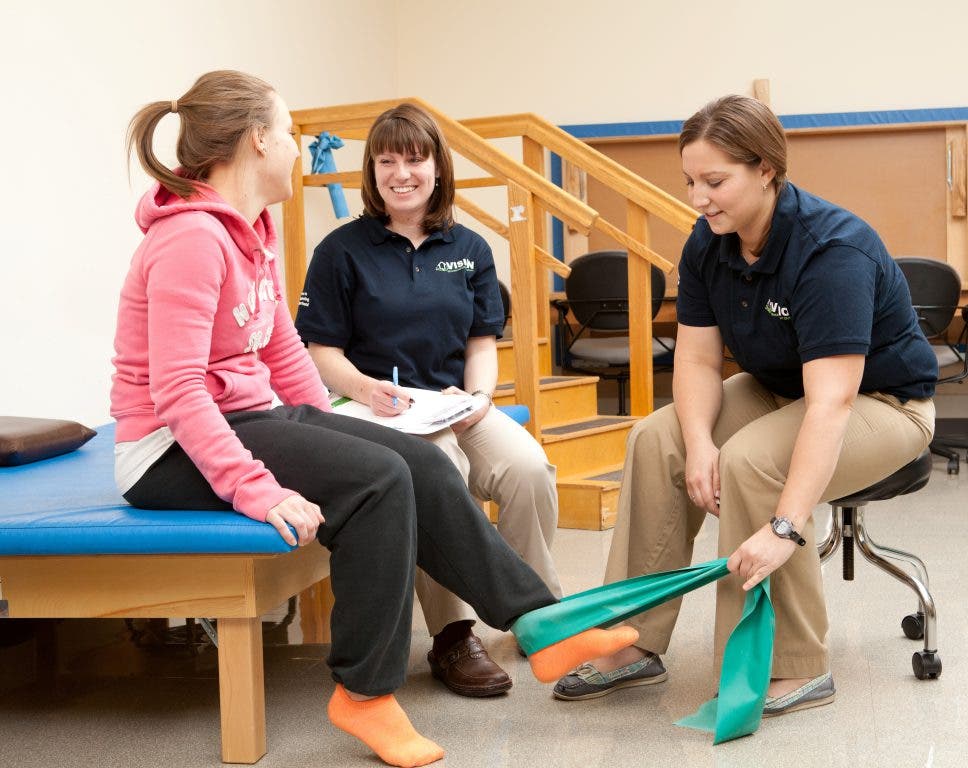
As sixth-year physical therapy students at Quinnipiac University, Traci Underhill and Meredith Wolanin learned that they could help patients with few resources.
Find out what's happening in Hamdenfor free with the latest updates from Patch.
“In physical therapy, we can do a lot with just our hands,” explains Wolanin, of Loudonville, N.Y. “We can motivate people and, with minimal equipment, we can improve their quality of life. It’s really amazing to see some of the high-tech physical therapy interventions, but they are not necessary all the time.”
So, when physical therapy students said they wanted volunteer opportunities that put their professional skills to work, Underhill and Wolanin rolled up their sleeves and began drafting plans to offer pro bono physical therapy services. Although they had few resources, they knew what they could offer would benefit neighboring communities.
Find out what's happening in Hamdenfor free with the latest updates from Patch.
After more than a year of work, the duo created Quinnipiac’s first student-run health care service, aptly named the VISION Rehabilitation at Quinnipiac University. It stands for Volunteers in Service Impacting Our Neighborhoods. VISION officially launched on March 6 and is open on Tuesday evenings on the North Haven Campus.
“We’re hoping to be an outlet for people who don’t have access to physical therapy services,” says Underhill, of Stetson, Maine.
It is completely run and operated by Quinnipiac students with faculty supervision.
“They are developing incredible leadership skills,” says Maureen Helgren, professor of physical therapy and adviser for the project.
The idea originated as Underhill and Wolanin’s capstone project, which is a requirement for the doctor of physical therapy. At conferences, they learned about the success other universities have had starting pro bono health care centers. The students reasoned that, with outstanding facilities as well as a large physical therapy class, Quinnipiac was in an even better position to open one. They created a well-developed business plan and gained the university’s support as well as some funding.
The Quinnipiac students partnered with HAVEN Free Clinic, which is run by Yale health professions students in collaboration with the Fair Haven Community Health Center, for residents in Greater New Haven. HAVEN has and will continue to refer patients to VISION for physical therapy. About 27 percent of HAVEN’s patients have musculoskeletal complaints, but it doesn’t offer physical therapy services.
Enter Quinnipiac students.
“It seemed like a perfect opportunity,” explained Janine Sun, a second-year nurse practitioner student at Yale and one of three executive directors of HAVEN. Sun plans to send about five patients each month to work with the Quinnipiac students for several weeks. Sun says that the partnership could help in monitoring the patients’ health.
“Since they have a longer course of treatment, they may come across other issues they can communicate back to us,” explains Sun, who began working with Underhill and Wolanin about a year ago. The HAVEN board members have shared tips on managing the clinic with the Quinnipiac students. “Since then, they have done an amazing job in creating their own board and student-run clinic.”
Wolanin and Underhill have established a board of about 20 students to run operations of the VISION Rehabilitation. Thus far, they have more than 100 students signed up. It is purely a volunteer endeavor; students cannot get course credit for participation.
The VISION students treat patients in teams led by a sixth-year physical therapy student. Some students hold the role of ambassador and are in charge of communicating with the clients to answer questions and remind them of appointments.
Some student volunteers are working to raise money to sustain the services and provide assistance to clients, such as transportation vouchers. Other volunteers are planning educational presentations that will be given in the community.
Currently the students are interested in finding Quinnipiac students who are fluent in Spanish who could help with the translations. Underhill and Wolanin plan to include more students and offer more services. The goal is to incorporate occupational therapy students in Fall 2012. In the future, they plan to include nursing, diagnostic imaging and physician assistant students, and eventually students from the Frank H. Netter, M.D., School of Medicine at Quinnipiac University.
“We would like to stand as a foundation for the medical school,” says Underhill. By the time the medical school welcomes its first class in 2013, Underhill adds, “we should be up and running and have a few years under our belt by then.”
The project has piqued the interest of other universities. Underhill and Wolanin recently presented the poster, “The Role of Physical Therapy in Pro Bono Healthcare: Volunteers In Service, Impacting Our Neighborhood,” at the National Society of Student-Run Free Clinics Conference in Long Beach, Calif., and gave a presentation to the Yale School of Medicine. Despite what the students are gaining, Underhill and Wolanin crafted VISION’s mission to focus on patient care.
“It’s not just about having opportunities for our students,” explains Helgren. “It’s really about providing access and quality care to an underserved population—but we can do both.”
Get more local news delivered straight to your inbox. Sign up for free Patch newsletters and alerts.