Business & Tech
MakerspaceCT is First in CT to Offer Digital Badge Program
New Collar Workforce Network Credential; Next Generation of Skillset Development Will Provide Access to Jobs, Career Advancement

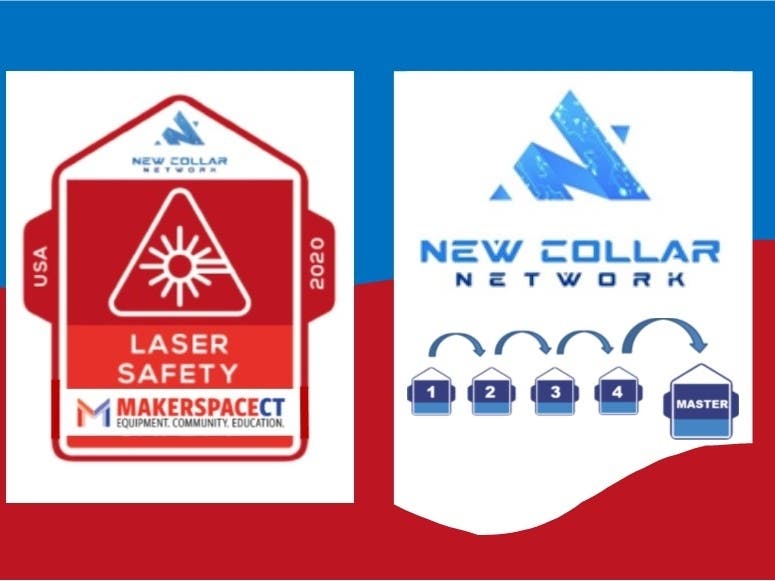
Digital Badges, a workplace credential system developed by a collaboration between IBM and Mozilla, provide a secure platform to recognize achievement by prospective employees in the manufacturing, engineering and technical fields. MakerspaceCT, in downtown Hartford, is the first facility in Connecticut to offer digital badges as a new element in their educational programs. The initiative is part of a recently developed New Collar Network, with MakerspaceCT as a charter member, focused on preparing people for in-demand high tech manufacturing jobs.
MakerspaceCT’s Digital Badge program is recognized by the Fab Lab Network, based at MIT. MakerspaceCT supplies talented instruction and sign-off on completed levels. The Digital Badge database will be updated with individual participant’s credentials. As Industry Week has pointed out, “In today's manufacturing environment, it's skills and ability—not academic pedigree—that matter most. It's time to update the blue-collar/white-collar approach to the workforce.”
That is precisely what the New Collar Network, and the Digital Badge system, does. Through this credentialing system, individuals will be able to bolster their skills by enrolling in short, high impact classes that will earn them layers of digital credentialing. It combines new technological skills and traditional trades as the talent pipeline that is key to the emerging innovation workforce.
Find out what's happening in Greater Hartfordfor free with the latest updates from Patch.
The digital badge credential system gives prospective employees widely recognized evidence of their technical skills. Digital badges focus on one specific skill, and when completing all levels within a specific discipline, badges are “stacked” and a Master Badge is earned.
Digital Badges are micro-certifications that provide affordable, short-term verifications of specific skills. New Collar Network digital badges are issued by the North American Digital Fabrication Alliance, a non-profit organization of Fab Labs, makerspaces, businesses, colleges and K-12 schools that is a recognized organization in the international Fabrication Lab Network founded at MIT’s Center for Bits and Atoms.
Find out what's happening in Greater Hartfordfor free with the latest updates from Patch.
MakerspaceCT brings together experts in manufacturing, industry leaders, entrepreneurs, educators and makers to roll out the program. Each badge focuses on project-based learning. The initial coursework getting underway at MakerspaceCT offering Digital Badge credentials are Fundamentals of Additive Manufacturing, CNC Machining, and Laser Cutting Operations and Safety. Plans are for additional Digital Badge courses to be added during 2021, including: AR & VR for the Real World, Shop Safety for Manufacturers, Plastic Thermoforming Technology and Electronic Component Testing and Soldering.
“This comprehensive forward-looking initiative was in the planning stages before COVID, but COVID has sharpened our lens further and across many businesses and industries, we are pivoting our perceptions of education,” explained Devra Sisitsky, Executive Director of MakerspaceCT. “The world has changed! From medical device manufacturers to aerospace technologies, the priority is
to identify talent to meet the demand for innovation. They are measuring, defining, and ultimately hiring talent in vastly new ways. Digital badging is an effective response – a win-win for employees and employers.”
In a newly released October 2020 report, Governor Lamont’s Workforce Council noted that “demand for manufacturing employees is projected at approximately 6,000 per year,” and that traditional “sources of manufacturing labor in the state are not sufficient to meet the projected demand.” The report pointed out that “Connecticut’s manufacturing workforce is aging. The percentage of employees age 55 and over increased from 18% in 1996 to 35% in 2018. As a result, employers must invest in incumbent worker training to replace the skills lost as the most experienced workers retire, in addition to their investments in training new entrants into the workforce.”
The report also referenced “badges that can be stacked into higher credentials,” noting that “40 percent of manufacturing employees work at 25 large companies, and 60% work at 4,000 small and mid-size firms, where the average size is 24 employees and the median is less than ten. Education and training programs need to address these diverse employer needs.”
In addition to Hartford, New Collar Workforce participating labs are at 10 locations nationwide, including Dallas, Dayton, Denver, El Paso, Santa Fe, and Tulsa. Former IBM CEO Ginni Rometty has pointed out that “We have a lot of jobs that don’t require degrees but require skills.” The Digital Badge system tracks prospective employees mastering of skills, with a consistent system that employers can depend on.
MakerspaceCT, a leader in Hartford's emerging innovation ecosystem, is a 25,000 sq. ft. community resource facility offering training and classes for all types of tools needed to make or manufacture prototypes, art, small business projects, and entrepreneurial pursuits. With nine on-site, state-of-the-art shops, emphasis is on hardware and software, prototype creation, additive (3D), CNC machining, electronics, coding, fiber arts fabrication, wood and metal, and arts.
For employers, Digital Badge system provides an effective way of identifying qualified prospective employees. The international program allows employers can log onto the badge database to confirm a person’s badge completion level, stacking system, or whether the individual has achieved a Masters level. Digital Badges are economical in time and cost, and create real job opportunities.
Sarah Boisvert, author of the 2018 book "The New Collar Workforce," has been in the forefront of the effort nationwide, points out that “new collar” workers that manufacturers seek have the digital skills needed to “run automation and software, design in CAD, program sensors, maintain robots, repair 3D printers, and collect and analyze data.”
“We provide training in the specific skills people need to qualify for well-paying, engaging, meaningful careers,” Sisitsky added. “Yesterday’s ‘blue-collar’ jobs are today’s ‘New Collar’ jobs, and training must respond to changing industries and evolving employment needs. Our mission is to use making to lift up individuals and communities, impacting lives by enabling access, innovation, and education - to provide people of all ages and backgrounds with the expertise to launch a successful career or change careers, and advance in the New Collar Workforce.”
MakerspaceCT's approach to hands-on, life-long, project based learning is combined with intensive short-term, high impact, on-site equipment based learning in shops specifically designed to provide the skill development supported by industry experts as instructors. Operating through adaptive re-use in the former G.Fox building on Main Street in Hartford, MakerspaceCT empowers manufacturers, entrepreneurs, hobbyists and students with all experience levels to take classes and develop skills in modern technology.