Schools
Rare 15th-Century Text Discovered At Prominent Hartford College
A rare 15th-century printed fragment hidden for more than a century is believed to be linked to the famed inventor of the printing press.


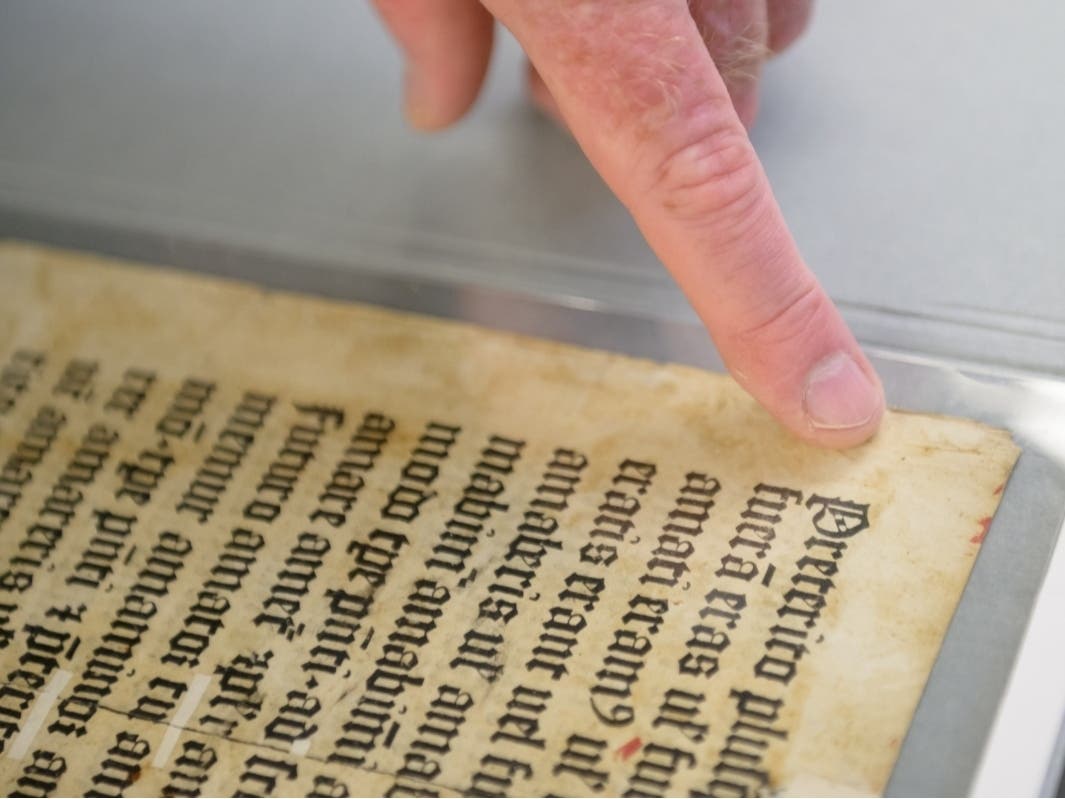
HARTFORD, CT — A page of text tucked inside an uncatalogued scrapbook at Trinity College for more than a century has been identified as a previously unknown example of 15th-century printing connected to associates of Johannes Gutenberg, the famed inventor of the printing press.
The discovery at Trinity's Watkinson Library in Hartford was later confirmed by scholars at Princeton University Library, according to the college.
The fragment is an incunable, a term for books and texts produced during the first 50 years of movable-type printing in Western Europe, from 1450 to 1500.
Find out what's happening in Greater Hartfordfor free with the latest updates from Patch.
Scholars identified the page as a leaf from "Ars minor," a Latin grammar textbook written by the fourth-century Roman grammarian Donatus.
It was printed using type developed by Gutenberg associates Johann Fust and Peter Schöffer.
Find out what's happening in Greater Hartfordfor free with the latest updates from Patch.
"Any new discovery of a book from this period, especially of an unrecorded book—one that we had no record of anywhere at all—is always a big event," said Eric Johnson-DeBaufre, rare books and special collections librarian at Watkinson Library. "And when it's one that's connected to Mainz, Germany, which is where printing in the West began, it's especially exciting."
Johnson-DeBaufre said such a discovery in the United States is "almost unheard of."
The fragment could also offer scholars new insight into the early development of European printing.
Unlike other examples, the Watkinson fragment was printed on paper rather than vellum.
Scholars believe it may have been a proof sheet produced before the text was printed on its more durable final material. Its type derives from the first state of type used to print the Mainz Psalter in 1457, according to Trinity.
Vincent E. Tomasso, associate professor and chair of Classical Studies at Trinity, described "Ars minor" as essentially a classroom textbook teaching students the parts of speech and fundamentals of Latin.
Donatus texts were among those printed by Gutenberg and his associates, according to Johnson-DeBaufre, providing income while also allowing printers to test type before undertaking more ambitious projects such as the Gutenberg Bible.
The newly identified page had been hiding in a scrapbook containing pieces of binding waste collected by William Cowper Prime, founder of Princeton University's art history department and the first vice president of the Metropolitan Museum of Art.
Prime donated more than 40 scrapbooks and nearly 1,500 books printed during the 15th and 16th centuries to Watkinson Library in 1905.
The scrapbooks include original prints by artists such as Albrecht Dürer, Jost Amman, Lucas Cranach and Rembrandt.
"This scrapbook collection has sat in the Watkinson as a sort of hidden collection," Johnson-DeBaufre said. "It has not been catalogued for the entire time that it has been with us, since 1905."
Johnson-DeBaufre recognized the fragment's significance while reviewing the collection and made the initial identification of its type.
Paul Needham, Scheide librarian emeritus at Princeton University, and Eric White, Scheide librarian and assistant university librarian for special collections, rare books and manuscripts, subsequently confirmed the identification.
"It's an important discovery for early book history," White said. "The Trinity fragment represents a 15th-century printing of a schoolbook, the Latin grammar of Donatus, that has never been seen before and was never expected to exist."
Researchers are continuing to examine the fragment, with high-quality scans made at Princeton potentially helping them determine more about when it was printed.
Johnson-DeBaufre, Needham and White plan to publish their findings in a scholarly journal before the fragment is made more broadly accessible through Trinity College's digital repository.
Watkinson Library houses Trinity's rare books, special collections and college archives and is directed by College Librarian Christina Bleyer.
Founded in 1858 through a gift from David Watkinson, the library moved to its current location on Trinity's Hartford campus in 1951.
Its collections support research, teaching, and learning and are open to members of the public.
Trinity College was founded in Hartford in 1823. The liberal arts college has about 2,100 students representing 41 states and 80 countries and a network of more than 30,000 alumni. Its historic Hartford campus is also a designated arboretum.
Get more local news delivered straight to your inbox. Sign up for free Patch newsletters and alerts.