Health & Fitness
From murky to magnificent: The art of navigating transitional waters
Transitional waterways can be hell if you don't know what you are doing and why. Find out how to get through the rough spots and gain sustenance along the way.
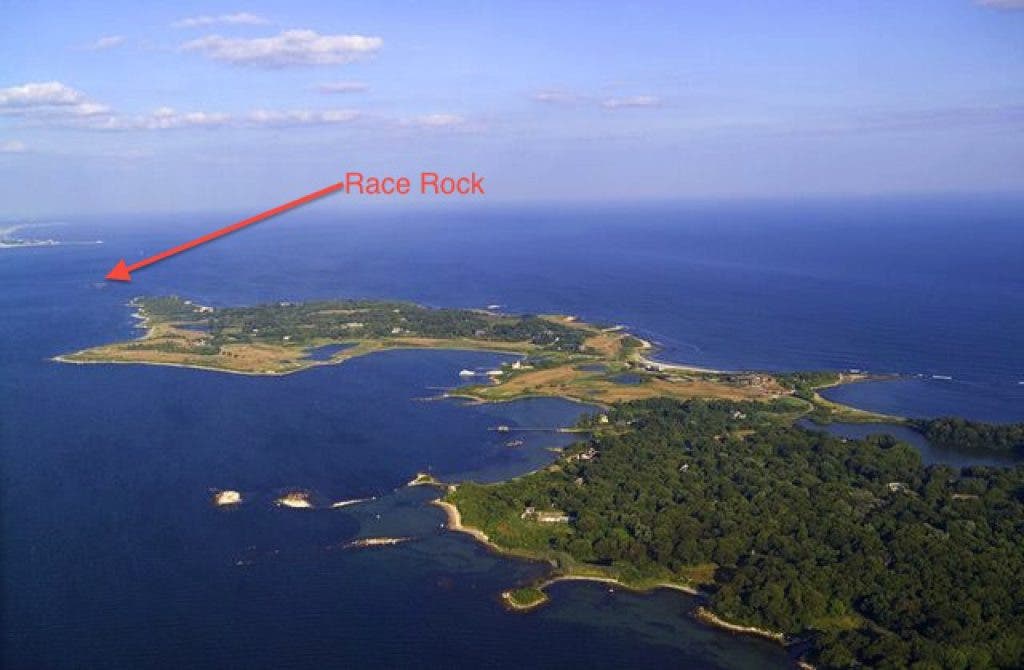
Race Rock is kind of a big deal for boaters in this region. Located just off the southern point of Fishers Island New York, Race Rock, (or “The Race”) is where the ocean rushes in and out of the Fishers Island Sound in synch with tide fluctuations. The Race separates the sheltered, shallow, murky waters of the Sound from the deep, clear expansive waters of the Atlantic. It is place abundant with wind swept, jagged, rocky reefs and racing tides that seem to boil up and surge rapidly from an adjacent 250-300 foot deep channel.
Why people like it
Those daring enough to navigate Race Rock waters do so because they usually have their eye on a prize: FISH.
Find out what's happening in Ledyardfor free with the latest updates from Patch.
A favorite location of sport fishermen due to the variety of fish found in these waters, boats often gather at Race Rock throughout the summer months, creating a virtual traffic jam of tossing, swirling vessels, synchronizing their efforts while navigating this continually moving, narrow waterway. Things can get a little dangerous there. But despite the danger, fishermen love to troll those waters because it’s often where game fish like striped bass and bluefish are a bit easier to catch without having to venture too many miles off shore.
I don’t mind cruising through the race because I already know what’s on the other side: a beautiful ocean and Fishers Island beaches. The Fishers Island Sound, in comparison, is shallow and very murky so it's difficult to see the bottom. On the other side of the Race, however, the water is crystal clear, much cleaner, and opens to the vastness of the Atlantic. There is just more of everything on the other side.
Find out what's happening in Ledyardfor free with the latest updates from Patch.
Navigating transitional waters
Race Rock is, essentially, a point of transition.
Much like the turbulent waters surrounding Race Rock, we find ourselves in life-transitions that force us to contend with difficult and chaotic situations, making us fear we might lose our stomachs.
This is why it’s important to identify with and focus on the other side of that transition zone. We need to set our minds to a point where our original visions and purposes become the very compasses and motivators that empower us to push through our transition.
On the other side, there are clearer, deeper waters. There is beauty. There is tranquility. There is opportunity.
Once on the other side, we gain a unique vantage point where we clearly see what lies behind as well as the new horizon. It’s a place of vast openness; where things of the past now appear small and insignificant in comparison with all that lies before us. The other side becomes our place of renewed hope.
Transition can be dangerous
Navigating transitional “waters” is an experience like none other. It’s a place in which we find ourselves continually tossed about, shifting, tipping over and losing balance. We question ourselves. We become unsure of the simple things. We fight to regain control when we feel we are drifting against our will, far from where we ever intended. We grasp for the nearest compass, desperate to reacquaint ourselves with even the simplest points of logical direction. Simply put, transition can be hell if you don’t know what you are doing and why.
What we gain from the experience
Much like fishermen who endure the violent tossing of the waves to strike at the largest, most plentiful fish within The Race, you and I are able to gain sustenance from our place of transition.
Essentially, what we gain is the wisdom that comes from emotional and intellectual growth, having survived a difficult experience and became better for it. Our success, however, depends on timing, skill, and sheer will to get through the rough spots. Our success also depends on learning from others who have been there in different ways. It’s about knowing what to do, and what not to do.
Three ways to set yourself up for focused, successful transitioning
- Never drop your anchor in the midst of transition. If you do, you risk your vessel being torn to shreds by the wind, waves and other drifting vessels. Instead, allow yourself to drift with the flow, allowing the currant to carry you - to an extent. Sure, it's scary. This will be a time when the deepest areas of your faith will be stretched to the utmost limits. Learn to surf your waves of adversity, and you will find that each wave becomes the very thing that propels you forward. You may find you cannot accomplish this without leaning on a higher power. Your willingness to lean on God, allowing Him to take care of you and guide your next steps are most critical during this time. As you do, you will develop the finesse of knowing when to go-with-the-flow in a state of flux, and equally as important: when to fire up your engines and barrel full speed ahead to the other side.
- Be amazed as transition exposes the strengths you didn’t realize you had. Perhaps you have a high tolerance to chaotic circumstances. The kind of person who knows how to tune out the excess noise all around you. Or maybe you are a survivor who knows how to make the best of stressful situations. You might even be the kind of person who has a truckload of patience with others, or someone with the ability to let negative circumstances roll off your back without leaving you feeling vulnerable or lacking value. Recognize your strengths and journal them. Give yourself a pat on the back and allow your strengths to develop your confidence.
- Allow transition to expose your weaknesses. Unfortunately, you are likely to become aware of personality and character issues that might have gone unnoticed until this time of intense challenge. You will undoubtedly behave badly at some point, or even fail at something. Your ego will probably get bruised. Get used to the idea, but realize it’s not as bad as it may seem. Since nobody is perfect, it’s important to give yourself permission to fail from time to time. Do your failures make you less of a person? No they don’t. Therefore, get over it, learn from it, do whatever you can to correct your mistakes (if possible), and then use what you’ve learned as a valuable tool to help others.
Once you have set your mind to pull through successfully by keeping focused on the positive outcome, the next step is to learn all you can about yourself during the transition.
Self-reflecting questions during transitions:
- How do I react to stressful situations?
- Do I dial my internal compass to reflect my original goals, morals and intentions, or will I waiver and question even the simplest, most logical ideals?
- Do I wrestle with attempting to control the situation by indiscriminately tossing an anchor into the chaos, threatening the very vessel in which I exist?
- Can I exercise my faith and drift for a while, get my “sea legs”, and then listen when wisdom tells me to move forward?
- Do I have faith in my ability to learn, discern truth, gain wisdom, and grow from this experience?
- Has the experience increased my ability to understand others?
- Can I gain compassion and respect toward those who have fought through hardships, even when they are vastly different from me?