Neighbor News
Poll: Girls Pay Expectations Equal Boys for First Time; Student Expectations Regarding College Loans, Stud
Results Highlight Need for Junior Achievement Programs Aimed at Helping Teens Make Informed Choices about Their Financial Future

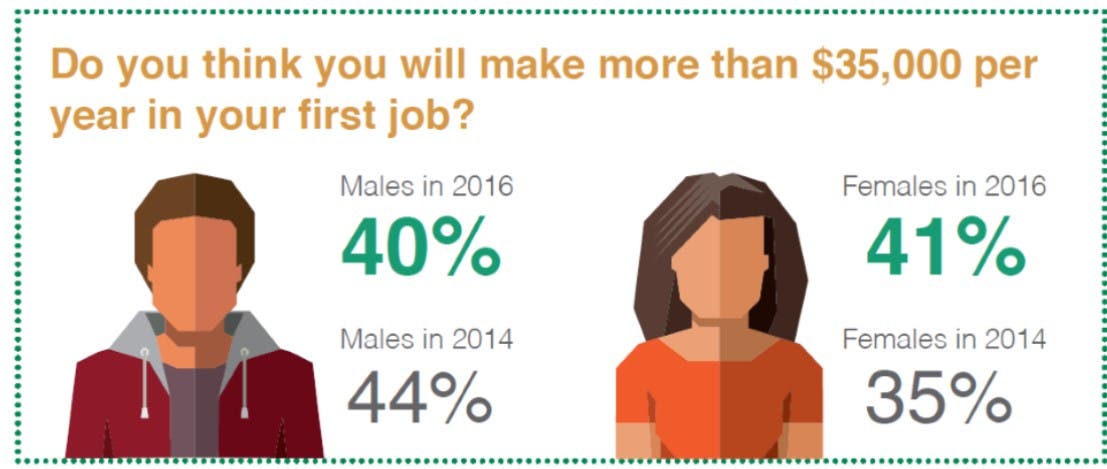
Teen girls now have the same income expectation as teen boys, according to a new national survey by Junior Achievement and Voya Financial. The survey results reflect a change from only two years ago, when a higher percentage of boys than girls indicated that they expected to make $35,000 or more in their first job. In the new survey, the gender gap in expectations has been wiped out.
“There has been a lot of talk about equal pay for equal work,” said Lou Golden, president of Junior Achievement of Southwest New England. “These results suggest that these efforts may be having a positive effect on young women’s expectations of what they should be paid as adults. That’s good news, and long overdue.”
Golden also noted that among its array of programs, Junior Achievement of Southwest New England has partnered with the Junior League of Hartford in offering JA Career Connections For Young Women, a program for female high school students that includes an 11-week after-school academy and job shadowing.
Find out what's happening in Manchesterfor free with the latest updates from Patch.
“We work diligently, with the support of our dedicated volunteers and partners, to prepare young people for own their economic success. That is as true for girls as for boys, and it is promising to see that progress is being made,” Golden said. “But as we know, the pay gap between men and women still exists in many occupations, and efforts to change that must continue.”
In 2014, Junior Achievement asked survey participants planning to go to college if they expected to make more than $35,000-a-year at their first job. In that survey, 44 percent of boys believed they would make more, compared to 35 percent of girls. In the 2016 survey, that numbers were virtually identical. (40% of boys; 41% of girls)
Find out what's happening in Manchesterfor free with the latest updates from Patch.
JA volunteers come from all walks of life and use their personal experiences to make the JA curricula practical and realistic, helping to empower students to own their economic success. JA's unique delivery system provides the training, materials, and support necessary to enable volunteers to build students’ skills in financial literacy, work readiness and entrepreneurship.
More than 2,500 volunteers - business professionals, parents, retirees, and college students – offered JA programs to more than 35,000 students in roughly 150 schools in communities throughout New Haven, Middlesex, Hartford, Litchfield, Windham, Tolland, and New London counties last year.
The new survey of 1,000 teens by Junior Achievement USA and Voya Foundation also found that 9 in 10 expect to attend college, and of those, 40 percent expect help in the form of scholarships and grants; 21 percent believe they will receive financial support from their parents and family members; 17 percent plan to work to earn money for college; and only 11 percent anticipate taking on student loans to help pay for their higher education.
The reality is likely to be very different, and that underscores the importance of JA programs to better prepare young people for the financial burdens that a college education often present.
Recent data indicates that 7 in 10 seniors (69%) who graduated from public and nonprofit colleges in 2014 had student loan debt, with an average of $28,950 per borrower, according to the Institute for College Access & Success. Over the last decade, the share of graduates with debt climbed from 65 percent to 69 percent, while average debt at graduation rose at more than twice the rate of inflation. In Connecticut, 62 percent graduated with debt averaging $29,750.
“These results demonstrate that today’s teens need information on how to make informed choices on choosing the best higher education path for them and a clearer understanding of how to pay for it,” Golden said. “This is why it’s so critical that our young people have the kinds of financial literacy programs that JA offers free to our schools.”
Golden noted that a four-year college education is the second largest investment many people will make in their lifetimes, and yet decisions to take on student debt are routinely made by 17 and 18 year olds who have received little to no financial literacy education. This can result in students assuming more debt than they are able to pay off with their expected future income.
The survey also found that nearly two-thirds of teens, or 65 percent, believe borrowers are ultimately responsible for paying off their student loans, even if they borrowed more money than they are able to pay off. However, 11 percent believe the government should do so, 7 percent believe it is the responsibility of the college and 5 percent think it’s up to the lender to resolve.
A valuable resource available to teens, parents, teachers, and school counselors is JA Influencer, a free online resource that explores the opportunities and challenges associated with student loans. A guide titled “Understanding The Student Loan Explosion: Implications for Students and Their Families,” also investigates the various factors students should take into consideration when exploring opportunities in higher education. These include gaining a better understanding of the real costs of going to college and weighing alternatives to a four-year school, such as community college and technical schools.
JA Influencer is the result of support from Voya to reach students through Junior Achievement. Voya has partnered with Junior Achievement since 2001; the partnership is centered on the shared belief in the need to actively prepare and equip future generations to succeed.
The survey results represent the findings of an Opinion Research Youth CARAVAN survey conducted among a sample of 1,000 13-17 year olds. That survey was live March 1-6, 2016.