Neighbor News
Implications of Migration on Connecticut’s Future is Focus of CT Data Collaborative Forum
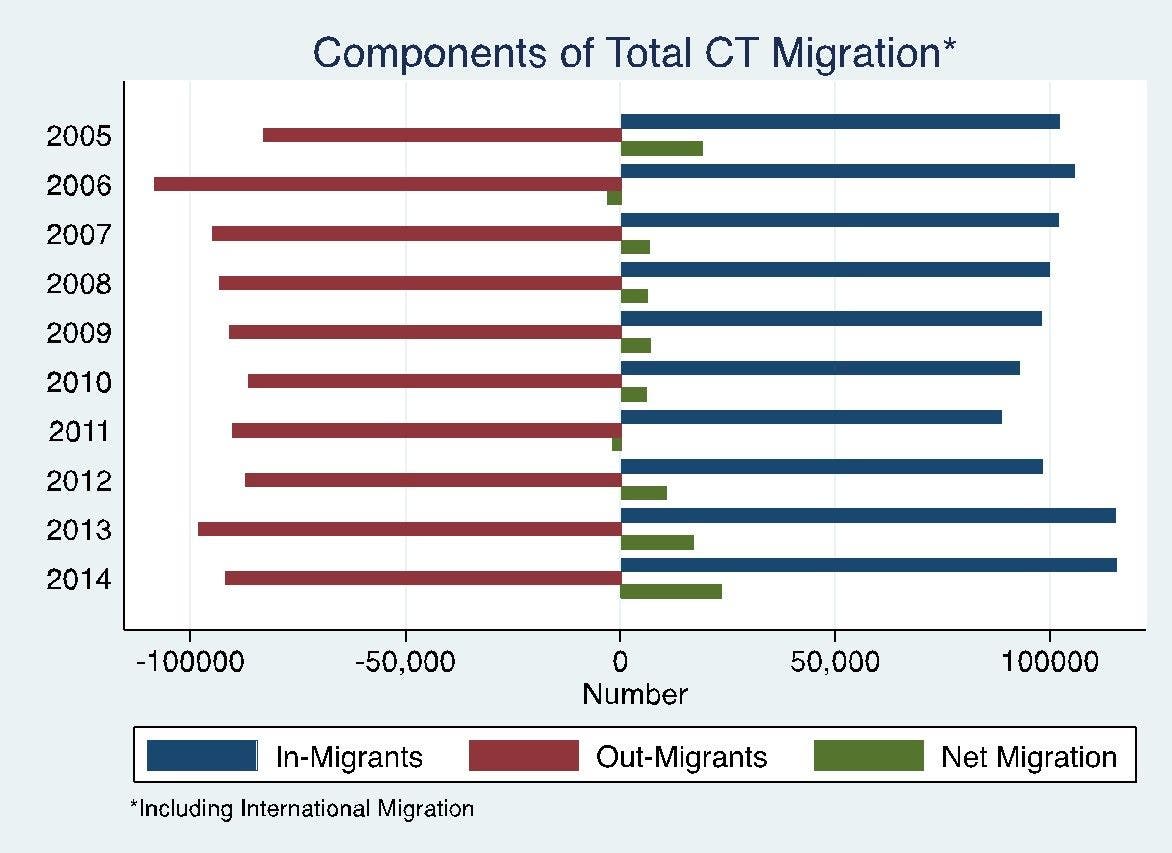
Data indicates that Connecticut saw a net inflow of people in eight of the ten years from 2005 to 2014, UConn Prof explains.

The Connecticut Data Collaborative and its websitectdata.org has launched a quarterly series of forums to discuss pressing questions facing state policymakers, focusing on current research and areas of research that could be pursued in order to better inform policy leaders and drive decision-making.
The first forum, held this week, provided an in-depth look at migration, examining the trends in data and dispelling the anecdotes and headlines that discuss a net loss in population. In fact, Connecticut saw a net inflow of people in eight of the ten years from 2005 to 2014.
The initial session, attended by 25 individuals from throughout the state, included spirited discussions focused on enumerating the critical questions and issues, identifying relevant research that already exists, and determining data that is needed.
“Migration is a frequent topic discussed in the media, with conflicting statistics about the true story of the population changes of our state,” said Michelle Riordan-Nold, Executive Director of the Connecticut Data Collaborative. “In holding this forum, our objective is for the data – either existing or newly developed - to provide the foundation for how to move forward with answering the pressing policy questions facing our state.”
The discussion was led by Riordan-Nold and Thomas J. Cooke, Professor in the Department of Geography at the University of Connecticut. His expertise involves population, urban, and economic geography - with a primary interest in the interplay between mobility and inequality. As data-based charts he presented reflect, Cooke indicated international migration is a key component driving Connecticut’s numbers – including a net inflow of working age college graduates.
The forum examined the questions most often discussed in the media such as: migration of college graduates, if taxes impact migration, and whether or not millionaires are migrating out of state. There was tremendous energy and interest in this topic and a decision made to continue the dialogue. The next step will be to explore the drivers of mobility at each stage of life and determine the impact in Connecticut.
The Connecticut Data Collaborative is a public-private partnership that advocates for the public availability of open and accessible data, serving nonprofits, advocates, policymakers, community groups, and funders in using data to drive policy and improve programs and services, budgeting and decision making at the state, regional and local levels.
The publicly-accessible website, www.ctdata.org, provides data that can be used by a range of businesses, town and city governments, and various organizations in the state to further policy development, evaluation and analysis. To date, the website includes nearly 150 datasets on a wide range of subjects and programmatic areas.
The CT Data Collaborative also recently launched a new pilot program, CT Data Academy, which is being developed to increase data literacy, build data capacity and enable nonprofits, state and local government, community groups and organizations across the state to more effectively curate their own data and use open data sources in order to better understand, measure, advocate and impact their clients, residents and customers.