Kids & Family
Andrews Homestead Finally Gets a Facelift
Several years after securing funding for repairs, the city finally gets to work on the historic West Main Street home.
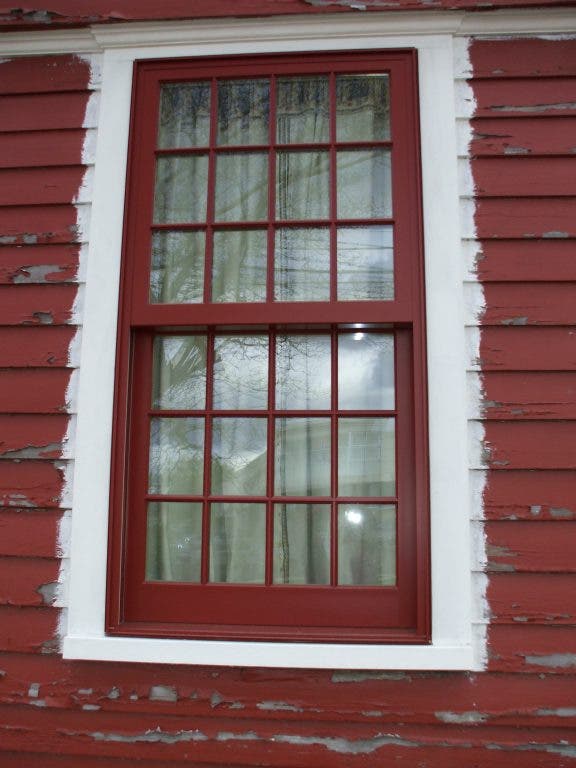


If you’ve driven down West Main Street lately, you’ve probably noticed that the historic Moses Andrews Homestead has been looking a little shabby. According to Meriden Historical Society President Peter Slavinski, the city of Meriden, which owns the 250-year-old building, got a $23,000 grant for repairs five or six years ago. “They’re just getting around to it now,” he says.
The homestead, which sits between McDonald’s and Benjamin Franklin School at 224 West Main Street, was built before the Revolutionary War. It is now the official headquarters of the Meriden Historical Society. The Society leases the traditional New England saltbox-style house from the city for $1 a year and maintains its historically important interior. The city is responsible for maintaining the exterior, but has been lax in doing so, Slavinski relates.
Find out what's happening in Meridenfor free with the latest updates from Patch.
In recent years, leaks and disrepair have plagued the home, which houses a permanent collection of Silver City artifacts and still includes some of the original features of the house. Among those features are the great fireplace with deep Dutch ovens, an exposed field stone chimney wall in the entrance hall, wide floor boards and a hiding closet.
Why the Delay?
Find out what's happening in Meridenfor free with the latest updates from Patch.
Mark Zebora, Director of Meriden Parks and Recreation, cites two reasons for the repair delay. First, he says, restoring a historic building is a long process.
“Each window is a different size because they were made so long ago,” he explains. The windows had to be custom made. That takes time, but is worth the wait, Zebora claims.
“They’re a really good replication,” he says.
The other reason for the delay comes down to priorities. The work is being done by Parks and Rec staff, which only has only two carpenters.
“Andrews Homestead is not a number one priority,” Zebora admits, citing events like Hurricane Irene and the October snowstorm that took precedence.
“My carpenter didn’t have a hammer in his hand for quite a while,” says Zebora. “He had a chainsaw in his hand.”
But Andrews Homestead did eventually rise to the top of the to-do list. The building now has 17 new windows on the north and west sides, two new doors, new gutters and a refurbished porch, Slavinski says.
The city’s proposed 2012-13 budget contains funds to finish the remaining windows, paint the peeling exterior and replace the dilapidated fence that was recently torn down, according to Zebora. That budget comes up for a vote by the City Council on May 7.
A Brief History of the Moses Andrews Homestead
The Andrews Homestead is one of Meriden’s oldest buildings. Built in 1760 by Samuel Andrews III, it was then passed down to his son Moses.
The home played a central role in the history of the Episcopal Church in Meriden. Moses Andrews, a Tory, was loyal to the British king during the Revolutionary War. As a loyalist, he wasn’t allowed to worship in the Episcopal church in Wallingford. Instead, he brought in wooden benches and held services in his own home. During the height of the war, services were carried on in secret in the basement.
The homestead stayed in the Andrews family until 1864. It then changed hands several times, serving as a school, boarding house, day care center and colonial museum. Over the years, several efforts have been made to restore the home and preserve it s history
Long on History, Short on Cash
The Historical Society continues to manage the building as a museum, but struggles to pay for its upkeep.
“It’s their building,” says Slavinski, referring to the city’s ownership. “We can’t afford to maintain it.”
The Historical Society has a difficult enough time taking care of the buildings it does own, the Morehouse Research Center and adjacent storage barn at 1090 Hanover Street in South Meriden. The heating bill there for the month of December alone last year was $972. And that was just to maintain the temperature at 55 degrees. People use the building just a few hours a week. Most of the time its only occupants are the historical records, catalogs and artifacts that fill its shelves and cabinets.
Thanks to a grant from the Cuno Foundation, a gas heating system was recently installed, replacing the expensive electric system and cutting heating costs roughly in half compared to the same period the year before, according to Slavinski. The cost-cutting measure was a big help, Slavinski says, but still doesn’t close the Society’s budget gap.
“We go in the red every year,” he shares, “but we’re getting a little closer.”
The organization raises money through investments, monthly , membership dues of $15 a year, and donations. It has recently taken to selling off some of its donated artifacts that are not related to Meriden history, Slavinski reveals.
“We don’t have enough members,” he adds. “Considering how many people there are in town, our membership is a very small percentage.”
The Andrews Homestead is open to the public on Sundays from 11 a.m. to 3 p.m. during the months of May and October. For more information or to become a member, visit the website at www.MeridenHistoricalSociety.org.