Health & Fitness
Coronavirus CT: 2nd Death Announced; New Details On Closures
New guidance was issued to restaurants concerning what is allowed and what isn't as they operate during the coronavirus.


CONNECTICUT — Here are the latest facts as Connecticut continues to try and slow down the new coronavirus. A total of 96 people have tested positive for the coronavirus and two people including a Ridgefield man in his 80s, died Wednesday while being treated at Danbury Hospital.
And Gov. Ned Lamont said Thursday morning that "we can sadly confirm reports that a 2nd person in Connecticut has died due to complications from #COVID19. The man is a 91-year-old resident of New Canaan who was being treated at@NorwalkHospital. Our hearts are with his family and friends at this difficult time."
Additionally, a person living at a Stafford Springs nursing home also tested positive for the virus and is being treated at a local hospital.
Find out what's happening in Milfordfor free with the latest updates from Patch.
It's vital to remember that health officials say for every person who tests positive we can assume that 100 people actually have the virus, which would put Connecticut's number near 10,000. And no one should be surprised that the numbers are increasing daily. A week ago it was virtually impossible for people to get tested but each day more and more people are getting tested, which is the reason why the official numbers are soaring.
It was also announced that Connecticut, New York, New Jersey, and Pennsylvania have all teamed up to close all of the following businesses: restaurants and bars, though takeout and delivery are allowed, movie theaters, casinos, gyms, large retail shopping malls, amusement parks, and bowling alleys.
Find out what's happening in Milfordfor free with the latest updates from Patch.
See related: Coronavirus CT: 1st Death in CT, 96 Positive Cases Now
More Specifics On What's Closed, Open In CT
Lamont’s Executive Order No. 7F enacts the following provisions:
Closure of large shopping malls: Effective at 8 p.m. on Thursday, March 19, 2020 and through April 30, unless earlier modified, extended, or terminated, any stores, pharmacies, restaurants, or other establishments located within or connected to large shopping malls must be closed to the public. For further details on which malls and stores this applies, please refer to the text of the executive order.
Closure of places of public amusement: Effective at 8 p.m. on Thursday, March 19, 2020 and through April 30, unless earlier modified, extended, or terminated, all places of public amusement, whether indoors or outdoors, such as locations with amusement rides, carnivals, amusement parks, water parks, aquariums, zoos, arcades, fairs, children’s play centers, funplexes, theme parks, bowling alleys, and other family and children’s attractions shall be closed to the public.
This directive does not apply to public parks and open recreation areas. (To stay on top of real-time coronavirus updates in your town and Connecticut sign up for Patch’s free newsletter here.)
Important Service Changes Including Medical
Expansion of Medicaid telehealth coverage to audio-only telephone: The order modifies state statutes in order to allow Medicaid to cover audio-only telehealth services.
Waiver of in-person service, hearing, and screening requirements for facilities that have issued orders limiting visitor access to protect the public health: The order modifies state statutes in order to provide flexibility for critical legal functions regarding conservators and competency hearings to ensure the safety of nursing home patients.
Here's What's Allowed By Restaurants Concerning Take-Out/Delivery
To help provide additional guidance to restaurants and bars about Executive Order No. 7D, which was issued on Monday and limits these establishments to take-out and delivery services only, Lamont provided the following information:
These establishments are permitted to continue operating during the pandemic, however they cannot sell alcohol, and any food that is served at these establishments must be for take-out and delivery only, meaning that the food cannot be consumed on-premises.
They can still allow customers inside of their buildings to place orders and pick up the food to be taken out and consumed at a different location.
They can still permit customers to use the restrooms as they normally would.
In addition, the order does not require onsite workplace cafeterias to close or stop serving food. Employees in general are encouraged to bring their own meals to work if possible rather than using such facilities.
To the extent feasible, employers are encouraged to permit or require employees who order food at workplace cafeterias to eat those meals in private work spaces. If employers permit employees to eat food within workplace cafeterias, they should implement appropriate social distancing measures and make every effort to minimize the number of people congregating within a confined space or area.
Workplace cafeterias should also stop or limit self-serve food and drinks such as: Buffets and salad bars, Soups· Fountain sodas, Coffee· Reusable food and drink containers
Finally, the order does not apply to food trucks, however they are encouraged to practice safe social distancing.
See related: Restaurant Lays Off 41 Staff Members, Cites Coronavirus
CT Hospitals Could Be 'Overwhelmed' With New Coronavirus Cases
Schools Aren't Canceled But Here's Another Change
The State Department of Education (SDE) is seeking a waiver from the U.S. Department of Education for the standardized testing requirements each school is required to complete annually.
As the COVID-19 pandemic has significantly disrupted classroom learning already this school year, SDE Commissioner Miguel Cardona said he believes that it is best to waive those requirements for this school year.
In addition, the agency is continuing to develop resources that best meet the needs of school districts in their efforts to support student learning while classes remain canceled.
On Tuesday, SDE compiled and disseminated a combination of print and digital resources designed to engage students in grade PK-12 and support their continued learning during this emergency period.
The department is engaging providers of content to obtain materials, utilizing RESC partners as repositories for resources, exemplars, and material that will be available to all districts.
SDE also continues to aid in the effort to ensure that school districts are able to continue delivering meals to students under the school lunch and breakfast programs. To date, 123 schools have been approved to participate in this revamped, emergency program, which allows students and their parents to pick up their meals at one location, take them away, and then consume them at home.
Districts are using a combination of locations for the meals to be picked up, such as schools, parks, YMCAs, Boys and Girls Club, town offices, and other locations. Families should check with their individual schools for instructions on their respective method for meal distributions.
Here Are The Medical Devices We're About To Receive
On March 11, 2020, the Connecticut Department of Public Health submitted its first request for resources from the Strategic National Stockpile. This request was made through the federal Department of Health and Humans Services, Office of the Assistant Secretary for Preparedness and Response (HHS/ASPR). The first shipment is expected to be received in the coming days. The following chart provides a description of what is anticipated in the first shipment:
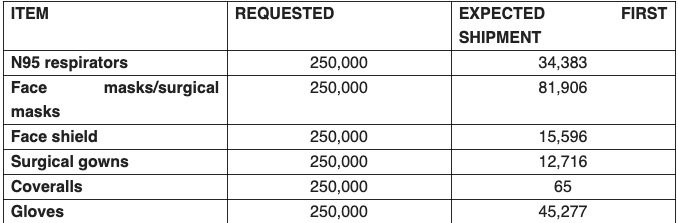
Once received these resources will be distributed on a priority basis to ensure medical providers, hospitals, emergency medical responders (including first responders who provide emergency medical response), and other stakeholders can continue to provide essential services.
A distribution strategy has been developed through existing channels utilizing the Connecticut National Guard and other partners.
Early Release Of Some State Aid To Local Towns In CT
To provide towns and cities with some financial assistance during this emergency period, Lamont ordered the Office of Policy and Management to release to all municipalities in the state the second of three annual payments from the Mashantucket Pequot and Mohegan Fund in advance of the statutory payment date.
The FY2020 state budget appropriated $51.47 million for this fund, and the related statutory provisions regarding the grants to municipalities requires them to be distributed in three separate payments throughout the year – by January 1, April 1, and June 30.
The second payment – due in April – totals $17.15 million. Municipalities should anticipate receiving this payment no later than Monday, March 23.
Unemployment Claims Spike By 20 Times Normal Amount
The Connecticut Department of Labor has closed its main office in Wethersfield and all of the American Jobs Centers throughout the state to in-person visits from the general public effective immediately.
The agency is encouraging people to utilize their online services, which can be found by visiting its website at www.ctdol.state.ct.us.The department has been processing nearly 20 times their normal daily amount of unemployment insurance claims (around 10,000 per day, as opposed to about 500 per day).
A friend e-mailed tonight. He just laid off 100 people at his 3 restaurants and he isn't likely to open them back up again when the crisis passes. That's just a hint of what we're up against, and why decisive action is needed to rescue the economy from potential catastrophe.
— Chris Murphy (@ChrisMurphyCT) March 19, 2020
Department of Agriculture affirms farmers’ markets and farm stands can remain open
The Connecticut Department of Agriculture delivered communications this morning affirming that farmers’ markets and farm stands in Connecticut can remain open during the civic preparedness and public health emergency. These entities are not covered by the executive order on restaurants the governor issued earlier this week.
A number of farm stands and farmers’ markets have already integrated online or order-ahead options with home delivery or curbside pickup. The agency is working with producers to compile an updated listing of farmers’ markets and farm stands on www.ctgrown.gov, which will be modified as new information is available.
Farm and retail staff are reminded to implement social distancing and limit customer interactions. Farm stores and farmers’ market managers are encouraged to reinforce the importance of washing hands, sanitizing surfaces frequently, and not working when sick.
Access Health CT opens special enrollment period for those who are uninsured
Connecticut’s health insurance marketplace Access Health CT today announced that a new special enrollment period will be available Connecticut residents who are uninsured. The special enrollment period begins Thursday, March 19 and ends on Thursday, April 2. Coverage for those who enroll during this period will begin April 1, 2020.
The only way to sign up for this special enrollment period is via telephone by calling 1-855-365-2428 (TTY: 1-855-789-2428). Telephone enrollment is available Mondays through Fridays from 8:00 a.m. to 5:00 p.m.
Individuals who lose coverage due to unemployment, experience certain other qualifying life events, or qualify for Medicaid/Children’s Health Program (CHIP), can always enroll online, in-person or over the phone and all help is free. For more information on this announcement, click here.
DEEP requests PURA take emergency orders to protect utility rate payers
The Connecticut Department of Energy and Environmental Protection has petitioned the Public Utilities Regulatory Authority to investigate and address several issues to help protect Connecticut residents and businesses during and after the public health and civil preparedness emergencies. Among other things, the petition asks PURA to:
· Issue emergency orders applying PURA's existing temporary moratorium on residential utility service disconnections to all customer classes for regulated utility customers and suspending late fees and other penalties on delinquent customers;
· Issue emergency orders waiving fees and deposits to enable the streamlined connection of regulated electric, gas and water utility customers who are currently without utility services, including those who were disconnected prior to the moratorium;
· Issue emergency orders related to outreach to small and midsize businesses and non-profit organizations in financial distress to establish bill payment arrangements and requiring the provision of payment plans to all customer classes;
· Accelerate consideration of methods to streamline income-eligible residential customer applications to access affordability/rate relief programs; and
· Accelerate consideration of expanding existing program eligibility requirements and limits for various affordability programs and explore potential new programs to assist customers of all rate classes to fill identified gaps.
Coalition of outdoor advertisers donate electronic billboards to spread awareness
Through a partnership organized with Governor Lamont, the Outdoor Advertising Association of Connecticut is donating 42 electronic billboards and 2 static billboards at locations statewide with messages that will help spread awareness to the general public about COVID-19.
Lamont said he is grateful to these advertising companies for their donation and emphasized that this is an important public service they are providing. The coalition, which consists of Lamar Outdoor Advertising (25 locations), Outfront Media (15 locations), and Barrett Outdoor Communications (2 digital and 2 static locations), launched the billboards on Tuesday night.
Get more local news delivered straight to your inbox. Sign up for free Patch newsletters and alerts.