Health & Fitness
Teaching Male National Identity in Early America: The Three R’s, Part 5
Following the Revolutionary War, how did Early American males become "Americanized"? This eight part blog explores this question using an average 19th century Montville resident as an example.

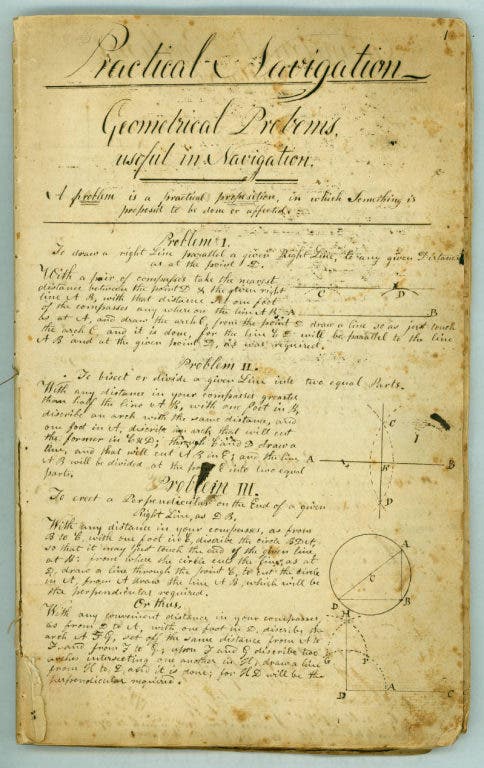

Mathematics was another key educational tool for emphasizing American nationalism. In the case of mathematics, the teacher would read the equation and/or lessons to the students and the students would then copy the verbal lessons into their books. This method covered two areas of the student’s education, teaching from a mathematical perspective as well as penmanship.
In the period following the Revolution, the common style of handwriting was copperplate, which contained decorative capitals and flourishes. The student’s penmanship was of equal importance to the lessons learned for it also suggested the individual was well educated and civilized.
Nathan Daboll’s 1821 book entitled The Schoolmaster’s Assistant became one of the first mathematical books specifically for the American student. This book utilized mathematical equations and incorporated various trade-works during the period such as farming, grocers, tobacconists, and mercantilists along with the different activities related to men in that era. There are no references to women throughout the book. Rather, the book prepares any boy studying it for living in a male dominated society. Examples of Daboll’s book include:
Find out what's happening in Montvillefor free with the latest updates from Patch.
#40. A father left his two sons (the one 11 and the other 16 years old) 10000 dollars, to be divided so that each share, being put into interest at 5 per cent. might amount to equal sums when they would be respectively 21 years of age. Required the shares?
#21. A stationer sold quills at 11s. per thousand, by which he cleared 3/8 of the money, but growing scarce raised them to 13s.6d. per thousand; what might he clear per cent by the later price?
Find out what's happening in Montvillefor free with the latest updates from Patch.
With each of the aforementioned examples as with the remainders in the book, the primary emphasis was on the male perspective. Furthermore, there was an additional emphasis on the more common period employments, such as seafaring, farming, or running a mercantile establishment. The Daboll’s book also incorporated the wares associated with each of these jobs. This included dry good measurement such as grains, sugar or teas, cloth and lace allotments, acreage or farm animal based equations.
Additionally, math texts of the period contained numerous references to alcoholic beverages. Daboll’s work, Schoolmaster’s Assistant Improved and Enlarged Being a Plain Practical System of Arithmetic had over twenty-one examples of equations based on alcoholic beverages.
These include the proper mixture allowances for rum and water, brandy or wine. An example was: "With 95 gallons of rum at 8s. per gallon, I mixed other rum at 6s. 8d. per gallon, and some water; then I found it stood me at 6s. 4d. per gallon; I demand how much rum and how much water I took?"
The reason for the inclusion of these examples in the text is that alcoholic beverages were commonplace at the time. As of 1819, one could “go into hardly anyman’s house without first being asked to drink wine or spirits, even in the morning,” according to the book, America, A Narrative by George Brown Tindall and David E. Shi. Of interest is that Daboll published his book years before the national expansion of the Temperance Movement.
The subject matter in English text books reverberated with the sub-text of American nationalism. English texts included sections on elocution, reading and grammar. As in the case of history and mathematics, English also conveyed the lessons of virtue to the early nineteenth century youth. The text titled English Grammar, by Lindley Murray, included sections relating to “first, form and sound of letters, secondly, the different sorts of words, their various modification and their derivations; thirdly, union and order of words in the formation of a sentence and finally, pronunciation and poetical construction of sentences.”
To learn the correct techniques of proper conversation and sentence composition was of importance for with “the cultivation of letters and advancement in knowledge, are found to strengthen and enlarge your minds, to purify and exalt your pleasures and to dispose you to pious and virtuous sentiments and conducts, [thus] producing excellent effects.”
Within the abridged version, Murray utilized phrases that re-emphasized the significance of “virtuous sentiments and conducts” under different sub-sections within the heading of Parsing. They included, “An obedient son,” “A temper unhappy,” “Virtue will be rewarded,” and “Ridiculed, persecuted, despised, he maintained his principles.”
Additionally for study were “a few instances of the same words constituting several of the parts of speech” which included, “She is his inferior in sense, but his equal in prudence,” “Behave yourselves like men,” and “He is esteemed, both on his own account, and on that of his parents.” With all of the above phrases, the consistent reiterations of the male prescribed characteristics of humility, male dominance, obedience and piety are apparent.
Concurrently, the same thematic approach of incorporating virtue into educational material appeared in Noah Webster’s Elementary Spelling Book. With this text, Webster associated words with accompanying phrases as well as used moral tales to teach reading skills. For example, in referencing George Washington, Webster wrote, “Washington was not a selfish man. He labored for the good of his country, more than for himself.” Other examples used the ills of idleness, obedience and the duty of parents such as, “Idle children neglect their books when young, and thus reject their advantages” and “Children should respect and obey their parents” and “Parents protect and instruct their children.”
Webster also included in his text short fables intended to emphasize the importance of moral behaviors as well as a device for the students to practice their reading skills. One such fable, titled “Of the Boy that Stole Apples,” is a fine example of the need for proper manners.
An old man found a rude boy upon one of his trees stealing apples, and desired him to come down; but the young sauce-box told him plainly he would not. “Won’t you?” said the old man, “Then I will fetch you down;” so he pulled up some turf or grass and threw at him; but this only made the youngster laugh, to think the old man should pretend to beat him down from the tree with grass only.
“Well, well,” said the old man, “if neither words nor grass will do, I must try what virtue there is in stones;” so the old man pelted him heartily with stones, which soon made the young chap hasten down from the tree and beg the old man’s pardon. [The moral being;] If good words and gently means will not reclaim the wicked, they must be dealt with a more severe manner.
The fable reminded the young reader the unpleasant consequences of disobedience, insolence, and disrespect. Similar to Webster’s fables was an alphabet primer titled, Alphabet in Prose, Containing Some Important Lessons in Life. In this text, the alphabet combined with short stories to complete the lesson. Below are several excerpts from the book,
"Then came great C with little c behind him.
Mr. C, says he, you are a coxcomb and a coward; one who frowns and cringes in your manner, I doubt, has little sincerity and less resolution. I expect to have my company more manly and behave with openness and freedom
Then came up great I with little I,
Mr. I, says he, I hear you are an Idle fellow, and that you bring up your son in the same indolent manner. An idle man is an enemy to the nation, for he lives upon other people’s labor, and does nothing for his own support.
Then came great S with little s,
Mr. S, says he, I hear your are a Spendthrift, who have squandered away your Estate and neglected your own Affairs, and how can I expect you to take care of mine? Gluttony, Drunkenness, and Debauchery, you have encouraged, in Opposition to every Virtue, and no Man of Virtue will pay much regard to you: So walk on, Sir."
As apparent in these examples, the instruction of virtues resounded in most school texts. Fortunately, boys during the early nineteenth century did have an outlet for their less formal behavior in the guise of amusements.