Community Corner
Before Spec Shea, There Was Tim Murnane
Naugatuck-born baseball pioneer played, managed, umpired, headed leagues and wrote about the game. You'll even find his name in the Baseball Hall of Fame.

Three peas in a pod.
Frank “Spec” Shea, baseball and Naugatuck.
The late pitcher will forever be identified with the game he loved, and with the community in which he grew to manhood and lived until his death in 2002.
Find out what's happening in Naugatuckfor free with the latest updates from Patch.
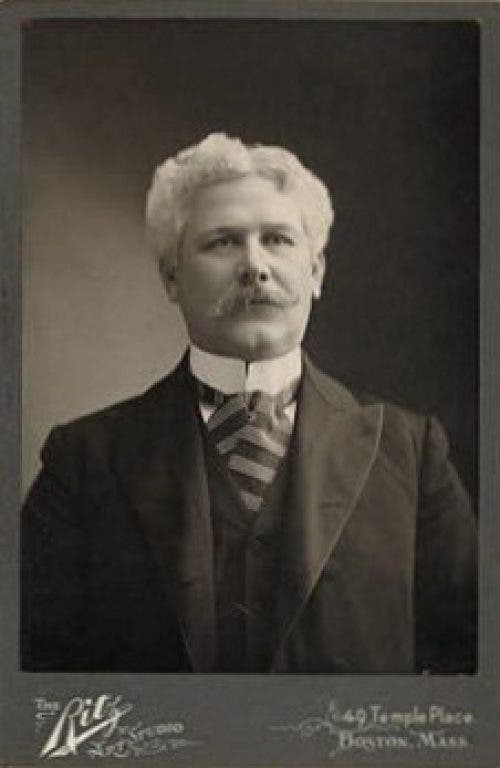
Long before Spec, though, there was another Naugatuck native who achieved success in baseball – as player, manager, umpire (briefly), minor league president, scout and then, in a career switch, as publisher of a weekly sports newspaper and baseball editor of the Boston Globe. His name is Tim Murnane.
It was in the latter capacity that he received, posthumously, the J.G. Taylor Award for “meritorious contributions to baseball writing” at the Baseball Hall of Fame on Aug. 5, 1979. Murnane was selected to the writers’ wing of the hall of fame with Dick Young, the contentious New York Daily News and New York Post columnist. (As one would guess, Willie Mays, a first-ballot hall-of-famer, received most of the attention that afternoon.)
Find out what's happening in Naugatuckfor free with the latest updates from Patch.
John Wiehn, the reference librarian at the , believes that Murnane hasn’t gotten the recognition he deserves, certainly locally but even beyond the borough.
“It seems like he’s forgotten,” Wiehn says. “We have streets named after war veterans, which is fine. It would be nice if a street was named after Murnane, or maybe a ball field."
“There is a Naugatuck Hall of Fame, but it seems you have to be born after 1900 to be considered.”
Wiehn keeps Murnane’s name alive on the library’s website. He’s front and center in the “Historical Places and Faces” category, along with three other borough notables, World War II Brig. Gen. James L. Dalton III, author Thomas Sugrue and actress Shirley Grey. The latter, born Agnes Zetterstrand in 1902, appeared in the theatre and in more than 45 movies during the 1930s.
Timothy Hayes Murnane was born in Naugatuck on June 4, 1851, the son of Irish immigrants. He inherited an Irish brogue from his father.
Fascinated with the new game of “Base Ball,” he began his playing career as a catcher with an amateur team in Stratford in 1869. Within three years, Murnane was able to make the leap to the Middletown Mansfields of the National Association, forerunner of the National League.
He played four seasons in the National Association – deemed a major league by some historians – reaching a peak of .359 in his rookie season with the Mansfields. Murnane spent the next three years with Philadelphia, then jumped to the Boston Red Stockings of the fledgling National League in 1876. He batted .282 as the club’s first baseman. (Bridgeport-born Orator Jim O’Rourke, who was elected to the Hall of Fame in 1945, led the Red Stockings at bat with a .327 average.)
Murnane drifted out of baseball in 1880 and opened a billiards hall and saloon in Boston. But in 1884, he became part-owner, manager, first baseman and recruiter (scout) for the Boston team in the new Union Association. The club finished in fifth place with a 58-51 record and the player-manager hit just .235.
With the league’s collapse, a soon-to-be-34 Murnane turned his attention to umpiring, served as president of two minor leagues (Connecticut and New England) and published the weekly Boston Referee, which covered baseball and polo.
When his newspaper folded, Murnane began contributing to the Boston Globe, ultimately becoming its baseball editor and a nationally respected writer. By 1917, “The Silver King” (in tribute to his moustache and mane of white hair) was Boston’s patriarch of the national pastime.
On the evening of Feb. 7, 1917, Tim Murnane and his second wife, Agnes, went to Boston’s Shubert Theatre to see a Victor Herbert opera. He collapsed in the theatre lobby and died of a heart attack at age 65.
To honor its beloved dean, baseball chose to stage an all-star game, the funds from which would be donated to Murnane’s widow and four children. On Sept. 27, 1917, a crowd of 17,119 gathered in Fenway Park to watch the Red Sox (featured a slugging pitcher named Babe Ruth) play a team of all-stars drawn from both leagues.
Including Ruth and teammate Harry Hooper, no fewer than nine of the assembled players would be elected to the Hall of Fame years later – Walter Johnson, Grover Cleveland Alexander, Ty Cobb, Tris Speaker, Eddie Collins, Rabbit Maranville and Johnny Evers. The all-stars’ manager, Connie Mack, is also in the hall. Were it not for the Black Sox scandal, another participant, Shoeless Joe Jackson, would have been enshrined, too.
There were two other notables on the premises: John L. Sullivan, the Boston Strong Boy who held boxing’s heavyweight championship from 1882-92, coached at first base for the all-stars. Will Rogers, the American entertainer known for his homespun humor and rope tricks, amused the crowd by lassoing some of the ballplayers.
Ruth, who won the fungo-hitting contest prior to the game, pitched five scoreless innings for the Red Sox, who held on to win, 2-0.
But the real winner was the Murnane Memorial Fund. A purse in the amount of $14,000 was presented to Agnes Murnane.
Don Harrison, a frequent contributor, is the author of a new book, “Hoops in Connecticut: The Nutmeg State’s Passion for Basketball.”