Community Corner
How Big A Bear Problem Does Connecticut Really Have? Examining The Data
Legislation failed that would have started a bear hunting season in Connecticut. New data shows bears increasing in one CT county.


By Jack Kramer, Correspondent
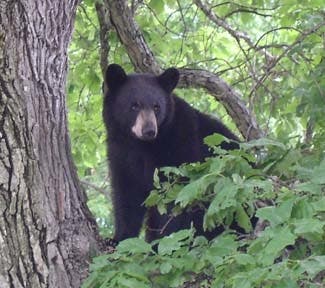
Listening to some talk, the state of Connecticut has a huge problem with a growing bear population in the state. But numbers don’t lie. According to the statistics from the Department of Energy and Environment (DEEP) there is 1 black bear in the state for every 5,142 people.
Compare that to Maine, where there are 44 people per bear; Vermont, 104 people per bear; New Hampshire, 272 people per bear, New York, 1,307 people per bear, and Massachusetts, where there is 1,694 per bear.
Find out what's happening in New Canaanfor free with the latest updates from Patch.
Clearly Connecticut has a lot less bears per person than any of its neighboring states – all of whom allow seasonal bear hunting to help control the bear population in their states, by the way.
The problem in Connecticut, however, is that the bear population seems to be increasing in one county in particular – Litchfield.
Find out what's happening in New Canaanfor free with the latest updates from Patch.
Sen. Craig Miner, R-Litchfield, said the bear population in his district is growing so fast that there is no way to control it.
This week Miner tried to get his fellow senators to back legislation to start a bear hunting season in Connecticut. When that failed, he amended his legislation to try and get them to back a bear hunting season just in Litchfield County.
That failed, too.
“My constituents talk to me about it every single week,” Miner said, adding that he was especially concerned because the summer season was approaching “and he has 15 youth camps” in his district.
According to testimony on the bill, the black bear population has rebounded and bears are now common in parts of Connecticut. Males can generally weight up to 450 pounds.
The bill written by Miner would have required the Department of Energy and Environmental Protection commissioner to establish a black bear hunting season, applying the same requirements and restrictions that apply to deer hunting.
Miner’s fellow senators said they had two reasons for not supporting the legislation. One, they said, the numbers showed the bear population isn’t that big a problem in Connecticut, especially in other counties besides Litchfield.
Second, some pointed out, the bears have rights, too – and if humans are careful in how they act around bears (i.e. don’t leave food outside) then the problem can take care of itself.
The bear hunting legislation had the support of DEEP.
“Based on the tagging and tracking data gathered by the DEEP, the department estimates that Connecticut’s black bear population is increasing at a rate of 10 percent per year,” DEEP Commissioner Robert J. Klee said.
“In the absence of natural predators and with easy access to food sources associated with the presence of humans, it is reasonable to project that the population will continue to increase, with the overall population reaching 3,000 or higher (based upon observed density in similar habitats),” Klee said.
Get more local news delivered straight to your inbox. Sign up for free Patch newsletters and alerts.