Community Corner
Surviving the Earthquake: A New Canaan Family's Story
Mother was at home in a high rise, father was in a noodle shop and their teenaged daughter was at school when the tremors began.

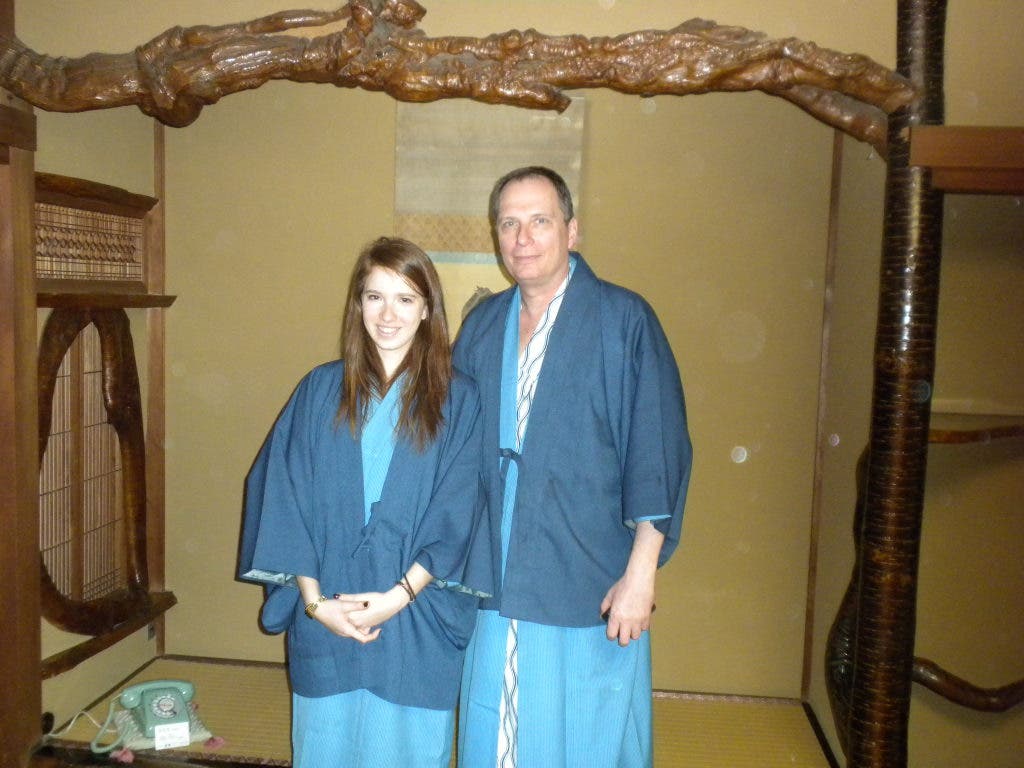


(Editor's Note: This story was written by Southbury Patch Editor Chris Duray, who lives in New Canaan.)
My sister, Julia Duray, can’t describe to me exactly how the earthquake felt when the tremors hit her school.
“Rumbling is a good word,” she says. “Not like a noise, but like a feeling. There is a noise, but it’s just of the objects falling… and the whole world is shaking so much that there’s plaster coming off the ceiling. And as it gets longer, you get the sense that it’s never going to end.”
Find out what's happening in New Canaanfor free with the latest updates from Patch.
My mother, Marje Duray, has an easier time explaining the smaller earthquakes, the benign ones. She was in the family’s Tokyo apartment when the big one struck.
“You look and the curtains are kind of moving like this,” she says, waving her hands back and forth. “Before the time you even think to stand up it’s…but this time it was a lot more violent. I mean a lot. And it just built and built.”
Find out what's happening in New Canaanfor free with the latest updates from Patch.
My father, Dave Duray, remembered how long it had lasted, in the noodle shop where he was getting a late lunch.
“It went on forever,” he says. “We’d been in earthquakes before, we thought they’d last thirty, forty seconds — this went on for five minutes. It wouldn’t stop. I was afraid that it would get worse. It started slow and kept building and I thought ‘it’s going get worse than this.’ I was scared to death.”
The three of them were in Tokyo on March 11, far from the epicenter of the 9.0 magnitude earthquake that killed at least 9,000 people that afternoon. They were far enough to be safe from, but not unaffected by, the tremors of the largest earthquake to ever hit Japan.
They arrived in America by way of Hong Kong last Wednesday, and their accounts of the five days before coming home to New Canaan are filled with uncertainty and stress from the bombardment of aftershocks and threat of nuclear fallout.
The Earthquake
March 11 started out as a normal day for them. Daily habits had formed in the roughly one and a half years they’d spent in Tokyo, after moving from Paris for the sake of my father’s work at IBM. There had been a series of small earthquakes leading up to that day, but none that would have caused alarm.
My mother, a homemaker, was doing paperwork when the earthquake started around 2 p.m., Dad was in a noodle shop, grabbing a late lunch between meetings and Julia, a senior in high school, was in a free period, reading.
None of them thought it was anything more than a small earthquake at first. My mother even finished an email “Oh darn, another Earthquake, God!!” But the shaking didn’t stop. And then it became more pronounced.
Julia had been reading when the tremors began to build. A teacher directed her and the other student in their study room under a table.
“We’re under the table and he’s next to me [her teacher] Mr. Smith,” said Julia. “And he keeps repeating these words: ‘Okay, okay, okay.’ As if this will stop it…As if he’s saying ‘Okay, that’s enough. That is enough.’”
It was the first time she had had a panic attack.
“Me? I’m – [she makes deep panting noises] literally, like I’m going into labor,” she said. “I’m seriously hyperventilating. I couldn’t get enough air in my lungs. Honestly, I thought I was going to die. I kept thinking of my death because when that’s happening you have no control. You think the building is just going to collapse on you.”
Dryly, she noted that before being confronted with her own mortality, she’d been reading “The Stranger” by Albert Camus.
My father said that when it started, he took his cues from the people in the noodle shop around him.
“I’ve been in a restaurant before when there was an earthquake [months earlier]…but I looked up at the owner and the cook and they were talking and they were just calm as can be,” said my dad.
“[This time] I looked at the cook and he was calm,” he said. “Then it got more violent. The counter began hitting my knees…and I looked up at the chef and he looked really concerned. I grabbed my computer bag and ran out.”
Briefly, at the urging of a nearby woman, he took shelter under a doorway, but as plaster began to fall from the ceiling he ran out, over a skywalk and down a working escalator, down the three floors to a courtyard.
“I thought something was going to hit me,” he said. “Not that I was going to die, but I thought I was really going to get hurt. I saw a way out to where that things weren’t going to fall on my head, and so I got out.”
In their Azubujuban apartment, 20 floors in the air, my mother said she kept her mind focused on getting out of the building, joining the throngs of people gathering in the streets.
“I thought ‘I’d better get up, because this is weird,’” she said. “I still have my computer in my hand and I’m being tossed around and now I’m getting really concerned.
She left immediately, without even taking a phone or her keys, and helping to usher out a neighboring family with a crying baby.
“The dying thing doesn’t go through your mind except for other people,” she said. “I thought ‘I gotta get out of here’ and I was really scared, but I never thought ‘I’m going to die…the whole time I’m thinking about where Dave is and where Julia is.”
Meanwhile, my father had reached the courtyard where other people in the building had congregated. He sat down on a short wall and realized that everyone was staring directly up at the skyscrapers.
“The buildings were swaying like they were in the breeze,” he said. “Literally swaying back and forth, two feet or so. Probably more because you could see them moving.”
The quality of the building astounded him. Tokyo was far from the epicenter, but the earthquake was still around a magnitude of 6 when it reached the city, which looked afterwards as if nothing had happened, shy of a few cracks and broken windows.
The Aftermath and Reunion
After about five minutes, the tremors began to subside, but slowly. Julia described the feeling like spinning around and stopping sharply, then seeing the world still move. Julia said she was gripped by the new uncertainty of how she was supposed to respond.
“When it started to calm down, we just didn’t know what to do,” said Julia. “Me and Mr. Smith were just like ‘what happened?’ There’s literally nothing to say.”
Eventually she found a group leaving the school, and followed them to the front of the building, then the football field where they lined up to make sure no one was missing.
“We’d had evacuation drills but when people make you do things that you’ve drilled for, it’s pretty unnerving because you only drill for things that are pretty serious situations,” she said. “You never actually think you’re going to have to use them.”
Our parents had a different problem. Because the buildings were so well built, it wasn’t immediately apparent to either of them that the earthquake had been anything but scary. Mom recalled asking the receptionist in her building if it had only felt so severe because their apartment was so high.
“He looked at me very seriously and said ‘No madam it was bad down here too,’ and I went ‘oh,’” she said. “And I realized exactly how upset everyone was.”
“No cellphones are working, no one can communicate with their loved ones, so you’re starting to freak out,” she said. “You’re starting to get the sense that this is not normal.”
My father went back in to finish his lunch.
“I was still really hungry…I thought maybe I shouldn’t go back into the building but I hadn’t paid the guy, and I’d left my glasses behind anyway,” he said.
In fact, he had every intention to return to his office when he realized that the subways were closed. And then the tsunami klaxons started to blare in the streets and he found his cellphone didn’t work. He realized that it might just be his part of the city that was alright, so he started home on foot. The only contact he could make was by email and to Julia, whose phone had Internet access.
“I got an email from Dad,” said Julia. “It said ‘Holy S***’ and that’s it. I’m like, yes I agree, ‘holy s***.’ That’s the only words I could say for awhile about the situation.”
“The subject line was ‘Holy S***,’” said my father. “Inside I said ‘Are you okay?’”
My mother had gone back inside for her phone, and come out again. but wasn’t able to make contact with anyone. An e-mail from the principal of Julia’s school told her that her daughter was safe, but pictures of the destruction in the countryside had started to come in, and everyone in the street seemed to be in shock.
“It was about an hour and a half after it happened, I was standing there and all of a sudden I was so relieved because I looked up and here comes Dad goofy as can be, smiling ‘Hey, I saw the building shake!’ ‘Hey I ate noodles and I went back and finished them!’” she said, laughing, then with mock disappointment, “Like ‘Oh God, here he is, he did survive!'”
It would be much later when they were reunited with Julia, however. The closed subway and elevated highways meant that only off-roads were available to school buses. A 45-minute ride would ultimately take eight hours. But after learning her parents were safe, Julia was still perturbed.
“I really wanted to hug someone, for some reason…I was just going nuts at the idea that I was in that huge-a** earthquake because it was literally unlike anything I thought I would ever experience in my entire life and I was just checking to make sure everyone understood how big it was.”
She spent the next ninety minutes shaking. When the first few aftershocks hit, she broke down into tears.
“I started crying so hard because I thought it wasn’t ever going to end and we were all going to die and it was just so unnerving and it made me so upset,” she said. “I just felt like I wanted to see everyone and make sure they were there, so I found my good friend Tucker and collapsed into him and I hugged him and just sat there and cried for awhile.”
She felt better on the bus ride home; unable to feel the aftershocks in the vehicle — which stopped several times for food and bathroom breaks on the eight-hour trip — and connecting with friends over facebook. Normalcy returned, and it was not clear to the students how much damage had been caused by the quake.
“There was a Zombie Nation concert the next day and we were just like, ‘Oh are you going to go to Zombie Nation? I don’t know, maybe? Are you gonna go out tonight?’ we were all just talking about tomorrow night’s plans,” she said.
She finally got home around midnight. Exhausted, the family fell asleep around 2 a.m., assailed by aftershocks.
Coming Home
Our parents had called my older brother and me much earlier that night. The phones were down until 11 p.m., but using Skype they called at 7 p.m. in Japan — 5 a.m. in America — hoping to break the news to us that they were alive before we heard about it on the news in the morning.
I live in their house in New Canaan, looking after it while they are away. To hear the news that they were alive before I understood their peril caused a brief moment of confusion, panic and then calm. I spent the rest of the day telling our extended families that everyone was safe and hoping that my parents and sister would come home.
No one found much relief on Saturday. Aftershocks hit with a distressing frequency — more than 180 struck that weekend — and news slowly poured in about damaged power stations.
“The American assessment [of the nuclear power] didn’t match the Japan assessment,” said my mother. “We just started to feel very uncomfortable.”
“We were glued to CNN,” said my father. “Everything was closed; not restaurants and things but everything needed to be inspected. You couldn’t go to the gym because they wanted to inspect all the equipment. You couldn’t get the car out of the garage because they wanted to inspect the equipment.”
“I was sure we were all going to be obliterated,” said Julia. “Which is clearly impossible but in my mind it was certain…and then the house was constantly moving…there was an overall sense of dread in the city. It just felt like something bad was going to happen.”
Sunday morning they went to the airport. My father said they thought it best to get there before a panic started in the city, making it impossible to leave. They booked the first flight they could — to Hong Kong.
“I was so relieved, but [the stress] didn’t stop,” said Julia. “I was sitting in a restaurant and I had this major vertigo. The room wouldn’t stop moving, I felt like I was on a boat that was constantly hitting waves…I started hysterically crying….I just wanted to go home.”
Despite a few more episodes, her vertigo slowly subsided and the family agreed that all they needed at that moment was stability. They came back to America a few days later. They are still trying to decide if they will ultimately return to Japan.
“I’m feeling very disoriented,” said my mother. “I have a hard time believing that I’m here and I feel unsettled because I’ve left so many things undone back there.”
“Japan has given me so much,” said Julia. “They’ve given me their culture, they’ve been kind and welcoming hosts, never asked me for anything and all I’ve done is take from them and now I’m running away completely guilt-free.”
Julia hopes to find a project she can work on while she’s in America.
“I just want to get the message out there that the money does make a difference and I don’t want anyone to forget that,” she said.
Despite her guilt, Julia says she doesn’t want to return to Japan.
“I feel really safe here and I don’t feel safe there,” she said.
Get more local news delivered straight to your inbox. Sign up for free Patch newsletters and alerts.